Text-based Storyboard — Craft Dairy
Kit 27 · Craft-Dairy Process Training · deliverable · designed and built by I Wayan Usada · fictional composite (Zuivelhoeve De Zwaan and its founder are invented)
Design premise
This kit is a pipeline with two audiences. The designer practises extracting requirements from an expert interview (01). The operator practises the tank-line routine (02 and the 3D line) and uses the floor manual (03). Revised after the build so it matches what ships: the 2D module and the 3D line both read tankline-data.js.
Scene plan
| # | Scene | Audience | The learner decides | Right path | Tempting path | Consequence shown |
|---|---|---|---|---|---|---|
| 1 | The interview, passage by passage (01) | designer | what kind of requirement each of 10 passages carries | critical task / misconception / vocabulary / constraint, as the kit classifies it | treats every passage as a task to teach | the extracted requirement, why it is that type, and the artifact it feeds |
| 2 | Gate 1 · reception bay | operator | tanker gauge vs. own probe + log vs. reject tag | own probe, yard delay noted | log the gauge reading | excursion math becomes impossible |
| 3 | Gate 2 · CIP panel | operator | green lamp vs. cycle record vs. extra cycle | read the record's end-state, out loud | green lamp means done | the line opens on the lamp alone |
| 4 | Gate 3 · valve manifold | operator | worn label vs. hand trace + allergen record vs. reroute | trace, relabel, check the allergen CIP | "line 2 is obvious" | cow-only batch on an untraced line |
| 5 | Gate 4 · release dock | operator | release stamp vs. deviation note vs. phone the founder | apply the two questions to the readings (24 min, 7.6 °C), release with the note | release with nothing written | the excursion leaves no record |
| 6 | The note | operator | which of six entries belong in the note | times, readings, both answers, name | add "driver said it was fine" / "smelled normal" | missing or non-record entries are named |
Changes from the earlier build
- Gate 4 used to state that "both protocol questions say yes"; it now gives the readings and the learner applies the questions.
- The note is now written, not just chosen: a separate task scored 0–2.
- The 01 explorer was click-to-reveal; it now asks for a classification first, and passages are keyboard-operable.
- The first 3D scene pulsed the next correct gate amber, so it tested click order. The v2 scene put three equally styled plinths at each station. The v3 flagship (below) uses the real objects, closed records you open, and a shuffled panel order.
- A claim about "23 pallets a quarter" as an "industry baseline" was removed (no source).
The 3D tank line (flagship v3)
Same gates, options, feedback and scoring as the 2D module (tankline-data.js). Built in tankline.js and cd-hall.js on the shared layer. Every frame below is a render from the shipped build, captured with node tools/qa/scene_frames.mjs craft-dairy.
Design rules. The props are the real objects at each station, not plinths: the tanker's display, the panel lamp, the worn label and the release stamp look like proof; the records (log book, CIP terminal, allergen binder, lab folder) are closed until you open them. Looking is free and opening a record is a physical action; acting is a separate choice. Nothing glows or pulses to hint the answer, and the panel order is shuffled every run. The glass line that fills white, amber or red is a teaching device and says so on screen. The time is 06:42 on a May morning (dawn through the reception door); four hours pass before the release question at 10:56 and the light changes with them. People stay off-screen.
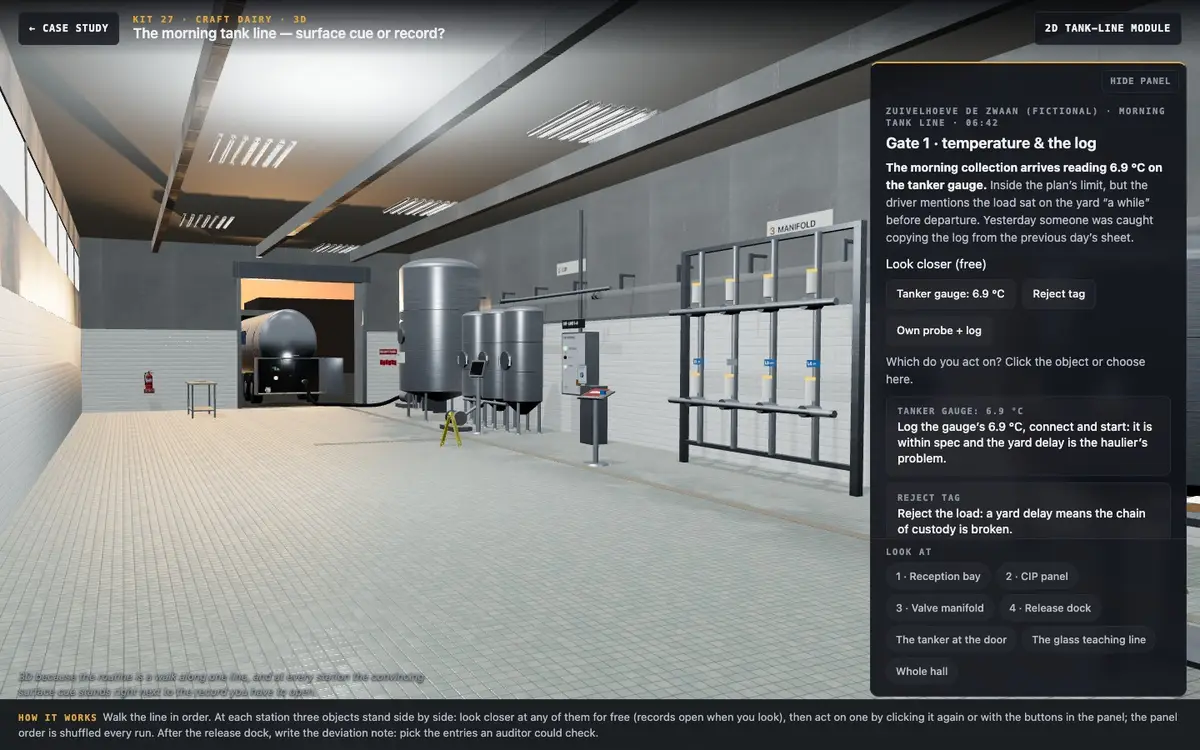
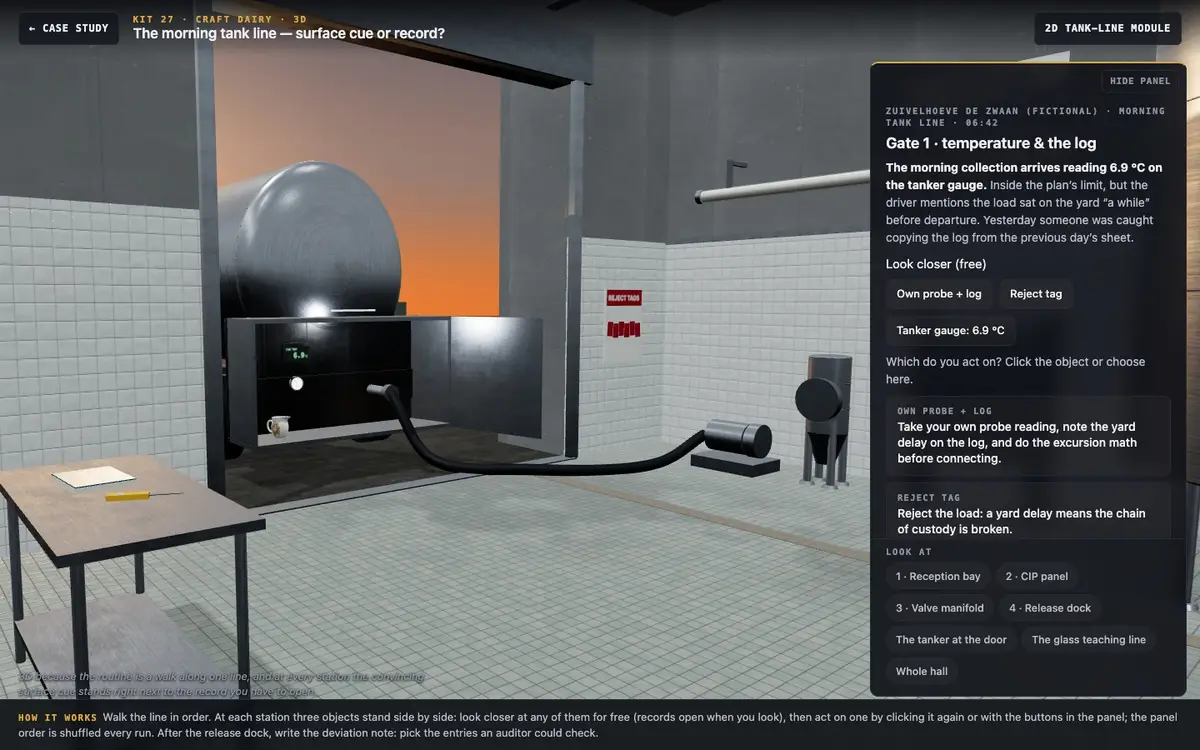
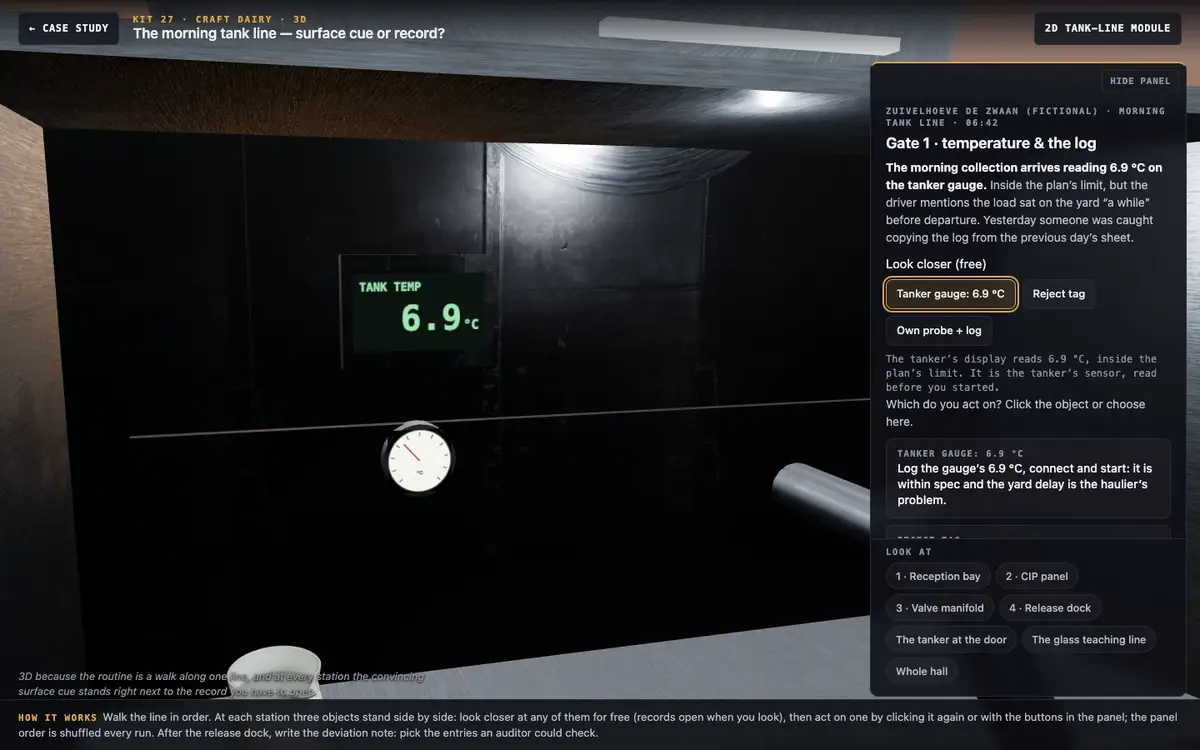
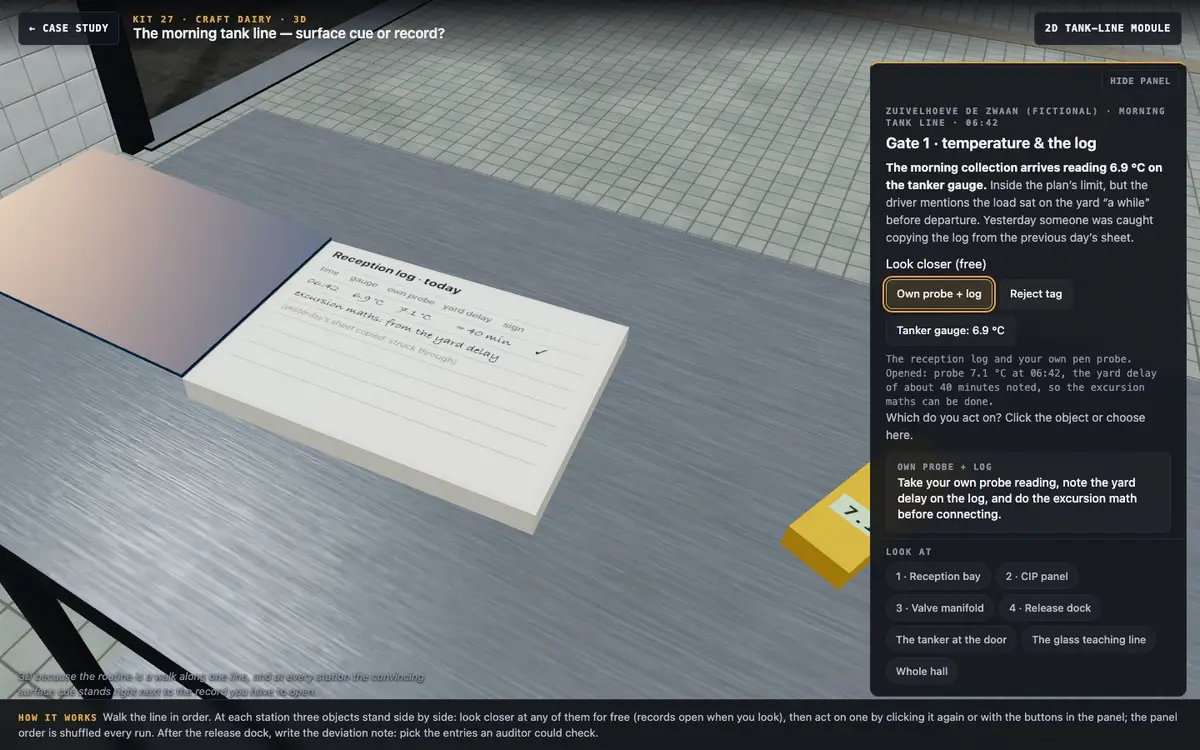
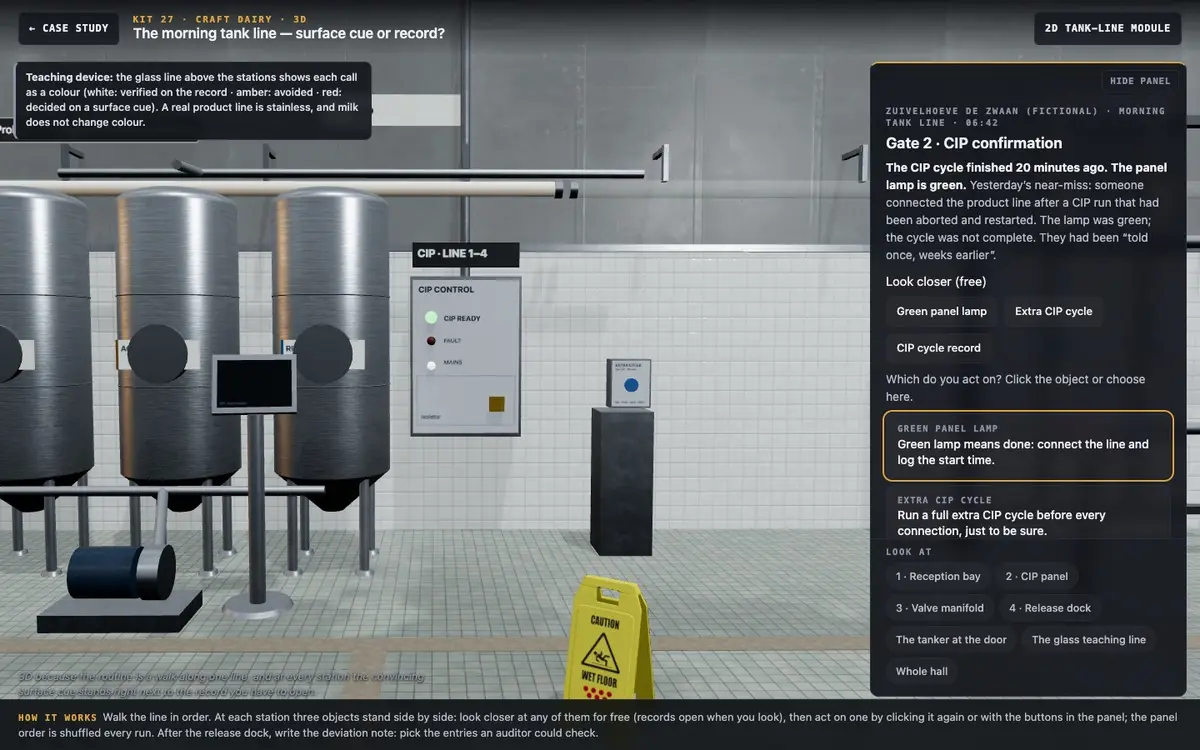
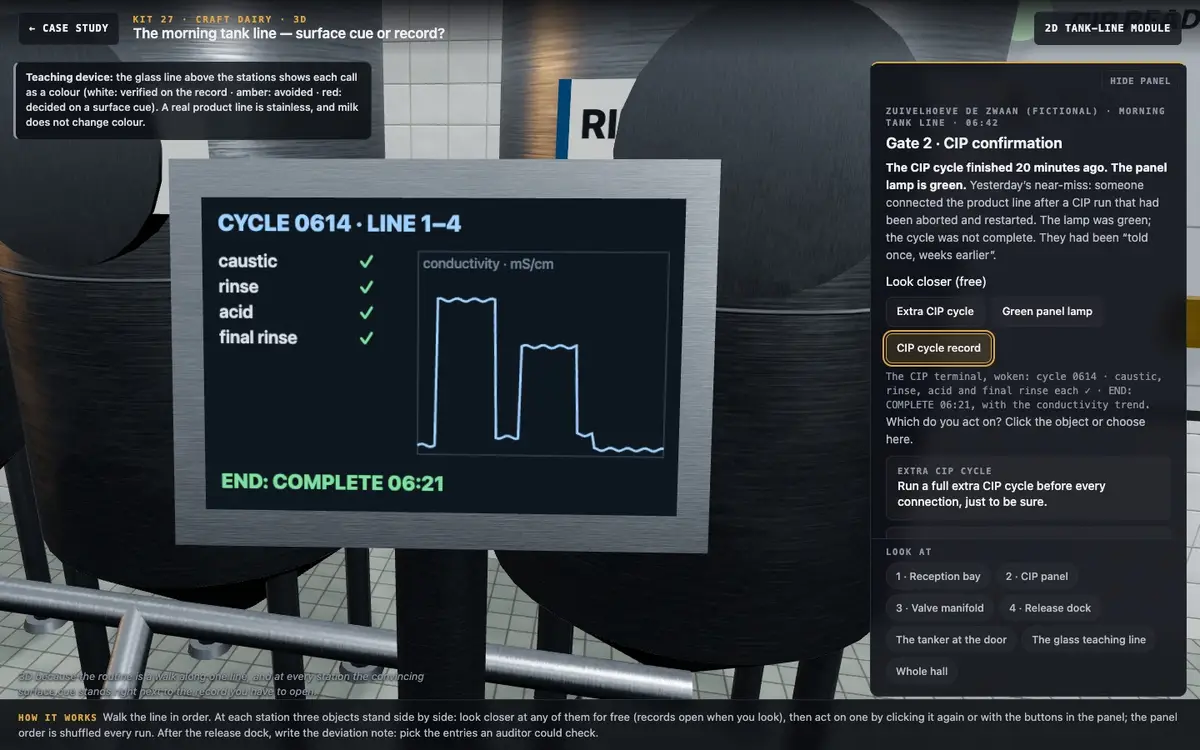
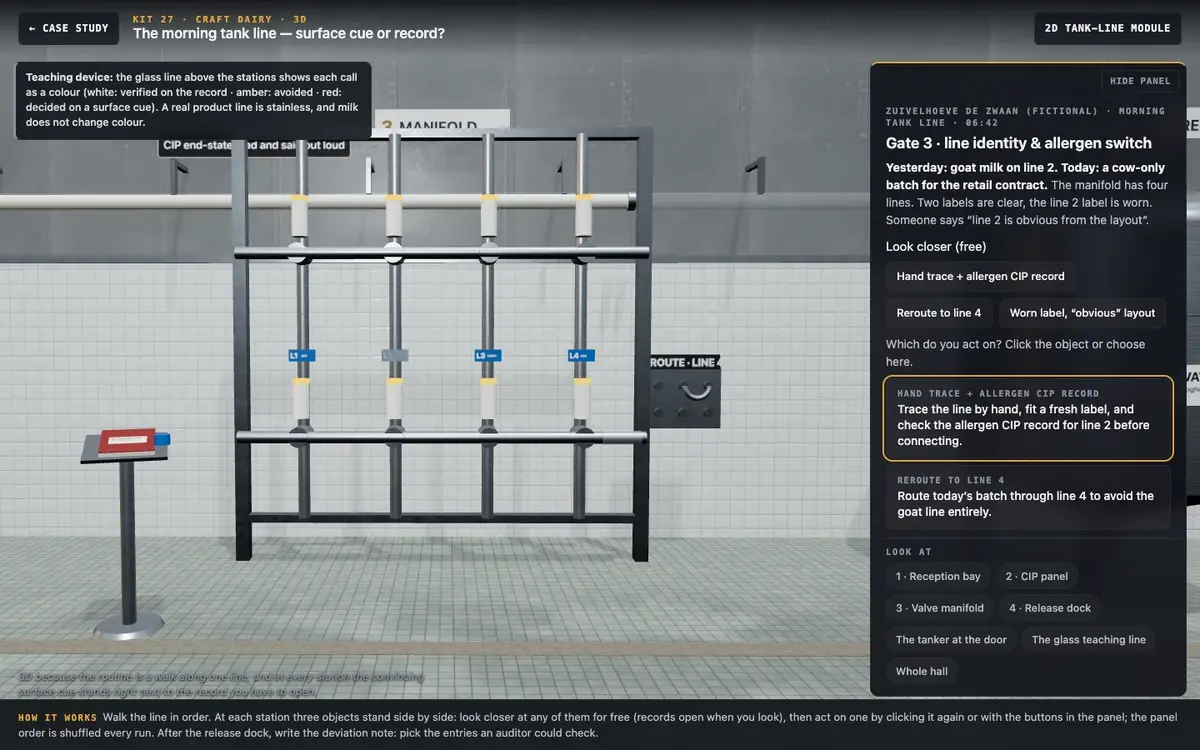
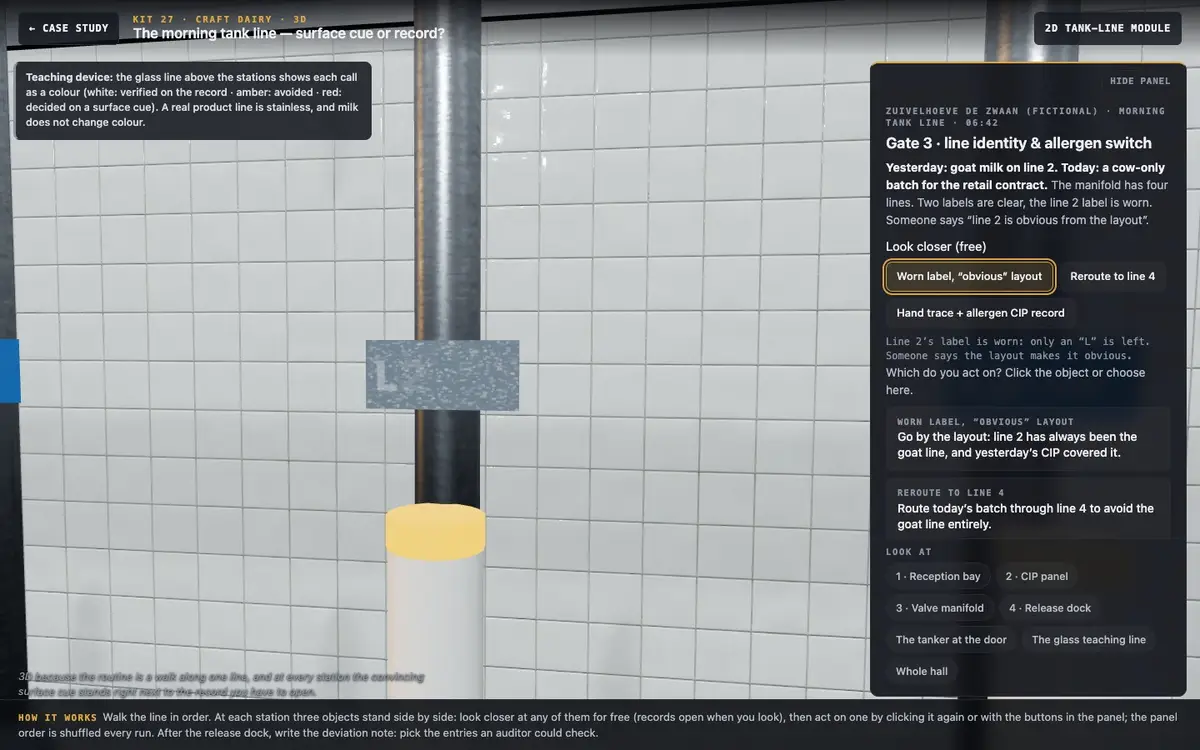
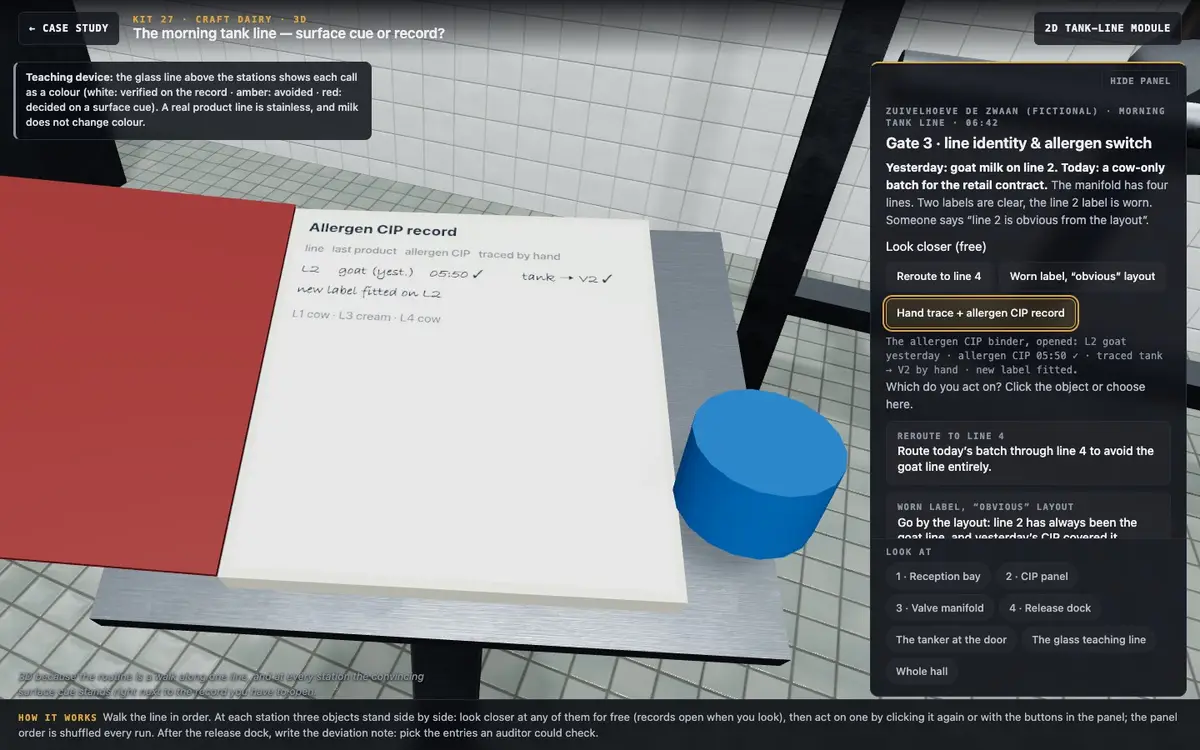
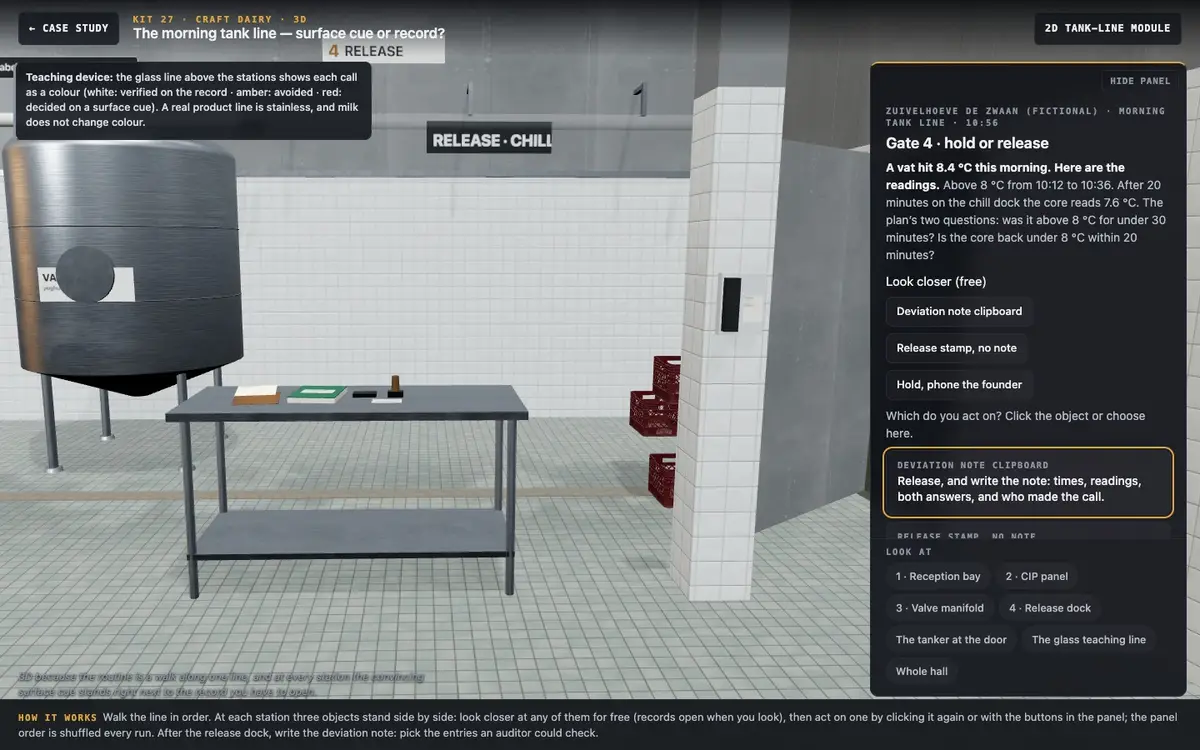
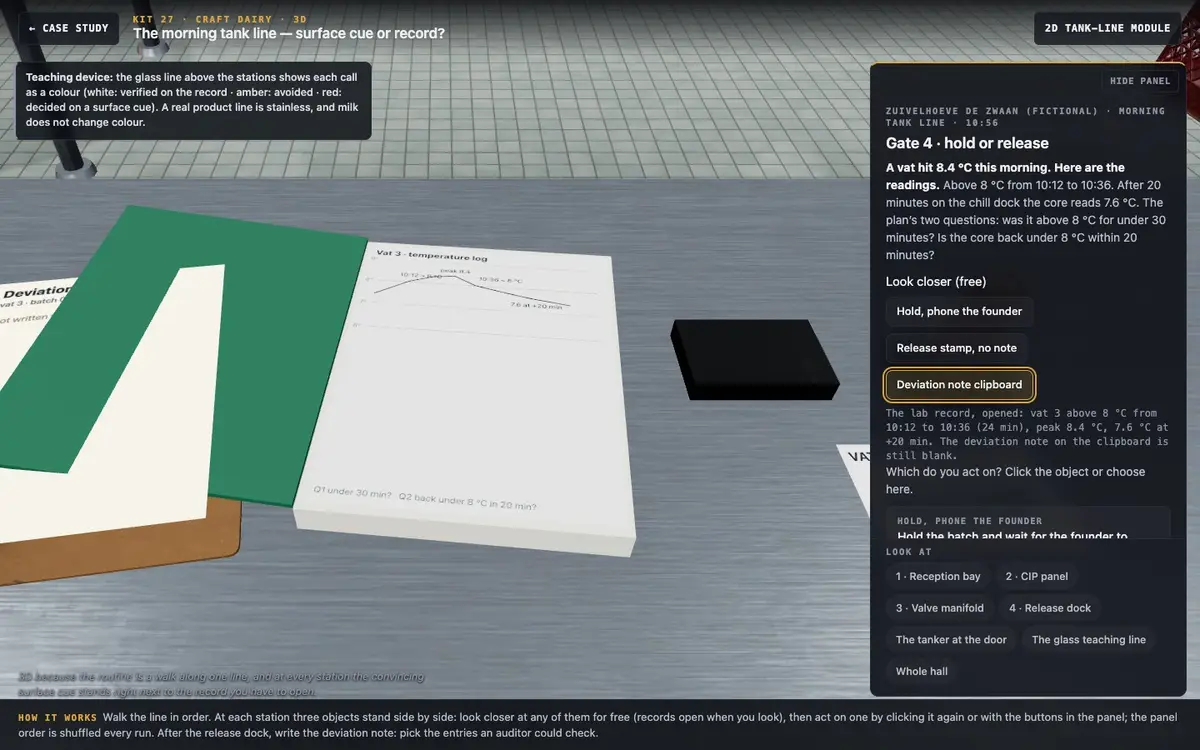
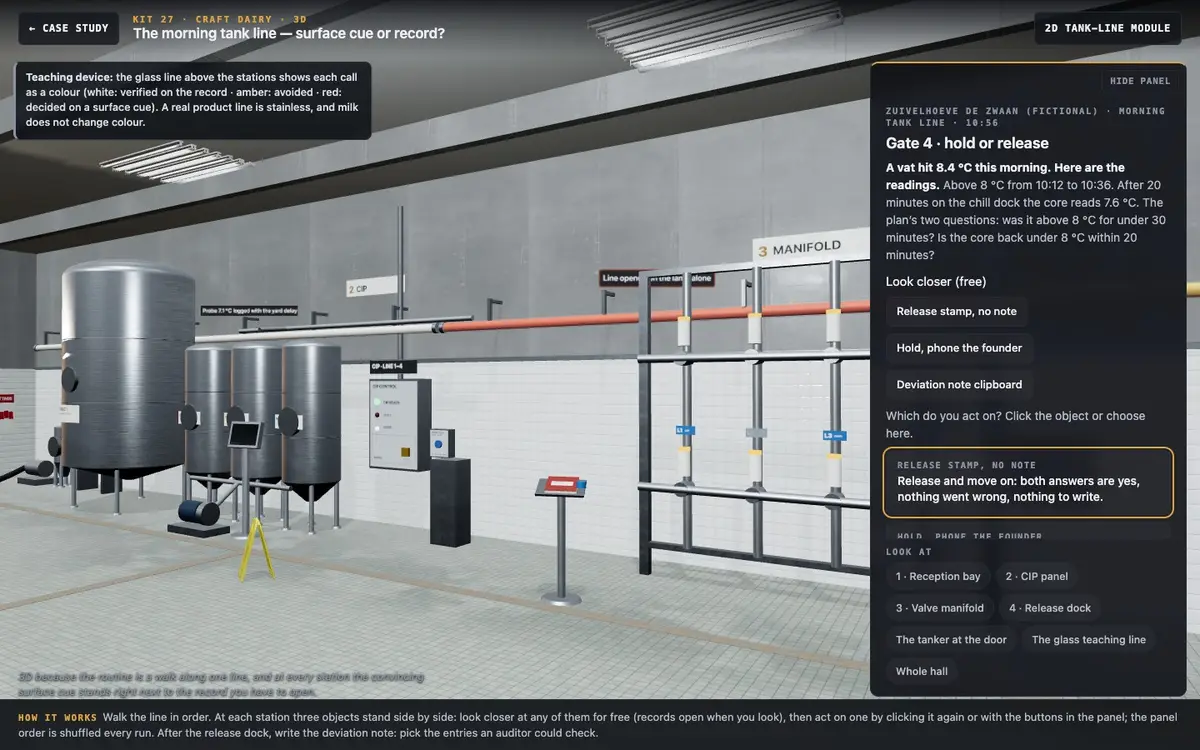
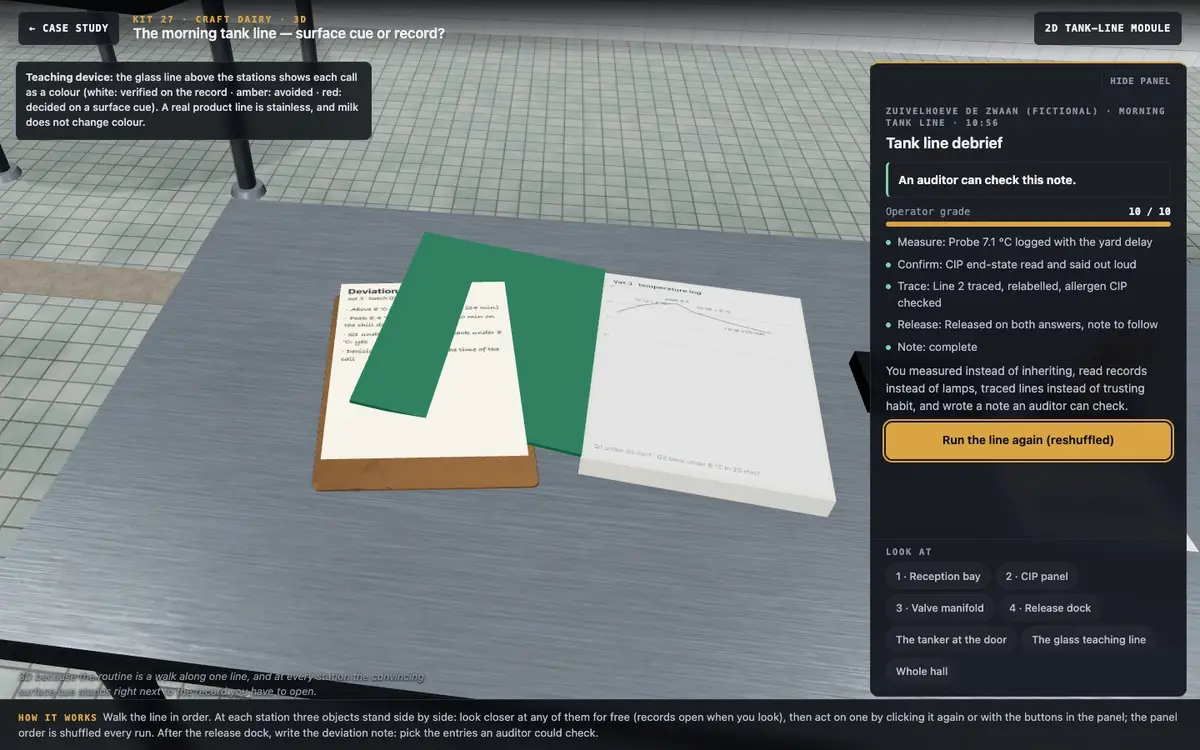
Interaction map. Walk to a station (the camera walks the route at eye height). Look closer at any of the three objects (free; a record opens when you look). Act on one by clicking it again or with the panel button: the act happens on the object (the valves on the chosen line stroke; the extra-cycle button presses), the glass segment out of the station fills, and the feedback names the record. After the release dock, write the note from the readings you opened. Under reduced motion every move is a cut.
Scoring
Four gates: record 2 · avoided the call 1 · surface 0. Note: 2 if exactly the four required entries, 1 with one slip, 0 otherwise. Max 10. Operator grade = at least 8, note complete, and no gate cleared on the surface cue.
Retry design
Options reshuffle on every run, so panel order never signals quality; in 3D each object stands where it belongs at its station. The interview explorer can be reset; the pack is reference, not scored.
Prefer the source? Download the raw markdown.