Text-based Storyboard — MedCheck
Kit 7 · MedCheck · deliverable · designed and built by I Wayan Usada · fictional training content, not clinical guidance
Design premise
Five prescriptions, one of them clean, dealt in random order. Revised after the build so that it describes what the 2D trainer and the 3D dosing-week bench actually do; both read prescriptions.js.
Per-prescription structure
- Read the prescription lines and the chart card (allergies, diagnosis, eGFR).
- (3D only) Fill the week. The organiser's lids open and each line's tablets drop into the days and slots its directive gives. The decision stays locked until the week is filled.
- Flag or clear. If flagging: choose the line that carries the problem and the category (duplication · dose or frequency · allergy on the chart · interaction to confirm).
- Annotate in your own words. Not machine-scored: shown next to a model annotation for comparison (does it name the drug, the reason and the next step?).
- Feedback: score out of 3, the expected answer, why, and the model annotation.
The 3D dosing week (flagship v3)
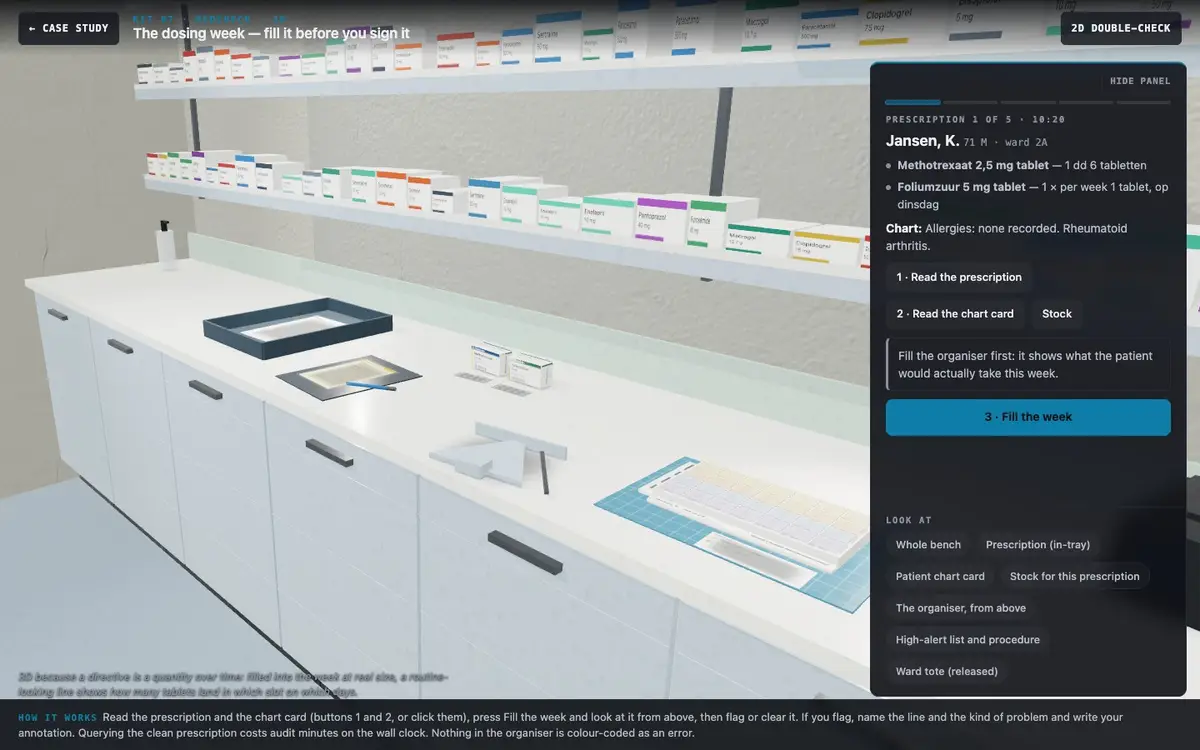
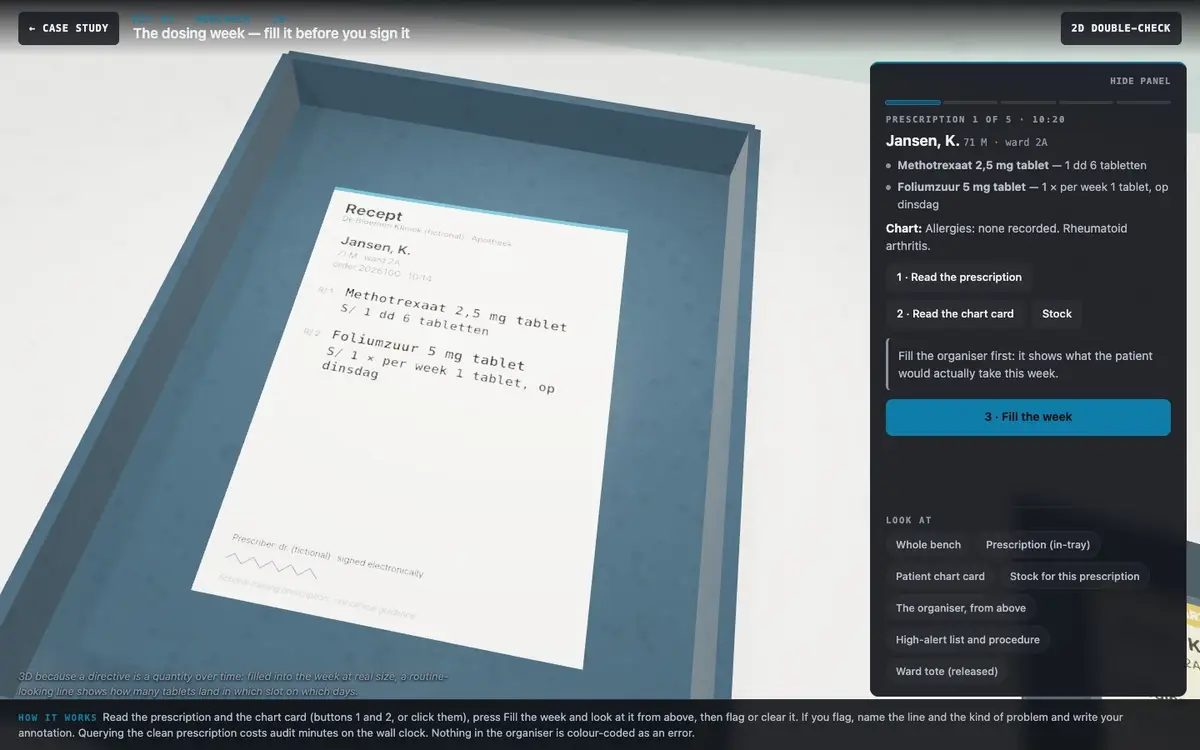
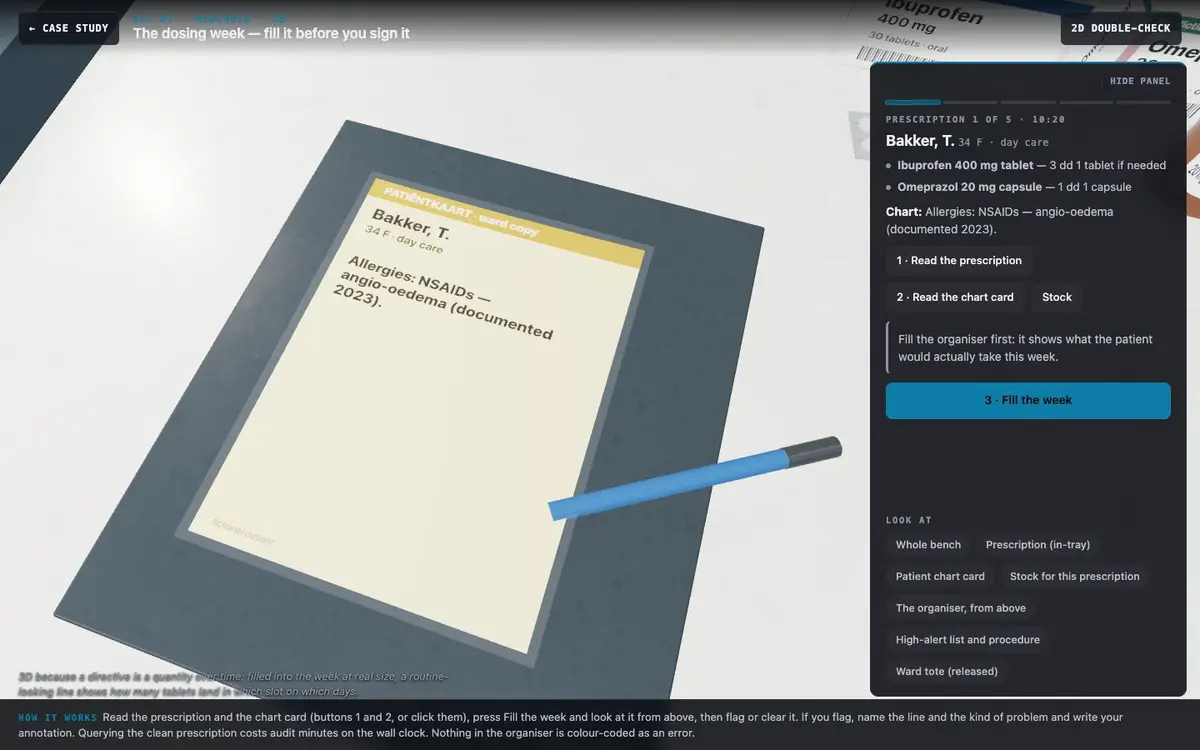
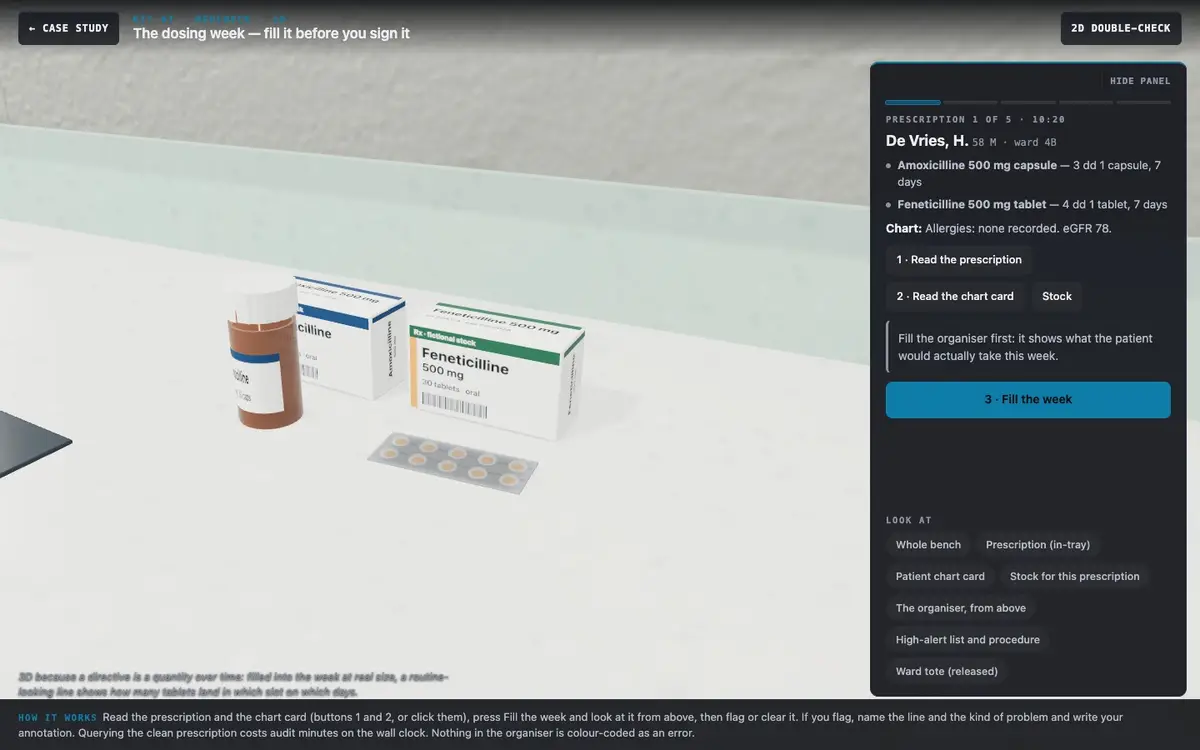
Built in dispense.js, mc-room.js and mc-week.js on the shared layer; same prescriptions and scoring as the 2D trainer. Every frame below is a render from the shipped build (node tools/qa/scene_frames.mjs medcheck).
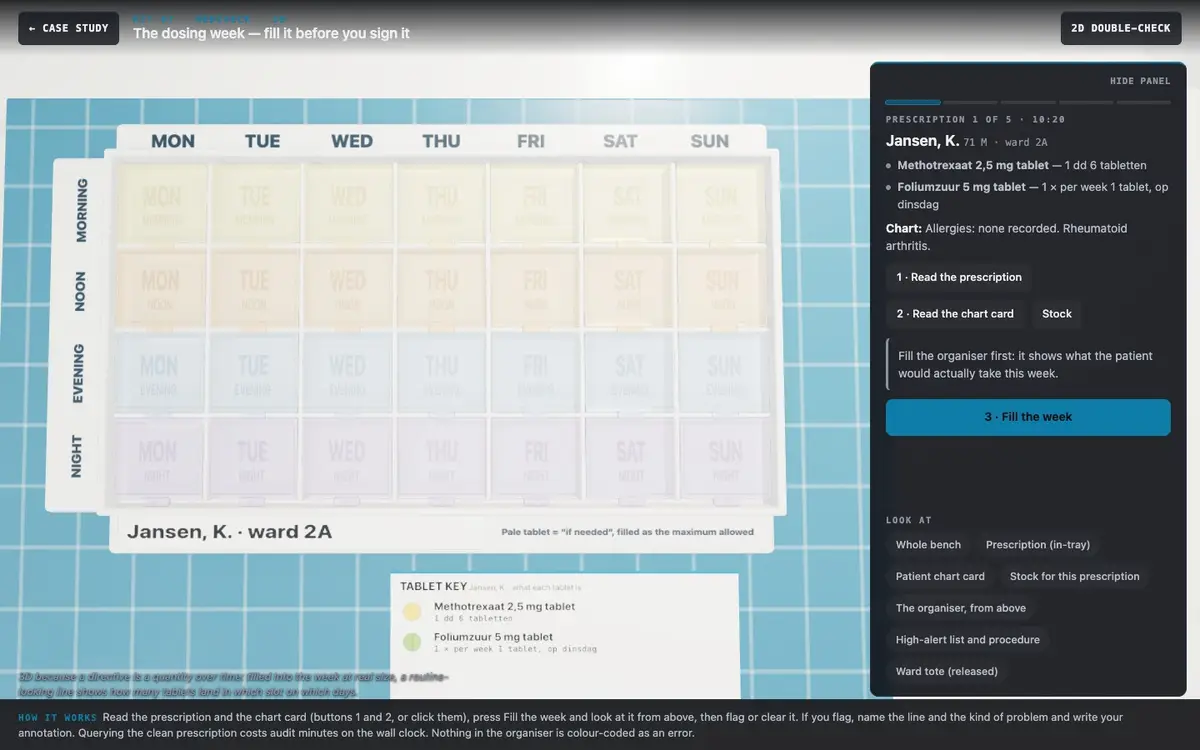
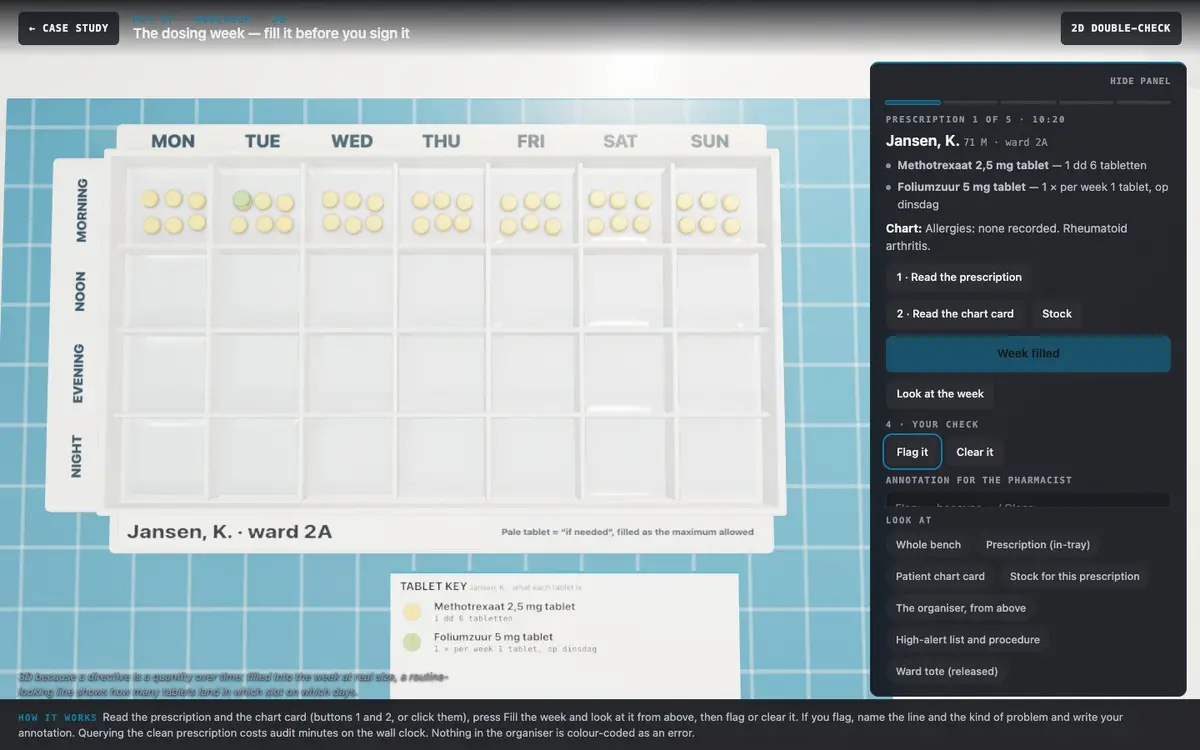
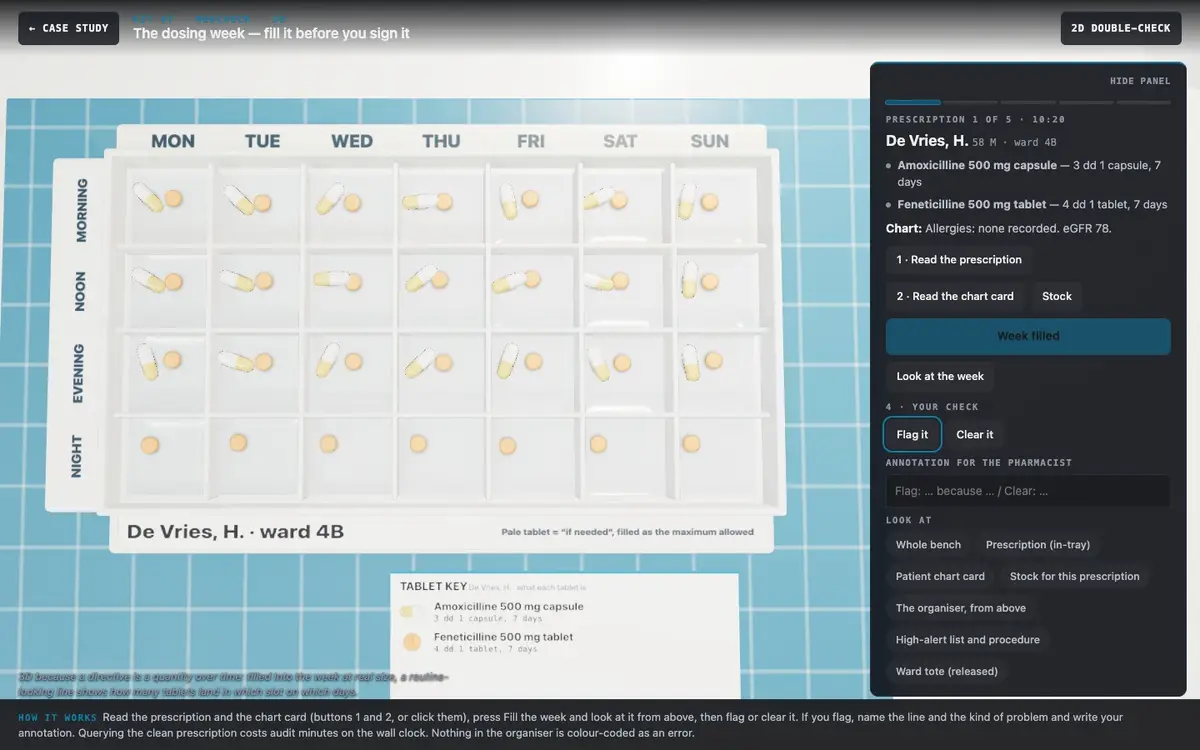
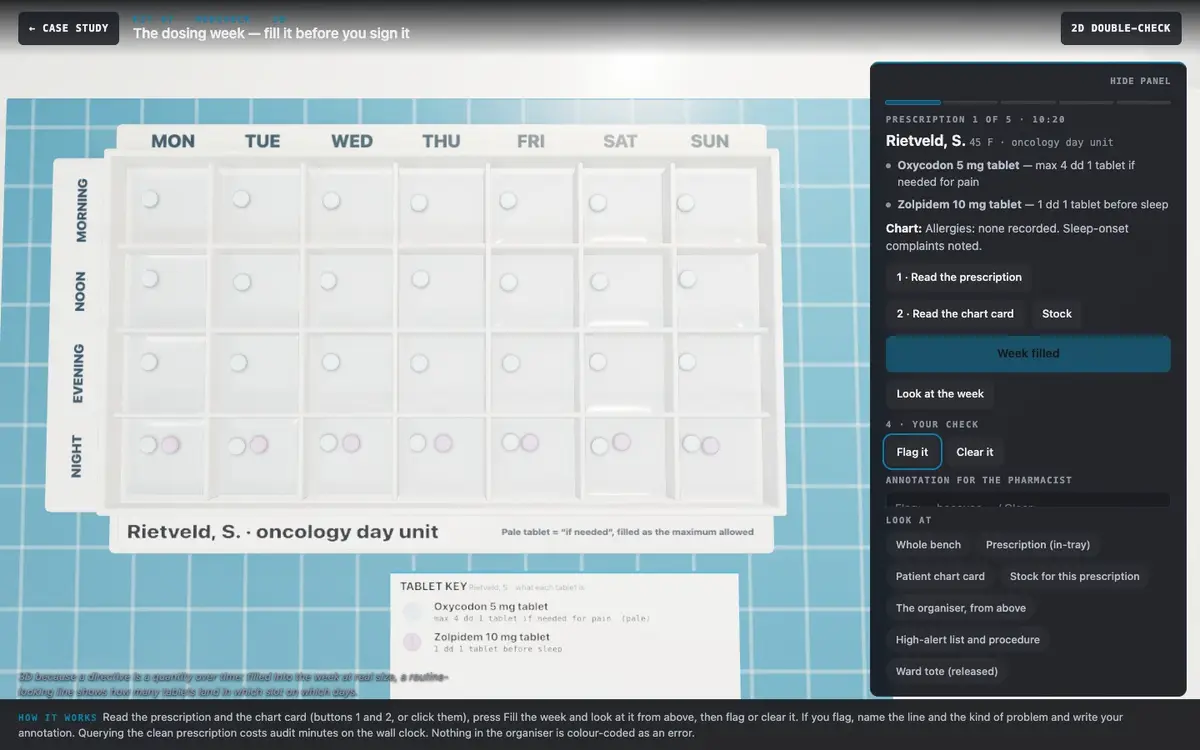
Design rules. The double check happens in its real order: prescription → chart card → fill the week → check. Tablets are at real size (8 mm) in a 31 × 16 cm organiser and drop in one by one, day by day; the camera looks straight down on the filled week. Nothing is colour-coded as an error; drugs keep neutral, identifiable colours. Light is bright and even (4000 K panels plus a frosted high window), no haze. An interruption is part of the place: during the third check the ward phone flashes; it changes nothing in the score. People stay off-screen.
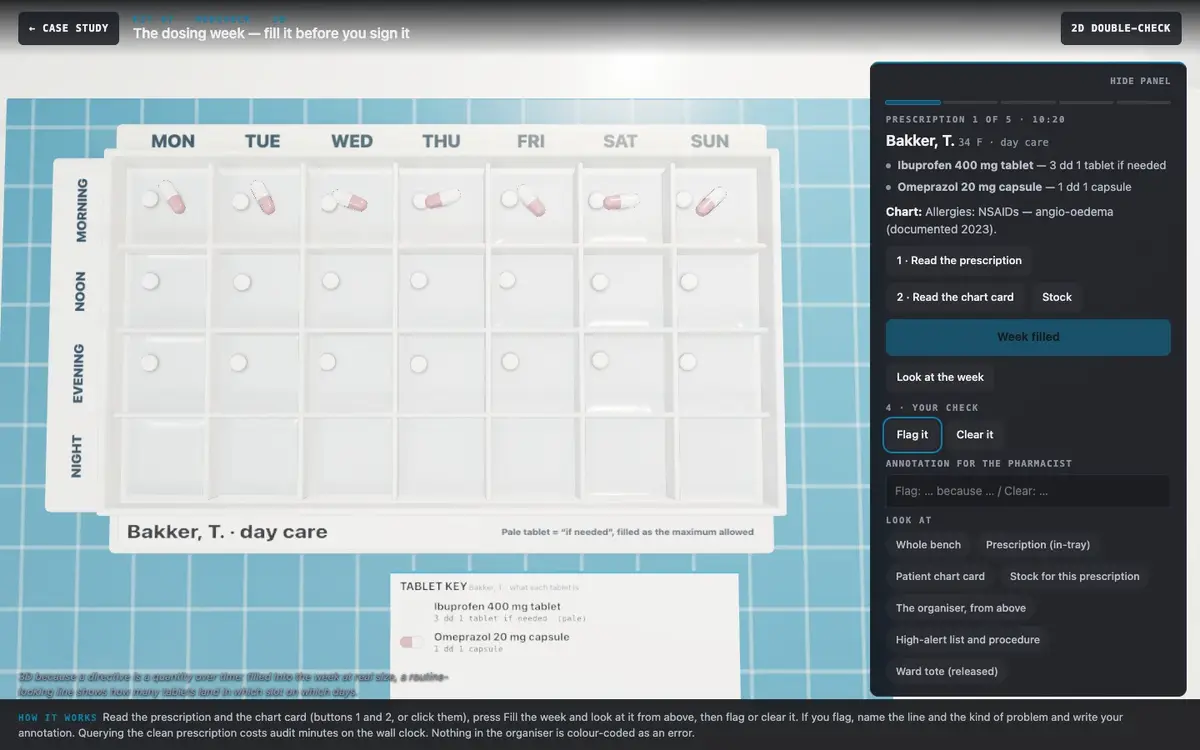
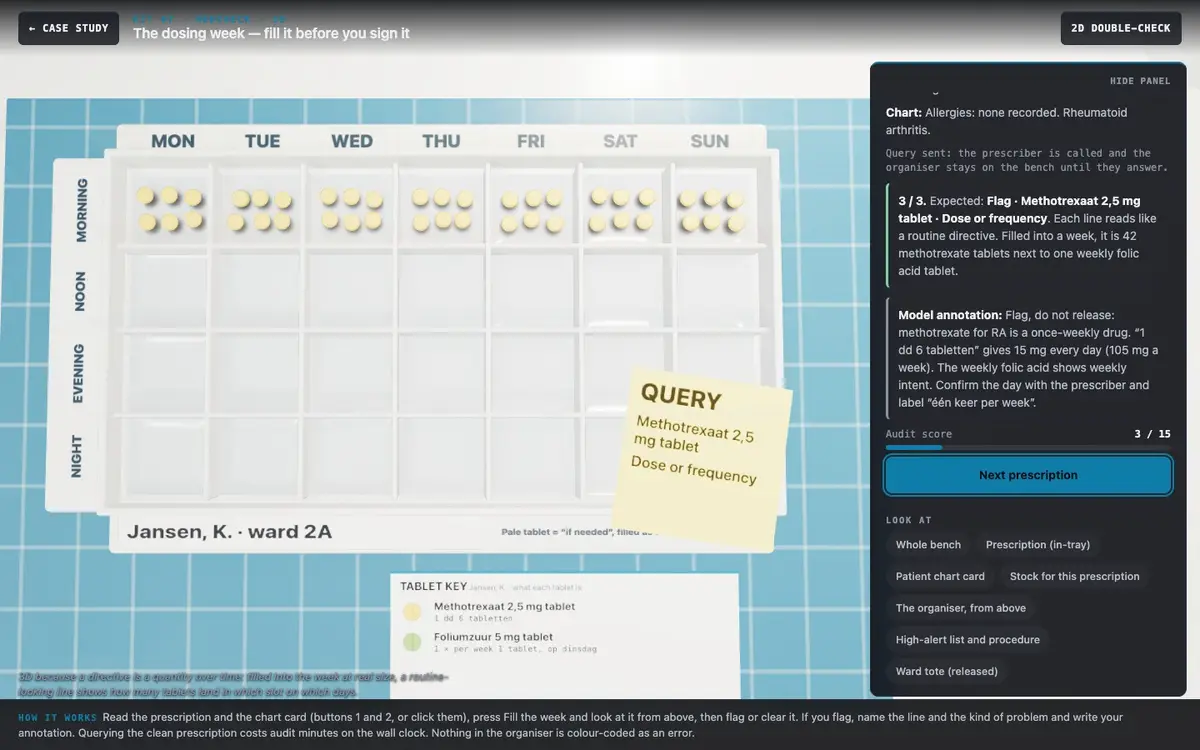
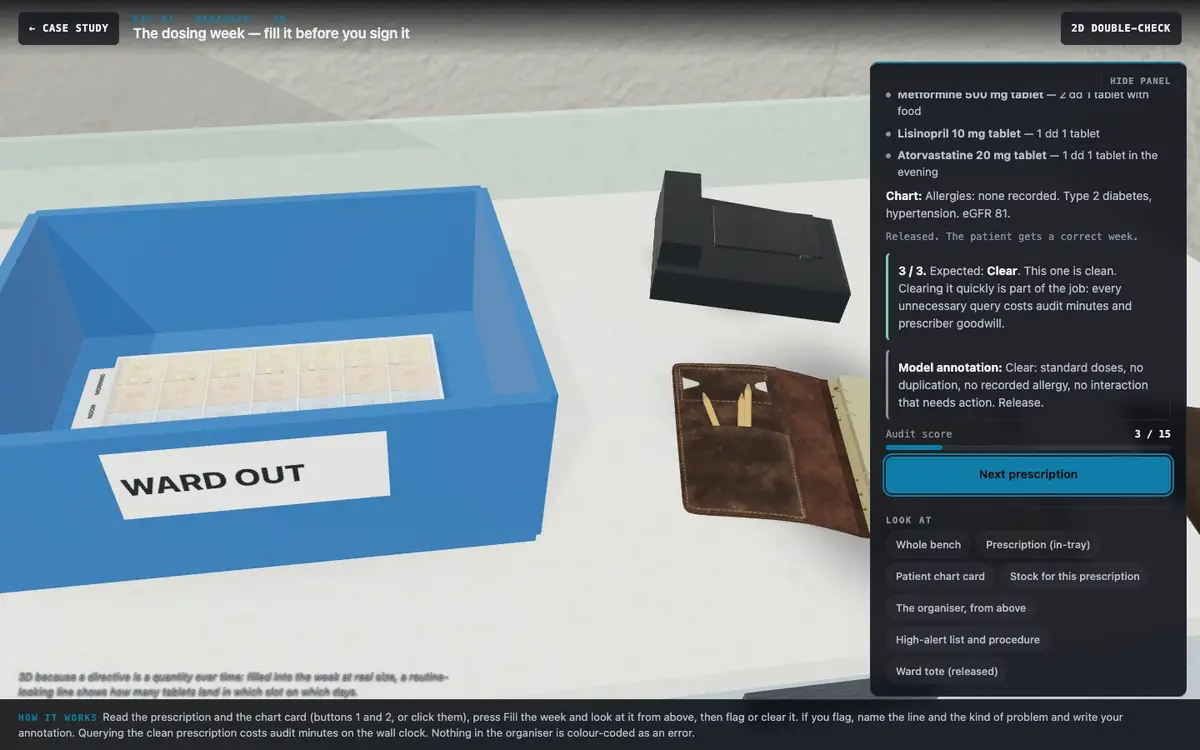
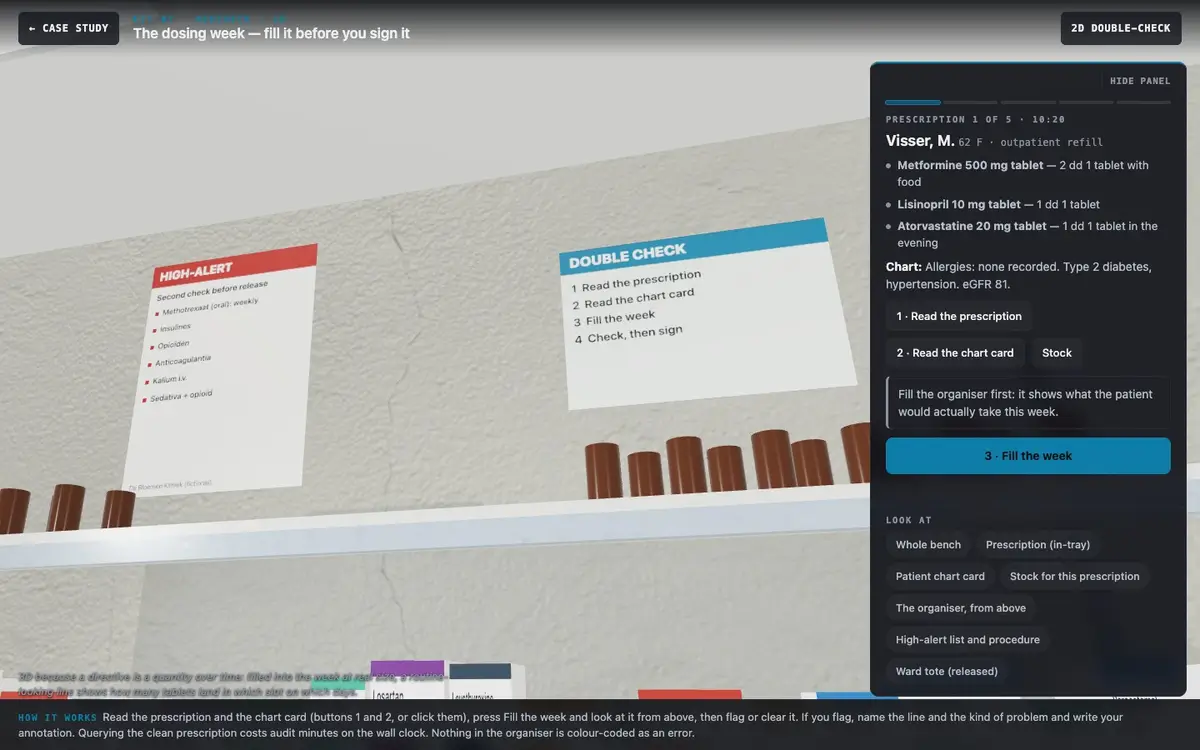
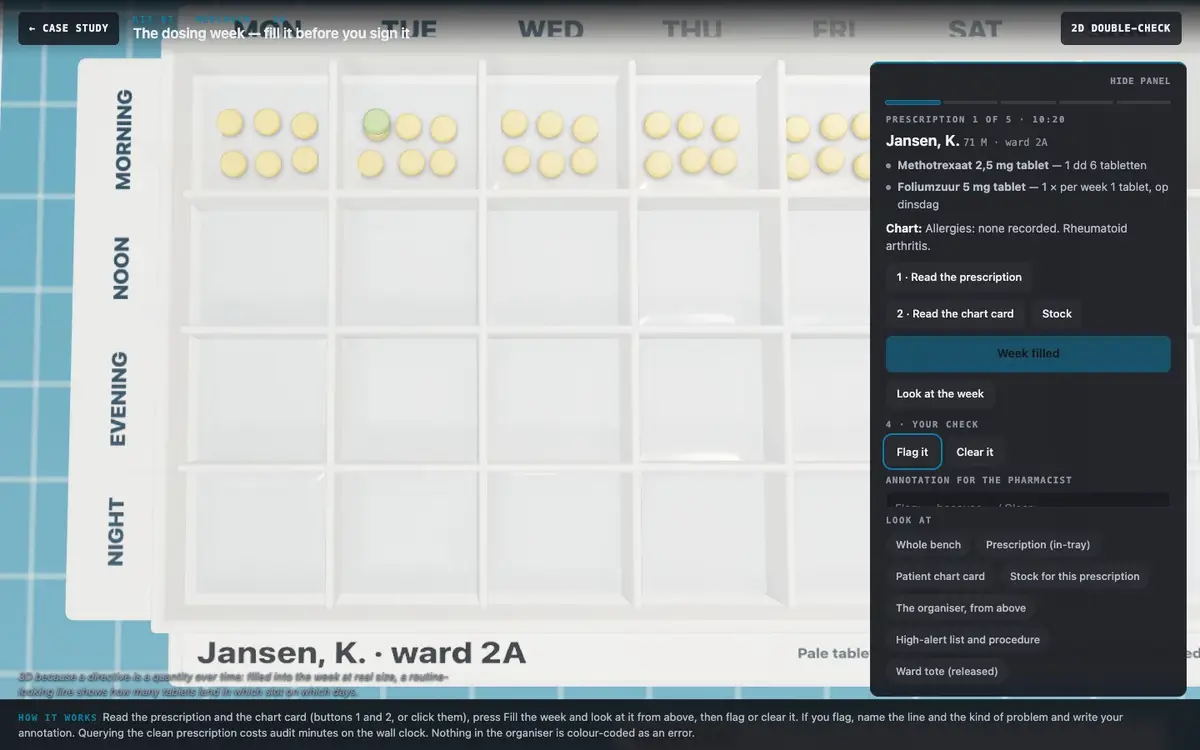
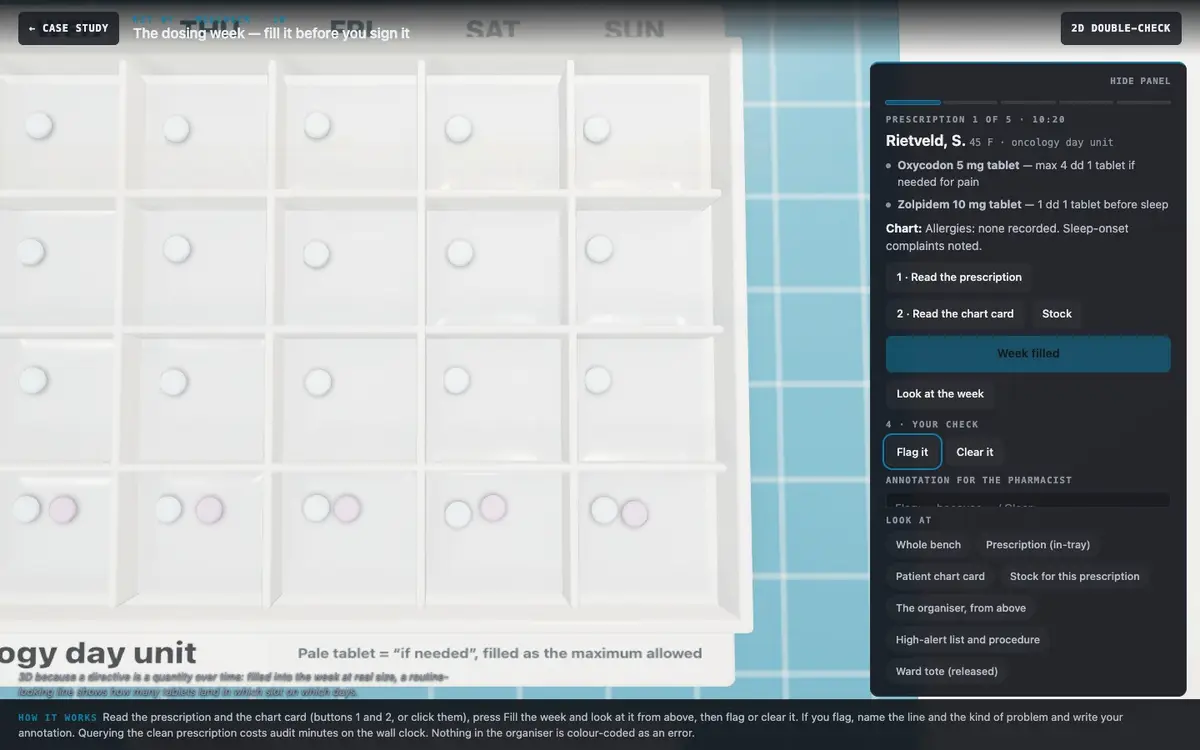
Prescription plan
| Patient | Lines | Expected | Category | Critical if cleared | What the week shows in 3D |
|---|---|---|---|---|---|
| De Vries, H. 58 M | Amoxicilline 3 dd · Feneticilline 4 dd | Flag (feneticilline) | Duplication | no | Seven penicillin doses a day in two colours |
| Bakker, T. 34 F | Ibuprofen 3 dd p.r.n. · Omeprazol 1 dd; chart: NSAID angio-oedema | Flag (ibuprofen) | Allergy | yes | An ordinary week. The problem is only on the chart card |
| Jansen, K. 71 M | Methotrexaat 2,5 mg "1 dd 6 tabletten" · Foliumzuur 1× per week (Tue) | Flag (methotrexate) | Frequency | yes | 42 methotrexate tablets next to one weekly folic-acid tablet |
| Rietveld, S. 45 F | Oxycodon max 4 dd p.r.n. · Zolpidem a.n. | Flag (zolpidem) | Interaction | no | Opioid and z-drug in the same night slot |
| Visser, M. 62 F | Metformine 2 dd · Lisinopril 1 dd · Atorvastatine a.n. | Clear | — | — | A tidy, correct week; flagging it costs 4 audit minutes |
The earlier version described methotrexate as correctly weekly and folinic acid as "same-day rescue"; that was clinically muddled and has been replaced by a clear daily-directive error.
Scoring and pass rule
Flag/clear 1 + line 1 + category 1 per prescription; the clean one scores 3 for clearing and 0 for any flag. Maximum 15. Pass = 12 or more and neither critical prescription released. Over-flags are counted in audit minutes.
Debrief
Score per patient, released critical errors named, minutes lost to over-flags, and one habit: "fill the week in your head and read the chart line before you sign".
Retry
New order each run; the prescriptions stay the same.
Prefer the source? Download the raw markdown.