Executive Briefing: Twelve Data Cards, One Decision
“Twelve numbers. Fifteen minutes. One decision — the brief is a decision, not a report.”
A brief builder: put up to five of twelve data cards on one page, build a three-part claim (what is happening, because, so we ask), write the trade-off line and your own opening sentence. Nothing is scored until the board reads it: a fifteen-minute read shows, minute by minute, which cards carried the claim, which raised “why is this here?”, and whether a decision was taken. Then revise and run again.
The Audience
Analysts and ops leads reporting to executives — plus anyone whose one-pager gets read for fifteen minutes.
Responsibilities
Card roles · three-part claim · fifteen-minute read model · trade-off disclosure.
The Build
Executive-communication design · claim calibration · scoring logic · AI-assisted drafting (disclosed)
How I used AI in this case
AI drafted variant wordings for the claim options and card notes; the card roles, the read model, the scoring and the trade-off framing were designed by me. Final copy edited by hand, use disclosed.
The build itself, not a video about it — open it, make the calls, and read what each one costs.
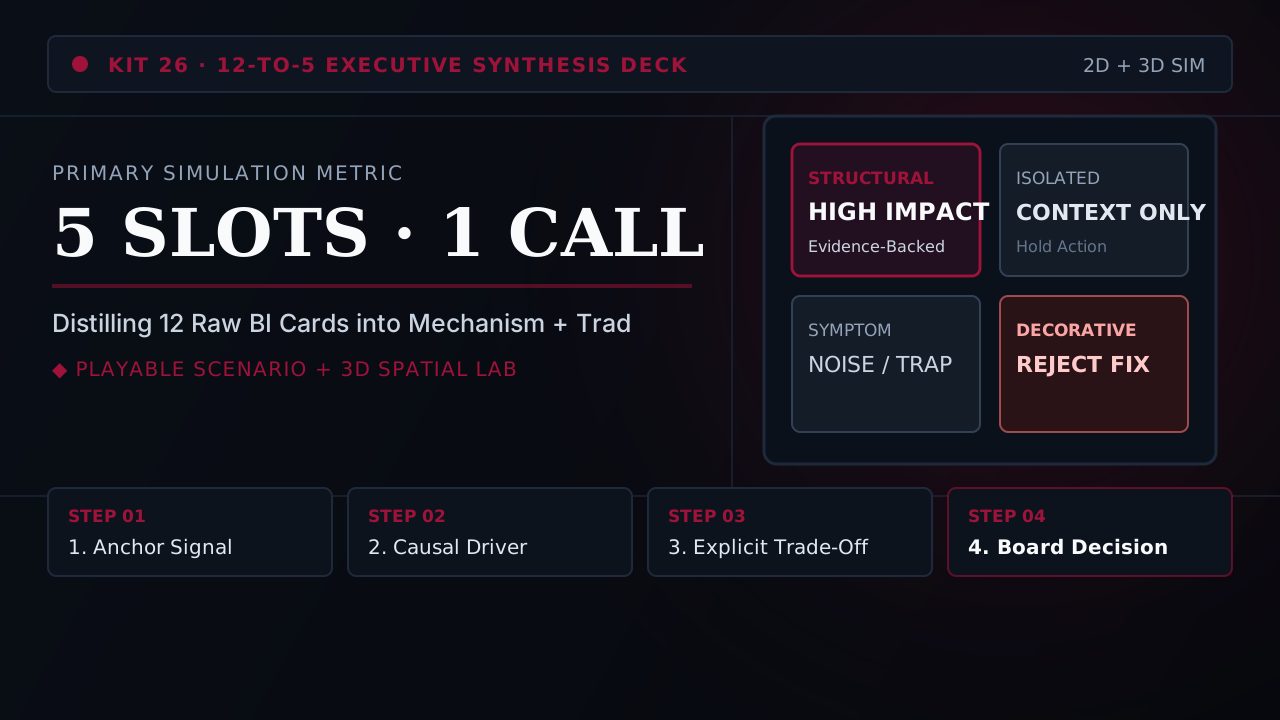
Board Brief — Primary Build
The builder: five card slots, three-part claim, trade-off line, opening sentence, then the fifteen-minute read
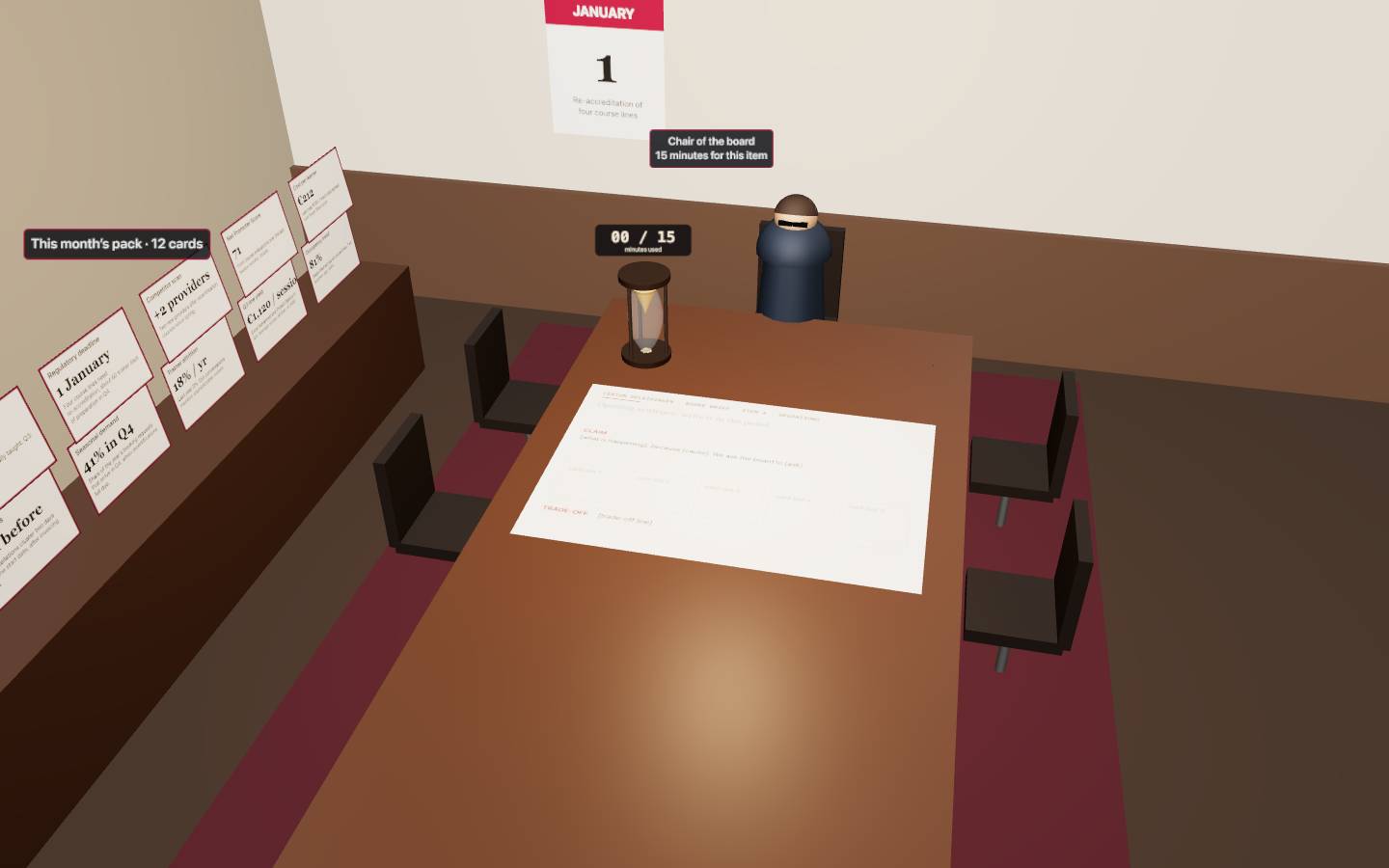
3D boardroom: the fifteen-minute read
Move cards from the credenza onto the brief, build the claim and the trade-off line, then hand it to the chair. The hourglass runs while she reads; threads and question marks show what each element did, and the outcome is stamped on the page.
Scene-by-Scene Storyboard & UI Spec
Scene plan for the builder and the read: card roles, claim options, trade-off lines, the read model and the revise loop.
Why conventional training failed the operational reality
The monthly pack (fictional) carries a story the twelve indicators hide:
Occupancy and cost per learner show the trend. The waitlist, the Q4 share of requests and trainer utilisation by quarter explain it; the Q3 yield names what the move costs and the 1 January deadline is what it must survive.
Core diagnostic finding
In this fictional brief, monthly board packs reported every indicator and decided nothing, or led with a confident claim the analyst’s own numbers contradicted. The skill is not slide design. It is choosing the few numbers that carry a mechanism, saying what you ask, and putting the cost on the page.
Scoring judgment honestly
Illustrative premise: names on the waitlist — 2.3× oversubscribed. Demand is not the problem.
Design Constraint → Build Rule: A brief is not right or wrong in itself; it is right if the board can act on it. So the claim is scored part by part against the cards on the page, and a part the page contradicts sends the item back.
Constraint as the teacher
Illustrative premise: trainer utilization — capacity exists, badly placed
Design Constraint → Build Rule: Five slots and fifteen minutes. Every element on the page costs reading time in the read model, so the limit is felt as the chair’s time, not as an arbitrary rule.
Trade-offs without cynicism
Design premise: every element on the page costs the reader minutes, so the page is judged by what it does in fifteen of them
Design Constraint → Build Rule: The three frames — visible, win-win myth, appendix-hidden — had to be ethically distinct without caricaturing any of them.
Five cards that carry a mechanism, one ask, the cost in view
Performance problem
At Certum Opleidingen (fictional), board items on operations are regularly deferred: the board receives twelve indicators, spends the slot asking what they mean, and takes the decision a quarter later, after the Q4 peak it was meant to address.
Learners and context
Operations analysts and team leads who report to a board or management team once a month. Comfortable with data; less practised at turning it into an ask. About 15 minutes per run, designed to be repeated with a second month’s pack.
Is training the answer? Not on its own
- The board-pack template. If the template requires all twelve indicators on page one, analysts cannot cut to five. The template needs a “decision items” page with the full pack as an appendix.
- The question in advance. Analysts often do not know which decision the board wants to take. A one-line agenda question from the board secretary, sent a week ahead, does more than any training.
- Feedback after the meeting. Nobody tells the analyst why an item was deferred. A two-line note from the chair after each meeting closes the loop that this builder simulates.
Alignment: every objective has practice, evidence, feedback and a route back to the job
| Objective | Practice | Assessment | Feedback | Transfer |
|---|---|---|---|---|
| LO1 Select the data that carries the decision | Five slots for twelve cards; the cards carry neutral notes, no hints | 1 point each for the five cards that do work (demand, capacity, cost, risk) | During the read: threads from cards that support the claim, “why is this here?” for cards with no job | A “decision items” page in the real board pack (recommended) |
| LO2 State a claim with a mechanism and an ask | Three-part claim; options of equal weight, shuffled | 2 points per part that holds; a part the page contradicts sends the item back | The board’s questions in the read, then part-by-part feedback | One-line agenda question from the board secretary (recommended) |
| LO3 Put the cost of the ask on the page | Trade-off line: visible, win-win, or in the appendix | Only the visible cost passes; the other two lead to “approved, then reopened” or “approved with doubt” | Outcome stamped on the page, with what happens six weeks later | Chair’s two-line note after the meeting (recommended) |
| All three, in your own words | Opening sentence, at least 12 words with a checkable figure | 1 point (length and figure checked automatically) | Shown next to a model opening | The opening sentence becomes the first line of the real brief |
Evidence register: what is real, what is invented
- Fictional premise Certum Opleidingen, its board and every figure on the twelve cards (310 waitlist, 64% / 52% / 93% utilisation, €1,120 Q3 yield, about €96k a year for the two lines).
- Design decision The fifteen-minute read model: one minute per element, one extra minute for a card with no job, three for a claim part the page does not support or contradicts, two for discussing a visible cost, four for a win-win claim. It makes the cost of clutter visible; it does not predict a real board.
- Design decision Scoring /14 and the pass rule (approved in the meeting and ≥ 12). Leaving off the risk card still passes but costs three minutes of questions.
- Not measured Whether analysts’ real briefs change. Earlier targets on this page (“≥70% land claim and trade-off”, “board decisions land in-meeting”) were stated as pre-committed; they are now proposals in the evaluation plan.
Measurable Performance Objectives
Three objectives, plus the opening sentence that combines them. The earlier version had a card selection that was never scored and a claim picked as one finished sentence; both are now built and scored.
Choose, from twelve indicators, the few that carry the decision: where demand is, where capacity is, what the move costs and what it must survive.
Evidence in the build: five slots; one point per card that does work; cards with no job cost a minute each in the read.
State what is happening, why, and what the board is asked to decide, so that the cards on the page support every part.
Evidence in the build: three-part claim, two points per part that holds; a part the page contradicts sends the item back.
Put the cost of the ask on the page in money, rather than calling it win-win or moving it to an appendix.
Evidence in the build: trade-off line; only the visible cost leads to “approved in the meeting”.
Why This Modality Won (Trade-Off Analysis)
Before committing to the final architecture, we evaluated and rejected lower-transfer alternatives against the workplace constraints:
The professional-development default. Rejected because the charts were already fine — the failure was selecting which numbers earn a place and committing to a claim with its cost visible. A prettier version of the twelve-card dump is still a dump.
Thorough and defensible. Rejected because the board's constraint is attention, not information — 'longer, with a summary' adds a layer to the exact artifact that already fails. The brief is a decision; the report remains in the appendix where it belongs.
A brief builder: put up to five of twelve data cards on one page, build a three-part claim (what is happening, because, so we ask), write the trade-off line and your own opening sentence. Nothing is scored until the board reads it: a fifteen-minute read shows, minute by minute, which cards carried the claim, which raised “why is this here?”, and whether a decision was taken. Then revise and run again.
Why no feedback until the read
The consequence is the feedback
Choices are not marked right or wrong as they are made. The board reads the page and the minutes show what each element did, which is how an analyst learns it at work, compressed into one run.
Why a revise loop
Build, read, fix
After the read the brief stays as it was, so the analyst changes one thing and runs it again. The run count is shown; the pass rule applies to each run.
Why 3D here
Time and attention as objects
In the boardroom the fifteen minutes are sand in an hourglass, the chair’s attention moves over the page, and cards that carry the claim are tied to it with thread. Clutter and missing evidence become visible as minutes.
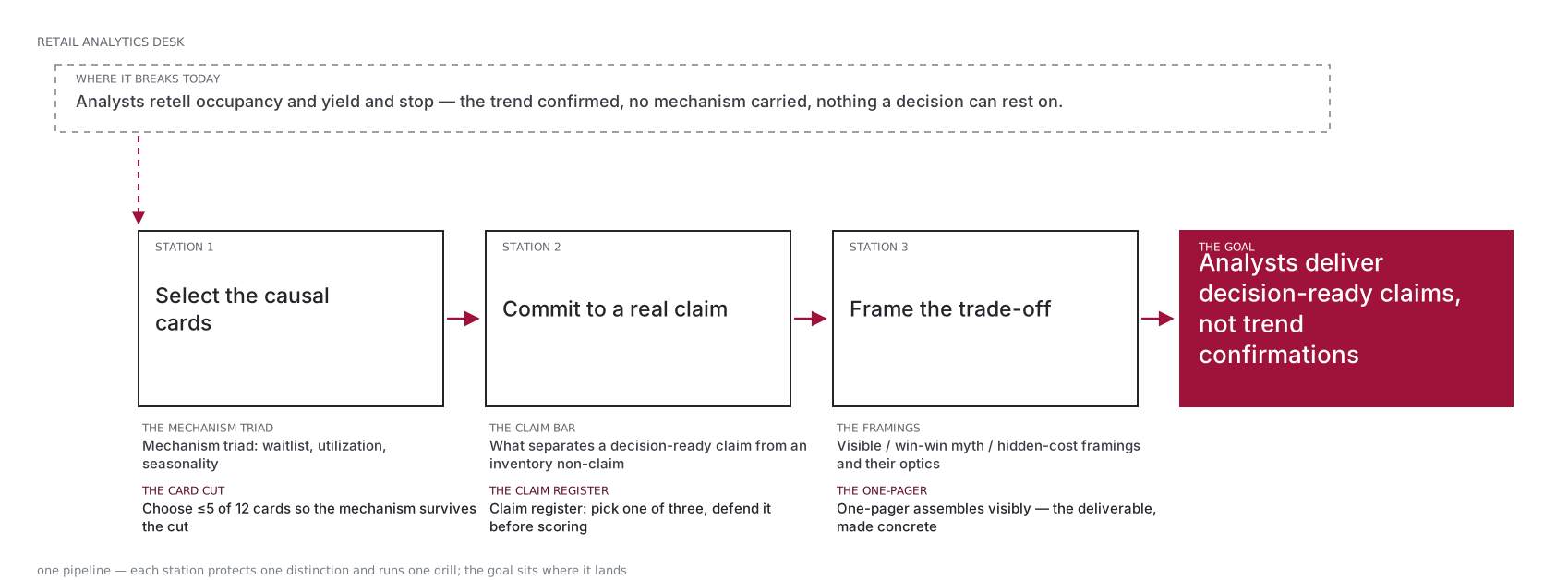
Production Sequence & Traceable Artifacts
The stages below show how the artifacts depend on each other. In this fictional case one designer produced all of them.
What would tell us it worked
A proposed plan. Nothing below has been measured.
| Question | Measure / instrument | When | What we would do with the answer |
|---|---|---|---|
| Can analysts build a brief that passes? | Runs to a pass, and which element was revised between runs (logged in the builder) | Pilot with 6–8 analysts, two monthly packs each | If most revisions are the trade-off line, the cost lesson needs an earlier example |
| Does the second pack go better than the first? | First-run score on a second, different pack | Same pilot, one week later | If the first-run score does not rise, the skill is not transferring between packs; add a third pack |
| Do real briefs change? | Sample of real board briefs scored with the same rubric (cards with a job, claim parts, visible cost) | 1 and 3 months | Target to agree with the board secretary (proposed: most briefs open with an ask and a stated cost) |
| Do decisions move into the meeting? | Share of operations items decided in the meeting rather than deferred (board minutes) | 6 months, compared with the 6 months before | Read together with the template and agenda-question changes; training alone cannot claim it |
Instructional Design Takeaway
“Why this form wins: the problem is insight drowning in inventory, so the solution limits the page to five cards, asks for a claim in three parts and lets the board’s fifteen minutes score the result — because boards forgive wrong calls long before they forgive hidden costs.”
The monthly pack was complete and unread: twelve numbers, no decision, and four executives redoing the analysis with worse data. The analyst's real skill is selection and claim-making, not comprehensiveness. The proposal is a brief builder: twelve data cards, at most five on the page, a three-part claim, a visible trade-off and an opening sentence, judged by a minute-by-minute read and improved by revising.
Transparent Portfolio Scope
Honest limitation: one designed pack with a key and a fixed read model. Real boards are not predictable, and real packs carry legal and financial constraints this builder leaves out.