Craft-Dairy Process Training: Expert Interview to Floor-Ready Kit
“One founder’s hands know the process. Twenty-four staff need it to survive a Friday — this kit traces every training decision back to her words.”
A three-artifact pipeline in which nothing exists “because training usually has one”: the interview produces requirements, the requirements produce the gates, the gates and the constraints produce the pack. Every artifact cites the passage it came from.
The Audience
New production operators at a craft dairy scaling from 6 to 24 staff — mixed NL/EN, no desks, no PCs on the floor; the founder is the SME whose craft must become a system.
Responsibilities
Expert-interview capture · requirement extraction · CCP micro-module · print/digital enablement pack · test protocol · wording standard — the full SME-to-kit pipeline.
The Build
Interactive interview-capture explorer · 4-gate decision module with shuffled options · print-style floor manual + KB + FAQ + test plan · offline, login-free by constraint.
How I used AI in this case
AI helped draft interview-question variants and manual phrasings; the interview design, requirement extraction, traceability model and gating decisions were authored by me. Disclosed per artifact.
The build itself, not a video about it — the whole pipeline, from the raw interview to the pack on the tank wall. Start with the interview: it is where every other artifact comes from.
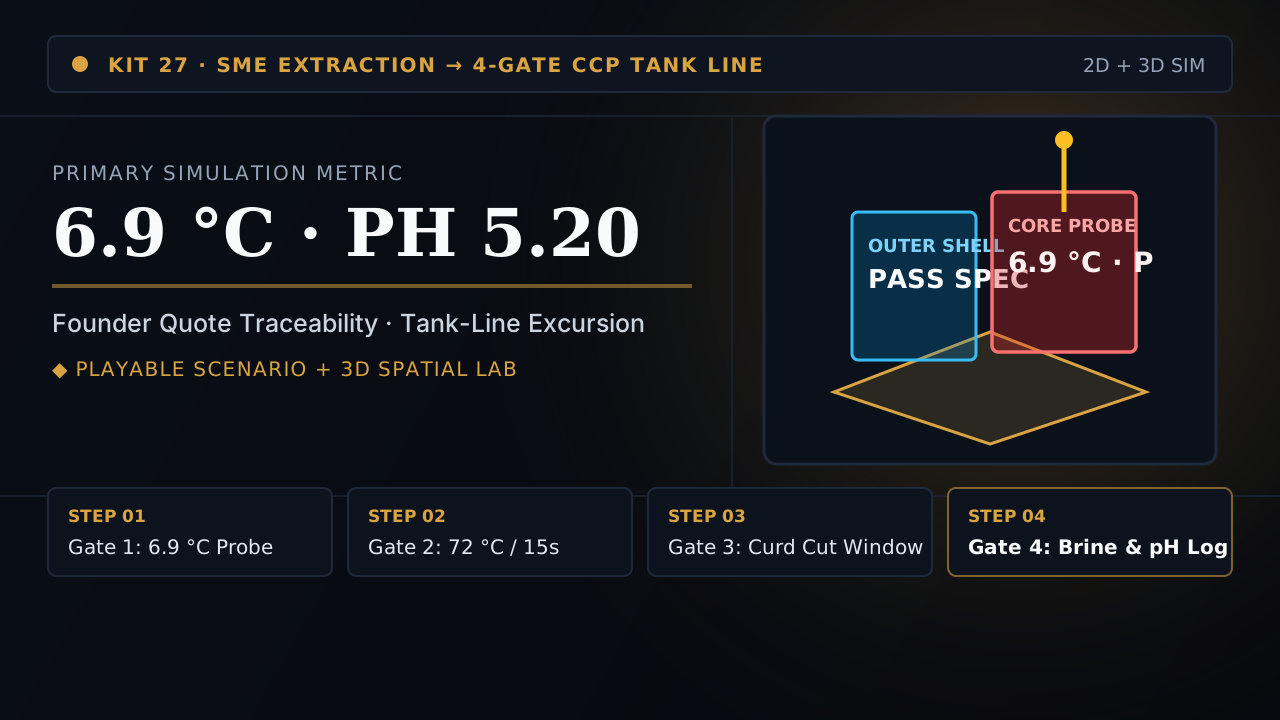
Tank Line Gates — Primary Build
The four-gate module, shuffled and scored, plus the enablement pack
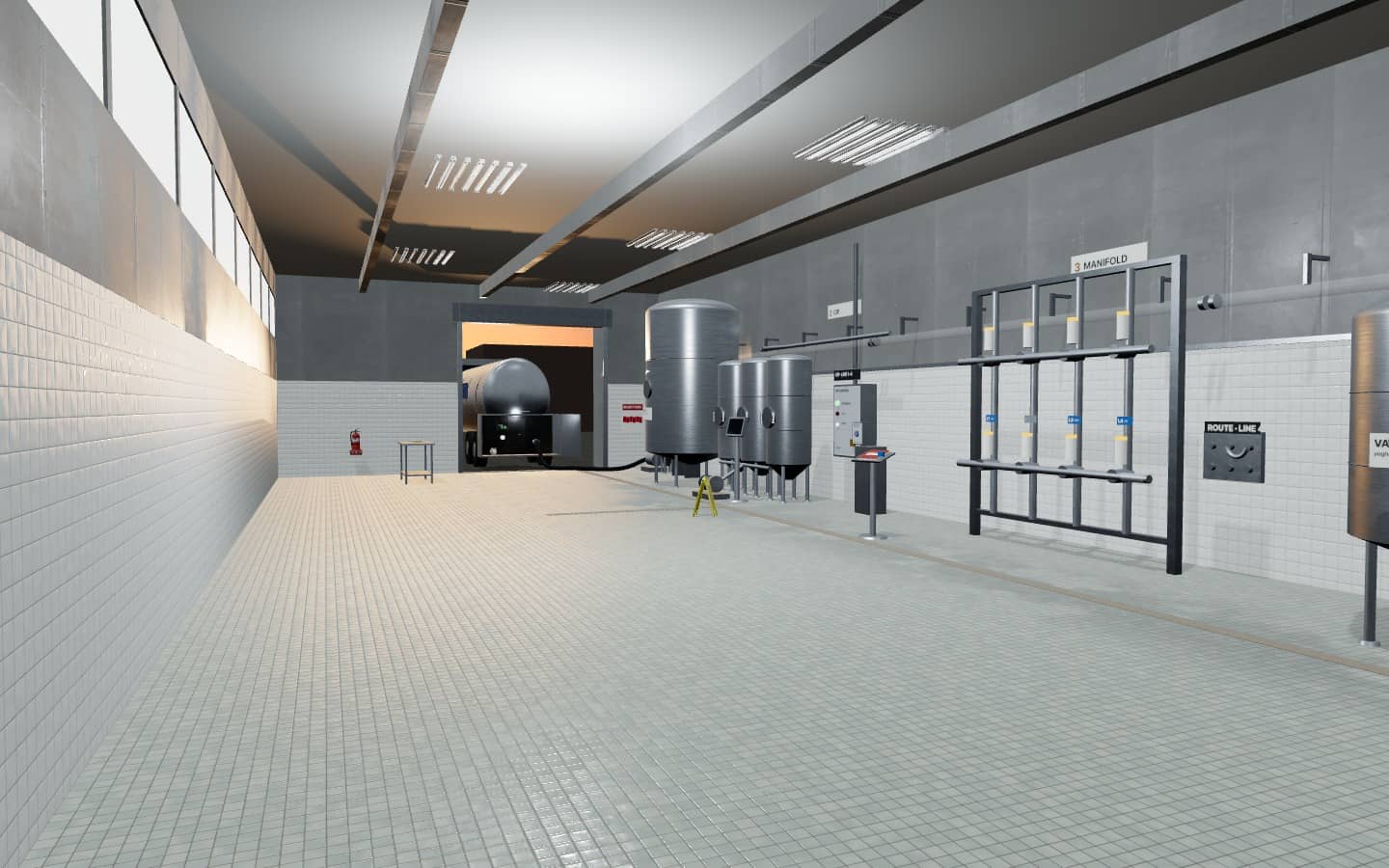
3D tank line
Walk the production hall of a small dairy at eye height, from the milk tanker at the door to the release dock. At each station look closer, open the record, then act: the surface cue, the record or an over-cautious move. A labelled glass teaching line shows each call. Then write the deviation note.
SME Interview Requirement Explorer
For designers: classify each highlighted passage of the (fictional) founder interview, then see the requirement the kit extracted and the artifact it feeds.
Why conventional training failed the operational reality
A craft dairy wins on process control nobody wrote down. Scaling quadruples the staff in one season, agency workers rotate faster than accounts can be created, and the two near-misses share one signature: routine steps performed from memory by people who were told once. The learning problem is not “teach the process” — it is convert one expert’s tacit craft into a system that survives a glance, one-handed, in boots.
Core diagnostic finding
In this fictional brief, the near-misses at a growing dairy shared one pattern: a routine step cleared on something that looked like proof (a gauge reading, a green lamp, a familiar layout) instead of the record that proves it. And when a batch was released correctly, the note was the part that got skipped.
Tacit, not documented
Illustrative premise: staff in one season — the founder’s hands can no longer be everywhere at once
Design Constraint → Build Rule: The SME’s knowledge is real but unsayable in protocol form — “what I do before I open that valve” is expertise, not a procedure. The interview has to make it extractable without flattening it.
Two languages, one tablet, no logins
Illustrative premise: near-misses this spring in cleaning-in-place, both by people “told once, weeks earlier”
Design Constraint → Build Rule: Half the floor reads Dutch only, half English only, nobody sits down. Print at the tank, a shared tablet in the break room, agency staff who rotate too fast for accounts. The format follows the constraint, not the tool list.
Familiarity disguised as competence
Illustrative premise: written protocols — the process lives as “what Sanne does before she opens that valve”
Design Constraint → Build Rule: The near-misses came from routine that feels expert. Re-explaining everything insults the room; skipping verification recreates the near-miss. The gates had to target the habit, not the facts.
The record, not the surface
Performance problem
In this fictional dairy, the founder’s tank-line routine lived in her hands. As the floor grew from 6 to 24 people, new operators learned it by watching once, and steps were cleared on surface cues: a copied log, a green CIP lamp, a worn line label.
Learners and context
Two audiences. Designers use the interview explorer to practise extracting requirements. New production operators (Dutch or English, standing, no PCs on the floor) use the module on the break-room tablet and the laminated card at the tank.
Is training the answer? Not on its own
- Equipment. One probe per station on a hook; a probe that is “somewhere” produces copied logs whatever the training.
- Labels. Worn line labels are a maintenance finding: replace them on a schedule.
- Controls. A CIP lamp that turns green only on a complete end-state removes the trap; that is a change for the panel supplier.
Alignment: every objective has practice, evidence, feedback and a route back to the job
| Objective | Practice | Assessment | Feedback | Transfer |
|---|---|---|---|---|
| LO1 Classify interview passages and name the artifact each feeds (designer) | 01 explorer: ten passages | Classification matches the kit’s, with the reason | Requirement, why it is that type, artifact it feeds | The same four categories in the next SME interview |
| LO2 At each tank-line gate, act on the record that proves the step (operator) | Four gates, three shuffled options or props | Record 2, avoided the call 1, surface 0 | Gate-specific, plus what the record shows | Laminated card at the tank, same words NL/EN |
| LO3 Write a deviation note an auditor can check (operator) | Pick the entries for the Gate 4 note | Four required entries, no hearsay or surface cue | Names what is missing and what is not a record | Manual step 4 and the KB article on the note |
Evidence register: what is real, what is invented
- Fictional premise Zuivelhoeve De Zwaan, the founder Sanne de Zwaan, the interview and the near-misses are invented for this portfolio.
- Illustrative values The 8 °C / 30 min / 20 min release questions and all readings. They are the fictional dairy’s plan, not a regulatory limit.
- Design decision The four gates, the note entries and the scoring. A claim that “23 pallets a quarter” was an industry baseline had no source and was removed.
- Not measured Operator behaviour, log quality and release notes. The test plan in the enablement pack has not been run.
Measurable Performance Objectives
Three objectives for two audiences. The earlier LO3 (“tell what the SME said from what training assumes”) could not be observed; it is replaced by the note, which can.
Classify expert-interview passages as critical task, misconception, vocabulary or constraint, and name the artifact each feeds (designer).
Evidence in the build: ten passages in the interview explorer.
At each tank-line gate, act on the record that proves the step, not the surface cue and not an over-cautious workaround (operator).
Evidence in the build: four gates, scored 2 / 1 / 0.
Write a deviation note with times, readings, both protocol answers and your name, and nothing that is not a record (operator).
Evidence in the build: the note task after Gate 4, scored 0–2.
Why This Modality Won (Trade-Off Analysis)
Before committing to the final architecture, we evaluated and rejected lower-transfer alternatives against the workplace constraints:
Rejected: nobody reads a 30-page SOP at the tank one-handed, and length is not the constraint — glanceability is. The four-gate card replaced it.
Rejected: that is the current system, and it is what broke at scale. The pack lets any shift lead deliver the same four gates in the same words.
A three-artifact pipeline in which nothing exists “because training usually has one”: the interview produces requirements, the requirements produce the gates, the gates and the constraints produce the pack. Every artifact cites the passage it came from.
Why classify first
Extraction is a judgement
Reading a passage and then seeing the answer is not practice. Choosing the type first makes the designer commit, and the reason shown afterwards is what transfers to the next interview.
Why three options
Surface, record, avoidance
Each gate has a convincing surface cue and an over-cautious move. Both are realistic errors; only the record proves the step. The avoidance option scores 1 because it is safe but leaves the habit in place.
Why 3D here
One line, walked in order
The routine is a walk along one tank line. At each station the green lamp or the stamp stands right next to the record, and the record is a book, a binder or a terminal you have to open.
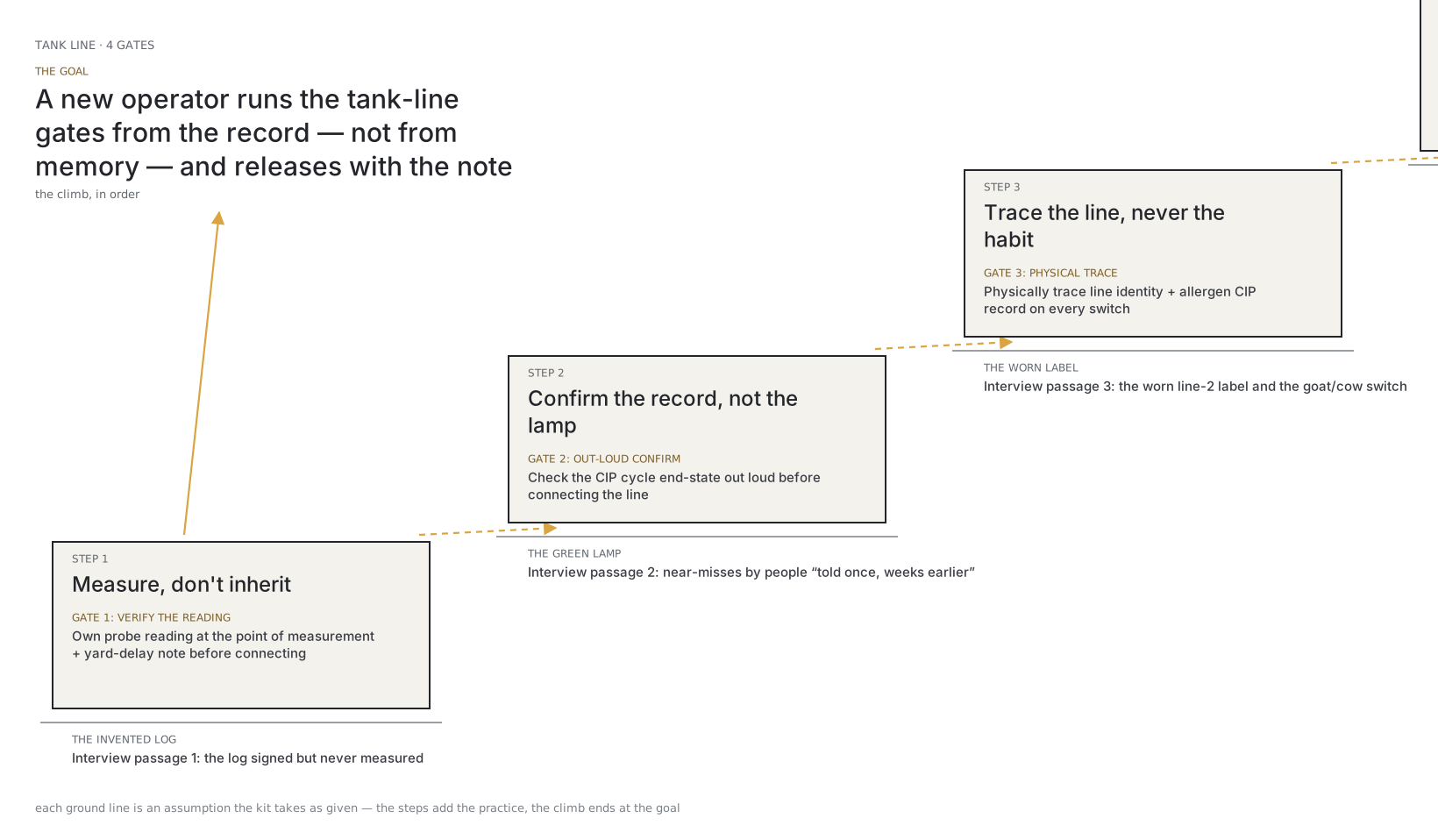
Production Sequence & Traceable Artifacts
The stages below show how the artifacts depend on each other. In this fictional case one designer produced all of them.
What would tell us it worked
A proposed plan. Nothing below has been measured.
| Question | Measure / instrument | When | What we would do with the answer |
|---|---|---|---|
| Do designers classify passages the way the kit does? | Matches per type in the explorer; which type is confused most | Peer review with two other designers | If misconceptions are read as tasks, add a worked example before the explorer |
| Do operators choose the record? | Gate choices and note completeness on first run (test plan step 2) | Three-learner session on the tablet | A gate cleared on the surface by two of three learners gets a rewrite of the card wording |
| Does the floor change? | Weekly sample of reception logs with yard-delay notes; excursion releases with a complete note | Two audit cycles after rollout | If notes stay incomplete, look at the form and the time available before more training |
Instructional Design Takeaway
“Why this form wins: a tacit craft plus physical constraints is an interview problem before it is a design problem — get the requirements traceable, then every artifact can be short, print-ready and login-free without losing anything that mattered.”
A three-artifact pipeline in which nothing exists “because training usually has one”: the interview produces requirements, the requirements produce the gates, the gates and the constraints produce the pack. Every artifact cites the passage it came from.
Transparent Portfolio Scope
Honest limitation: a fictional composite SME and dairy. The interview is scripted, the readings and release questions are illustrative, and no usability sessions have been run.