Cold-Chain Goods-In: Decision Training for Dock Receivers
“Your signature on the CMR decides whether a warm core becomes your problem or stays the carrier’s.”
An end-to-end decision-training certification, interactive 3D receiving bay cutaway simulator, and bilingual pre-shift huddle kit built around the 4-Gate Cold-Chain Receiving Protocol.
The Audience & Context
Goods-in dock receivers at VanDijk Logistics (24/7 chilled distribution hub) — seasonal hires and 10-year veterans operating ruggedized Zebra tablets under a 25-minute bay turnaround clock.
Instructional Design Role
End-to-end ownership: QA incident analysis · Cathy Moore Action Mapping · bilingual storyboarding · 3D spatial simulation design · SCORM/xAPI telemetry · Kirkpatrick L1–L4 evaluation plan.
Technical & Media Stack
HTML/CSS/JS scenario engine · Three.js receiving bay · SVG logger curves · WebAudio sound cues · on-screen EN captions with a draft NL toggle · Fisher–Yates exam randomisation.
AI Workflow (Disclosed)
AI assisted with Dutch (NL) terminology parity and distractor phrasing, documented in DOC 06. Needs analysis, 4-Gate rules, scoring logic, 3D mechanics, and xAPI schemas were hand-authored.
This training kit ships as three integrated artifacts designed for different moments on the warehouse floor: spatial mental-model building, individual tablet certification, and the 5-minute morning shift huddle.
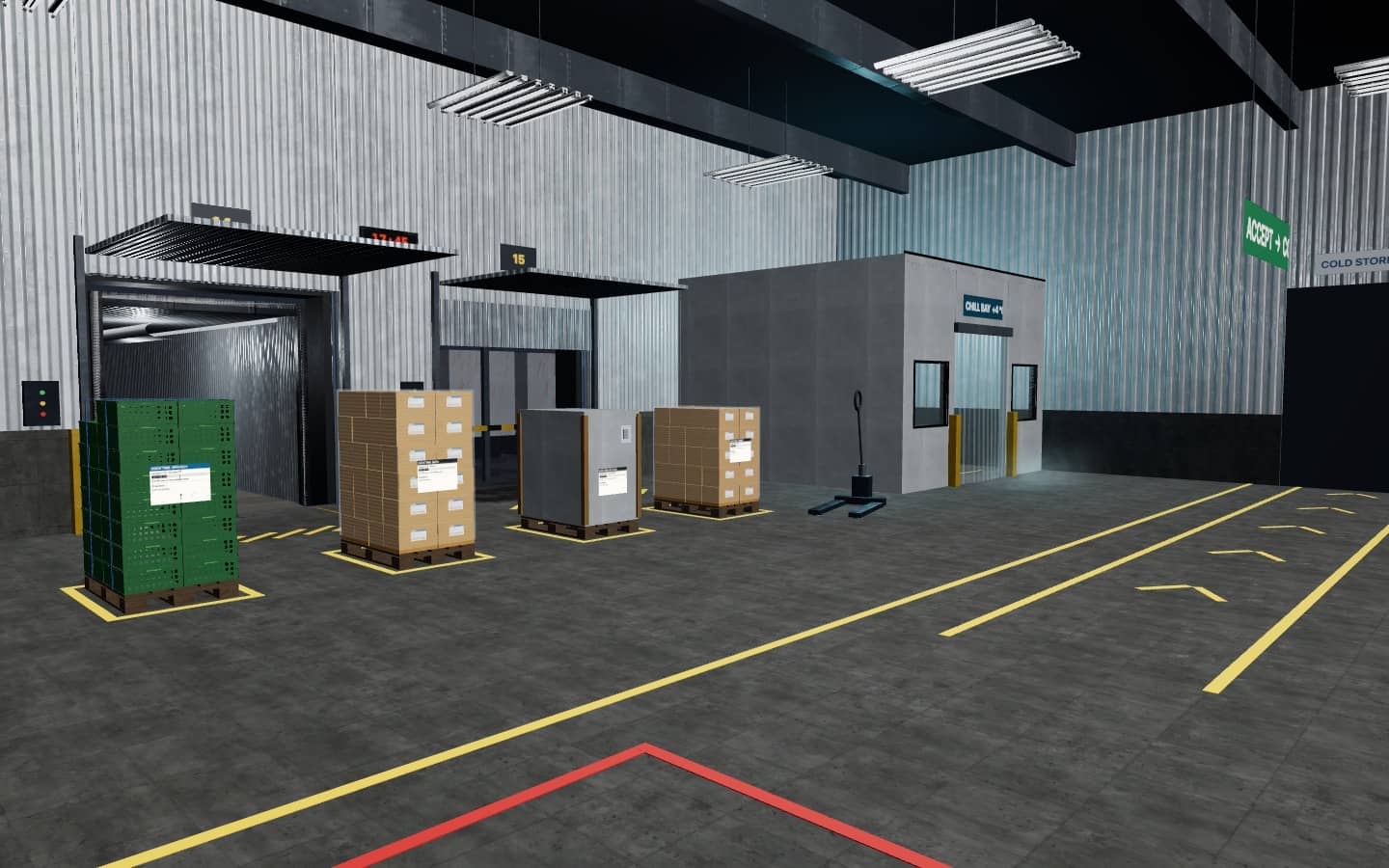
3D receiving bay
A receiving dock at 17:45 on a wet winter evening, worked at eye height. Scan with the IR gun, probe the core, pull waiting pallets into the chill bay on the pallet truck, set dispositions by lane, then write the reservations and sign while the driver waits in the cab. A 2D dock run has the same scenario.
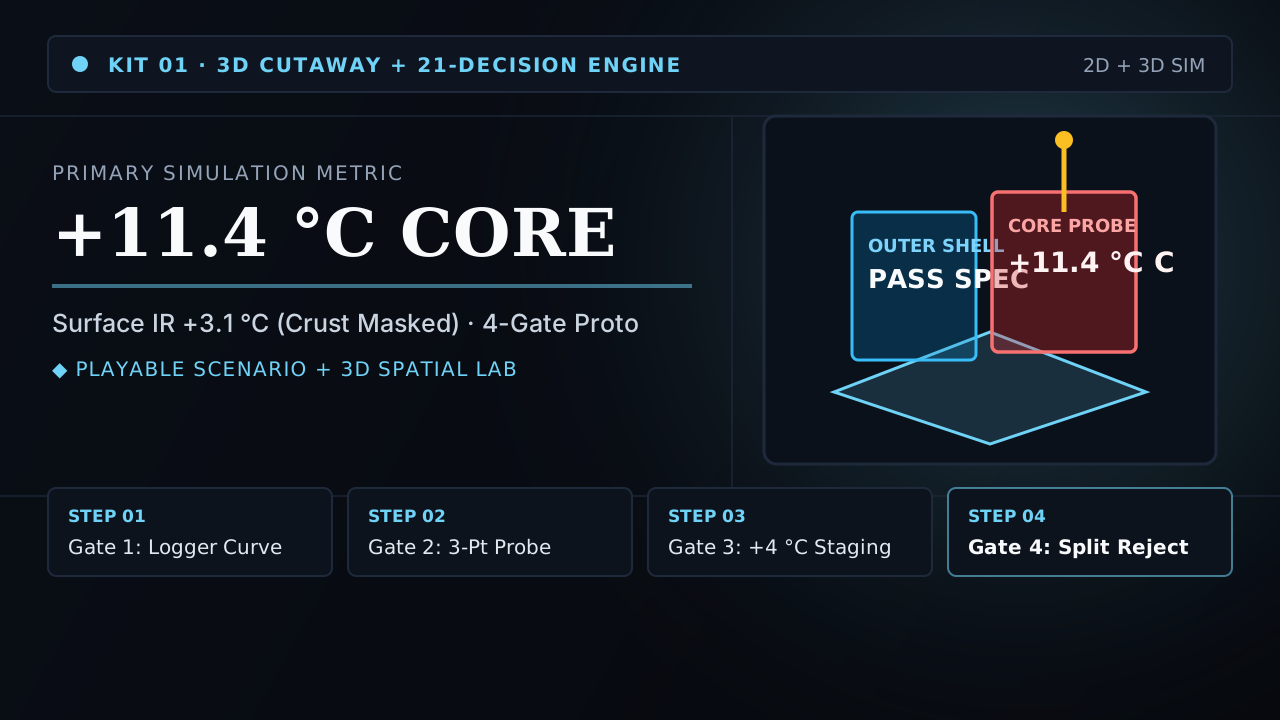
21-Point Scenario Certification Module
The primary shift-tablet assessment build. Guides learners through all 4 receiving gates with SVG logger graphs and 3-point cross-sections, tests 3 live borderline incidents, and finishes with a Fisher–Yates randomised 7-of-8 certification exam. An example xAPI statement is shown at the end; nothing is sent.
90-Second Story Explainer
Built for shift leads to play on the dock monitor during the 5-minute morning huddle. Dramatises a fictional €14,000 vaccine write-off caused by late-reefer crust-chilling, with on-screen captions (EN; NL draft pending native-speaker review), WebAudio cues, no voiceover, and a full transcript. Under reduced motion each scene shows its full content at once.
Why an annual SOP refresher failed to stop 23 problem pallets
At VanDijk Logistics (a fictional composite of EU chilled-goods operators), Q3 quality assurance logs recorded 23 high-cost receiving failures across dairy, produce, and pharmaceutical loads. Operations initially asked for “a short refresher course on cold-chain temperature limits.”
Our needs analysis (DOC 01) revealed that ignorance was not the problem. In this fictional brief, every receiver passed the annual policy quiz and could recite the 2.0–8.0 °C chilled band from memory.
Failures happened in the collision between the 25-minute bay turnaround clock and ambiguous physical evidence: receivers trusted clean paperwork when queues backed up, guessed defensively on borderline readings, and left pallets warming on the +18 °C ambient dock because nobody had given them procedural authority to pause the clock.
Core diagnostic finding
In this fictional brief, receivers knew the limits. Under a 25-minute turnaround they signed on clean paperwork and a surface reading, rejected whole pallets on one warm corner, and left borderline pallets on the ambient dock while waiting for QA.
Paperwork Sign-Off Without a Physical Core Probe
Floor behavior: When the carrier's CMR printout looked complete and a quick surface IR scan read 3.1 °C, receivers signed off without probing the center — missing 11.4 °C cores caused by late-reefer blast-air “crust chilling.”
Design Constraint → Gate 1 & Gate 2: Make skipping the core probe visibly costly on screen; train receivers to cross-check the 6-hour logger curve against a mandatory 3-Point Core Probe (A/B/C).
Defensive Over-Rejection on Borderline Edge Readings
Floor behavior: When a door-facing top carton read 8.9 °C after rear-door unloading, receivers defensively rejected the entire 60-crate pallet to avoid blame — triggering expensive carrier claims on healthy loads.
Design Constraint → Gate 2 Spatial Split: Teach receivers to distinguish localized door-edge warming (centre 5.1 °C, rear 5.0 °C → reject the 14 door-side crates, accept the 46 core crates) from whole-load failure.
Ambient Dock Exposure Past 30 Minutes During Escalation
Floor behavior: Receivers who spotted a borderline 8.2 °C reading called QA and waited by Bay 4 — leaving the pallet sitting on the +18 °C ambient dock past the 30-minute thermal limit until a salvageable load spoiled.
Design Constraint → Gate 3 Clock Pause: Establish an explicit rule granting receivers authority to roll any escalated pallet into the +4.2 °C Chill Staging Bay first to pause the dock clock.
Probe the core, keep the clock, sign last
Performance problem
In this fictional chilled-distribution hub, 23 problem pallets a quarter came from three moments: signing on paperwork and a surface reading (10), rejecting good loads defensively (7) and leaving pallets on the ambient dock past 30 minutes (6). The earlier pages called the second share “31%”; 7 of 23 is 30.4%.
Learners and context
Goods-in receivers, from seasonal hires to long-serving staff, on dock tablets between deliveries. English first; the explainer has draft Dutch captions.
Is training the answer? Not on its own
- Probes. A 3-point probe at every bay, not one per shift, removes the main excuse for surface-only checks.
- Authority. Receivers need written authority to move a pallet into the chill bay before QA answers.
- CMR form. Box-18 reservation fields (location, reading vs limit, units, action) on the form make complete notes the default.
Alignment: every objective has practice, evidence, feedback and a route back to the job
| Objective | Practice | Assessment | Feedback | Transfer |
|---|---|---|---|---|
| LO1 Probe the core before deciding, and tell edge warming from crust chilling | Gates 1–2 in the module; IR vs 3-point probe in the dock run | Dispositions made on probe evidence (2 points per pallet) | Names the gradient or the crust and what the core showed | Probe at every bay (recommended) |
| LO2 Keep every pallet under 30 minutes on the ambient dock, using the chill bay | Dock clock and chill bay in the dock run; Gate 3 in the module | No breach; borderline pallet accepted only after the 20-minute re-probe | Breach message at the minute it happens | Written chill-bay authority (recommended) |
| LO3 Refuse to sign the CMR until every pallet has a disposition, then write reservations an auditor can check | Driver pressure (Incident C); sign button always available in the dock run; box-18 fields | Signing early is critical; reservation fields scored | Shows which pallets became yours | Box-18 fields on the CMR form (recommended) |
Evidence register: what is real, what is invented
- Fictional premise VanDijk Logistics, the incidents and the 23-pallet breakdown (10 / 7 / 6).
- Illustrative values The 2–8 °C band, 30-minute dock limit and 20-minute recovery test as used here, and all readings. A teaching protocol, not a regulatory reference.
- Design decision Scoring and pass rules. The earlier explainer card claimed a “real €40k” write-off, synchronised EN/NL voiceover and WebVTT; there is no voiceover or WebVTT and the case is fictional.
- Not measured Floor behaviour and write-offs. The module’s L1 poll and xAPI statement are shown on the page only; nothing is recorded.
Measurable Performance Objectives
Three observable behaviours. The earlier LO3 (“achieve ≥ 85% on the exam”) was a score, not a behaviour; it is now the refusal to sign early.
Probe the core at three points before any disposition, and tell door-side edge warming (split) from late-reefer crust chilling (reject).
Evidence in the build: module gates 1–2 and the dock-run pallets.
Keep every waiting pallet under 30 minutes on the ambient dock by moving it into the chill bay, and accept a borderline pallet only after the 20-minute re-probe.
Evidence in the build: dock clock and chill bay in the dock run; module gate 3.
Refuse to sign the CMR until every pallet has a disposition, then record location, reading vs limit, units and action for each reservation.
Evidence in the build: the early-sign trap and the box-18 fields in the dock run; module gate 4 and Incident C.
Why This Modality Won (Trade-Off Analysis)
Before building the interactive simulation, we evaluated two lower-cost L&D interventions with QA and Operations:
Cheapest on paper, but audit records showed receivers could quote the SOP verbatim while still penciling in surface IR numbers under queue pressure. A memo adds a checkbox, not a habit.
Pulling receivers off a 24/7 rotating dock created overtime bottlenecks, and group discussion trains retrospective talk rather than the individual split-second call at Bay 4.
Designed for dock tablets between deliveries (English only for now), with a 3D and a 2D dock run that make the hidden core and the dock clock visible, and a simulated consequence for every early signature.
The 4-Gate Chilled Receiving Protocol
Standardized across the 3D Simulator & 21-Point ModuleJourney Logger Audit
Inspect the 6-hour continuous PDF/USB trip curve before touching the pallet. Flag mid-journey spikes (> 8.0 °C) for expanded core probing; quarantine loads with missing loggers in the Chill Bay while QA pulls carrier telematics.
3-Point Core Probe
Compare Surface IR against three physical probe points: A (Top-Door Corner), B (Geometric Core), and C (Bottom-Rear). Defeats both Ambient Edge-Warming (8.9 °C corner / 5.1 °C core) and Late-Reefer Crust Masking (3.1 °C crust / 11.4 °C core).
Dock Clock & Chill Staging
Ambient bay (+18 °C) exposure is strictly capped at 30 minutes. Roll any escalated or borderline pallet into the +4.2 °C Chill Staging Bay to pause the dock clock; borderline 8.1–8.5 °C excursions (< 30 min) pass if core recovers < 8.0 °C in 20 minutes.
Audit-Ready Disposition
Execute final routing (Full Accept, Corner-Split Quarantine, Chill Hold, or Full Reject) and log all four mandatory CMR elements: 1. Probe Zone/ID, 2. Measured °C vs. Limit, 3. Case Count, and 4. Disposition Action.
Why hidden cores
Nothing to read off the screen
The earlier 3D coloured every core from the start, so the answer was visible before the probe. Now the core is unknown until measured and the IR gun shows only the surface.
Why a clock
Time is part of the decision
Every action costs simulated minutes. A pallet waiting for QA on the ambient dock breaches; the chill bay pauses it. The run is deterministic, so a retry is a fair comparison.
Why 3D here
Surface, core and distance
In 3D the IR gun is in your hand and reads only the outside; the probe goes into the load; the chill bay is a pull across the dock on a pallet truck. The 2D dock run has the same scenario for anyone who prefers it.
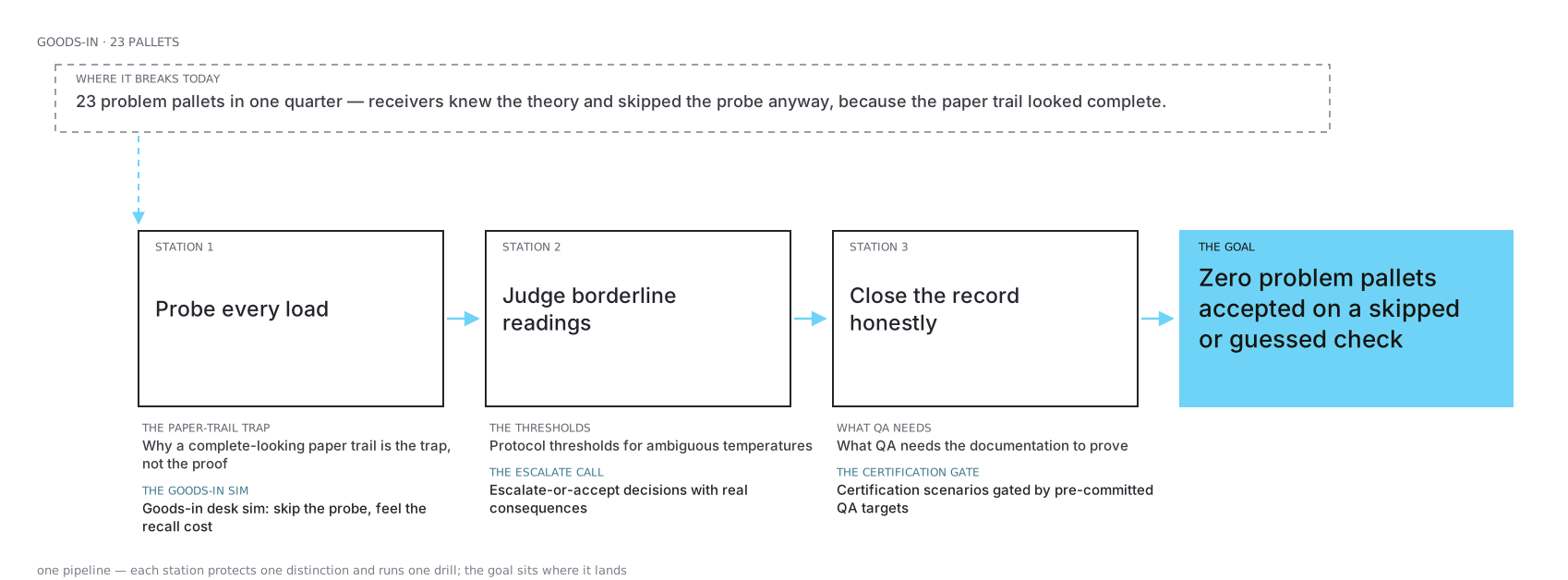
From a fictional QA incident ledger to a build and a packaging plan
Every stage of the instructional design lifecycle is documented and inspectable below. Click any specification to review the underlying analysis, storyboards, visual tokens, or telemetry schemas.
What would tell us it worked
A proposed plan (DOC 08). Nothing below has been measured; the module records nothing beyond the page.
| Question | Measure / instrument | When | What we would do with the answer |
|---|---|---|---|
| Do receivers probe before deciding? | Share of dock-run dispositions made on probe evidence; module gate 1–2 item analysis | Pilot with one shift | If surface-only calls persist, put the probe step on the CMR form |
| Do they use the chill bay? | Breaches in the dock run; borderline pallets accepted before the re-probe | Same pilot | If breaches cluster, check whether the chill bay is physically reachable in time |
| Does the floor change? | Weekly sample of 20 CMRs: complete box-18 reservations; good loads rejected per quarter (illustrative baseline 7) | 30 / 60 / 90 days | Target ≤ 2 unnecessary rejections a quarter; if not, review the borderline protocol before more training |
Instructional Design Takeaway
“A compliance module shouldn't be a digital textbook about regulations — it should be a rehearsal studio for the hardest 90 seconds of the shift. When receivers practise finding the +11.4 °C core under a +3.1 °C surface and pausing the dock clock, the routine has somewhere to be rehearsed before it is needed.”
Transparent Portfolio Scope
Honest limitation: a fictional composite with an illustrative teaching protocol. The module shows an xAPI statement and an L1 poll but sends and stores nothing; no SCORM package is built; Dutch captions are an unreviewed draft.
What is design specification: VanDijk Logistics is a fictional composite; the evaluation targets are proposals, written in DOC 08.