AI Adoption Program: From Curious to Governed Weekly Use
“300 desk workers, 60 days: from "AI is a chatbot I've heard of" to "AI is a governed habit in my week" — without a single policy-breach incident.”
A 60-day, four-stage adoption arc — Curious → Capable → Confident → Governed — taught through an interactive prompt-pattern trainer on the personas' real tasks, wrapped in manager huddle scripts and one-page guardrails with enforcement teeth (the traffic-light table).
The Audience
300 desk employees across Finance, HR and Ops-planning at Helios Facilities Group — general employees with Monday-morning workloads and no AI background; managers get their own enablement layer.
Responsibilities
Adoption-stage architecture · persona-driven curriculum · prompt-pattern trainer build · manager enablement pack · GDPR-aware governance design — the Curious→Capable→Confident→Governed arc.
The Build
Adoption-stage design · interactive prompt-pattern trainer (HTML) · traffic-light data classification · manager huddle scripts · AI-assisted drafting (disclosed)
How I used AI in this case
AI drafted first-pass persona task lists and huddle-script variants; the adoption arc, traffic-light classification and trainer scoring were designed by hand. All output edited, verified and disclosed.
The build itself, not a video about it — open it, make the calls, and read what each one costs.
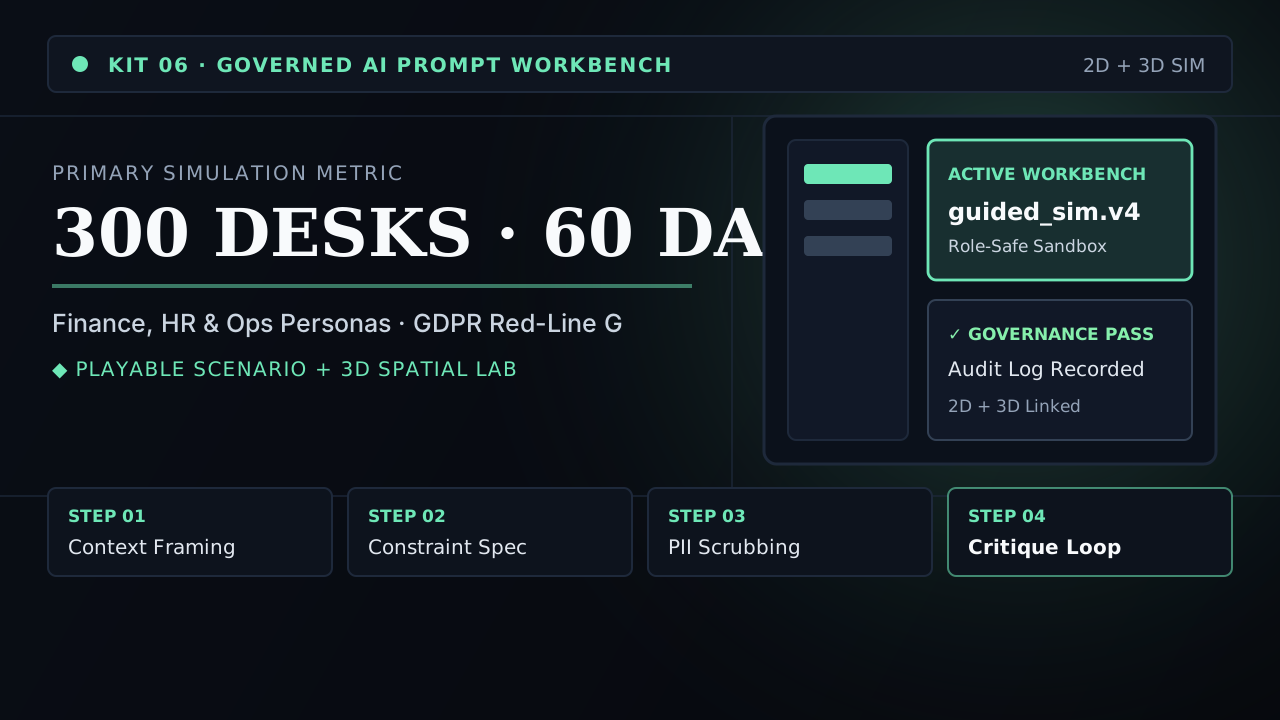
AI at Your Desk — Primary Build
The full kit: interactive trainer, manager pack and governance guardrails, launch-ready
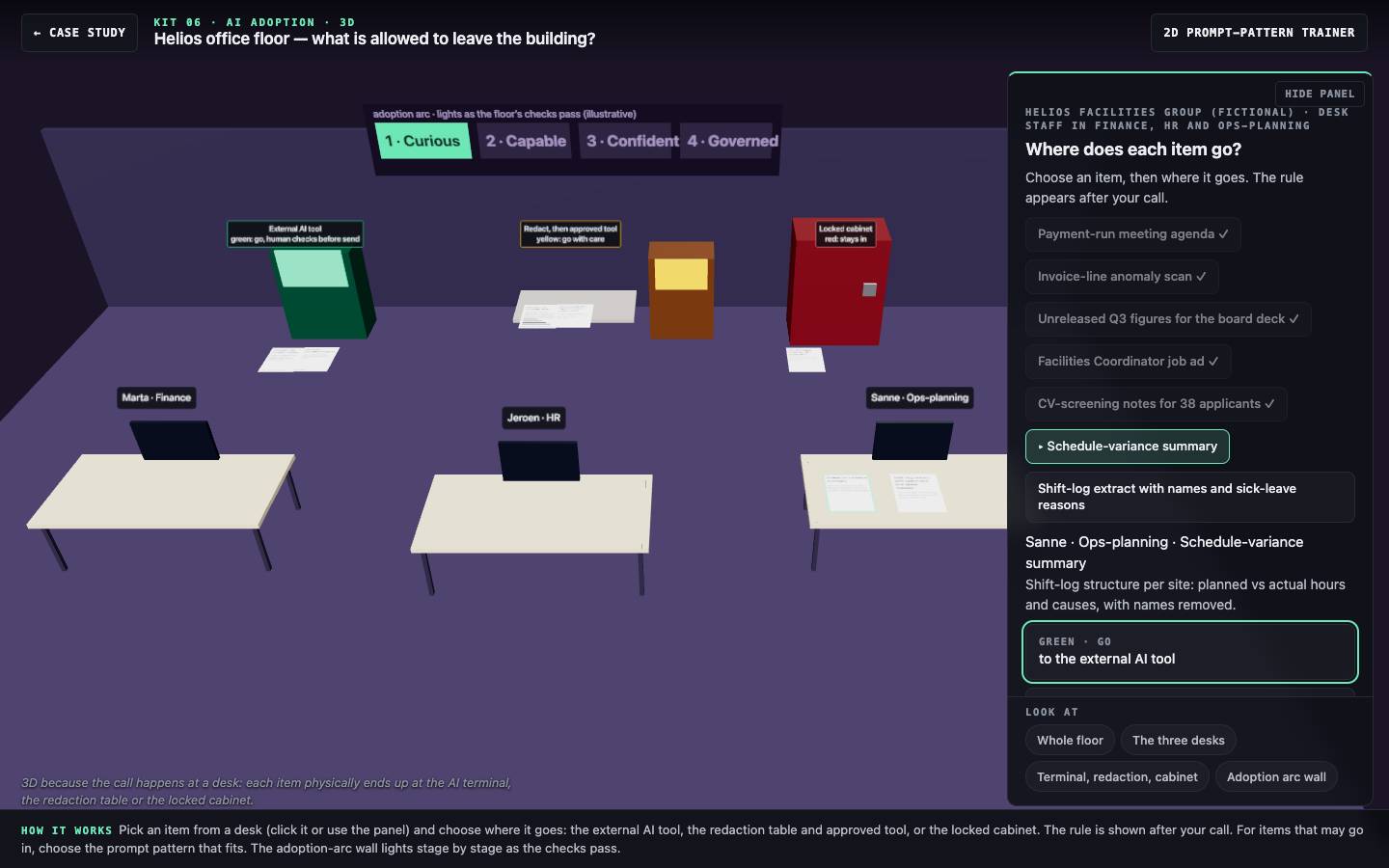
3D Helios office floor
Seven work items on three desks. Decide where each goes (external AI tool, redaction and approved tool, or the locked cabinet) before the rule is shown, then pick a prompt pattern.
Role-Matched Prompt Pattern Library
Four prompt patterns on your own desk’s tasks, then a desk check (traffic light before the rule) and a rewrite check.
Why conventional training failed the operational reality
Abstract adoption programs produce abstract adoption (zero). The honest baseline at Helios:
Every task here is real: Marta's 240-line anomaly scan, Jeroen's 38-CV screening, Sanne's 90-minute variance summary. If a training example doesn't map to one of their tasks, it gets cut.
Core diagnostic finding
In this fictional brief, desk staff had tried AI tools but had no governed habit, and the guidance they had was a policy PDF. The risky moments were small and frequent: pasting an export with bank details, a CV, or a shift log with sick-leave reasons into a public tool.
Adoption is not a course
Illustrative premise: desk employees — most have tried a chatbot once, none have a governed habit
Design Constraint → Build Rule: A 60-day arc with managers as co-deliverers cannot live in one module. The design had to produce artifacts managers actually use — huddle scripts, one-page guardrails — or the training would evaporate by week two.
Governance with teeth
Illustrative premise: Marta's weekly invoice-line scan — fatigue errors after hour 2
Design Constraint → Build Rule: Most AI guidance is vibes. Translating GDPR-aware rules into a traffic-light table an employee can apply with the two-second test, and a manager can enforce, took more iterations than any training content.
Personas without stereotypes
Illustrative premise: per CV for Jeroen — style drifts by CV #20, bias risk rises
Design Constraint → Build Rule: Finance, HR and Ops-planning work differently. Each persona needed real Monday-morning tasks inside the trainer, or the prompt patterns would teach nothing transferable.
The call happens at the desk
Performance problem
In this fictional company, 300 desk staff across Finance, HR and Ops-planning used AI tools ad hoc. Nobody could say which work items were allowed into which tool, and the trainer’s own HR example pasted CV content with no governance note.
Learners and context
General desk staff with real weekly tasks and no AI background; team leads run four 5-minute huddles, one per adoption stage.
Is training the answer? Not on its own
- Approved tool. Yellow work needs an approved internal tool; without one, people will use whatever is open.
- Exports. ERP and HR exports that strip bank details and names by default remove most yellow-to-red slips.
- Exceptions. A written DPO exception route for real business needs (such as CV screening) keeps people from improvising.
Alignment: every objective has practice, evidence, feedback and a route back to the job
| Objective | Practice | Assessment | Feedback | Transfer |
|---|---|---|---|---|
| LO1 Rewrite a vague request into a prompt with role, task, format and safe input | Rewrite check for your desk | 3 of 4 parts with the input right | Shows the assembled prompt and what failed | Printed cheat sheet for your desk |
| LO2 Choose the prompt pattern that fits a real task | 4 pattern checks; pattern step in the desk check | First-try answers; 1 point per fitting pattern | Why the pattern fits the task | Team habit picked in the first huddle |
| LO3 Classify a work item with the two-second test before it goes into a tool | Desk check: 7 items, light before the rule | 2 per light; any red item out fails | The rule and why, after the call | Governance one-pager at the desk |
Evidence register: what is real, what is invented
- Fictional premise Helios Facilities Group, Marta, Jeroen and Sanne, their tasks and hours.
- Illustrative values Before/after task times (for example 3.5 h → 1 h) are self-reported estimates from a fictional pilot.
- Design decision The seven items and their lights, pattern fits and scoring. The earlier trainer score counted retried answers, so everyone reached 12/12; it now counts first tries.
- Not measured Weekly use, breaches or time saved. The case page’s “6-huddle” and “gap radar” wording described things that do not exist; there are four huddles and no radar.
Measurable Performance Objectives
Three objectives; the rewrite check is the performance check for LO1, which earlier had only recognition questions.
Turn a vague request from your own desk into a prompt with a role, a specific task, a usable format and input that passes the two-second test.
Evidence in the build: the rewrite check, 3 of 4 with the input right.
Choose the prompt pattern that fits a real task.
Evidence in the build: first-try pattern checks and the pattern step of the desk check.
Classify a work item green, yellow or red with the two-second test before it goes into any tool.
Evidence in the build: seven items in the desk check; any red item out fails.
Why This Modality Won (Trade-Off Analysis)
Before committing to the final architecture, we evaluated and rejected lower-transfer alternatives against the workplace constraints:
Cheap, fast, and the default across the market. Rejected because awareness is not adoption: everyone completing it would still open the same three tools on Monday and use two of them badly. The unit of change is the task, not the awareness.
Concrete and demo-able. Rejected because tools churn — a year of tool-specific skill evaporates with the next vendor pivot. The program teaches persona-level patterns (draft-and-verify, summarize-and-check) that survive tool turnover.
A 60-day, four-stage adoption arc — Curious → Capable → Confident → Governed — taught through an interactive prompt-pattern trainer on the personas' real tasks, wrapped in manager huddle scripts and one-page guardrails with enforcement teeth (the traffic-light table).
Why call first
The rule after the decision
Showing the traffic-light rule next to each item turns classification into reading. Asking for the call first, then showing the rule, is the practice the desk needs.
Why rewrite
Recognition is not use
Picking the right prompt from three is recognition. Assembling one, including what you paste in, is closer to the Monday-morning task.
Why 3D here
Where the paper ends up
On the floor every item physically lands somewhere: the AI terminal, the redaction table or the locked cabinet. A red sheet at the terminal is hard to miss.
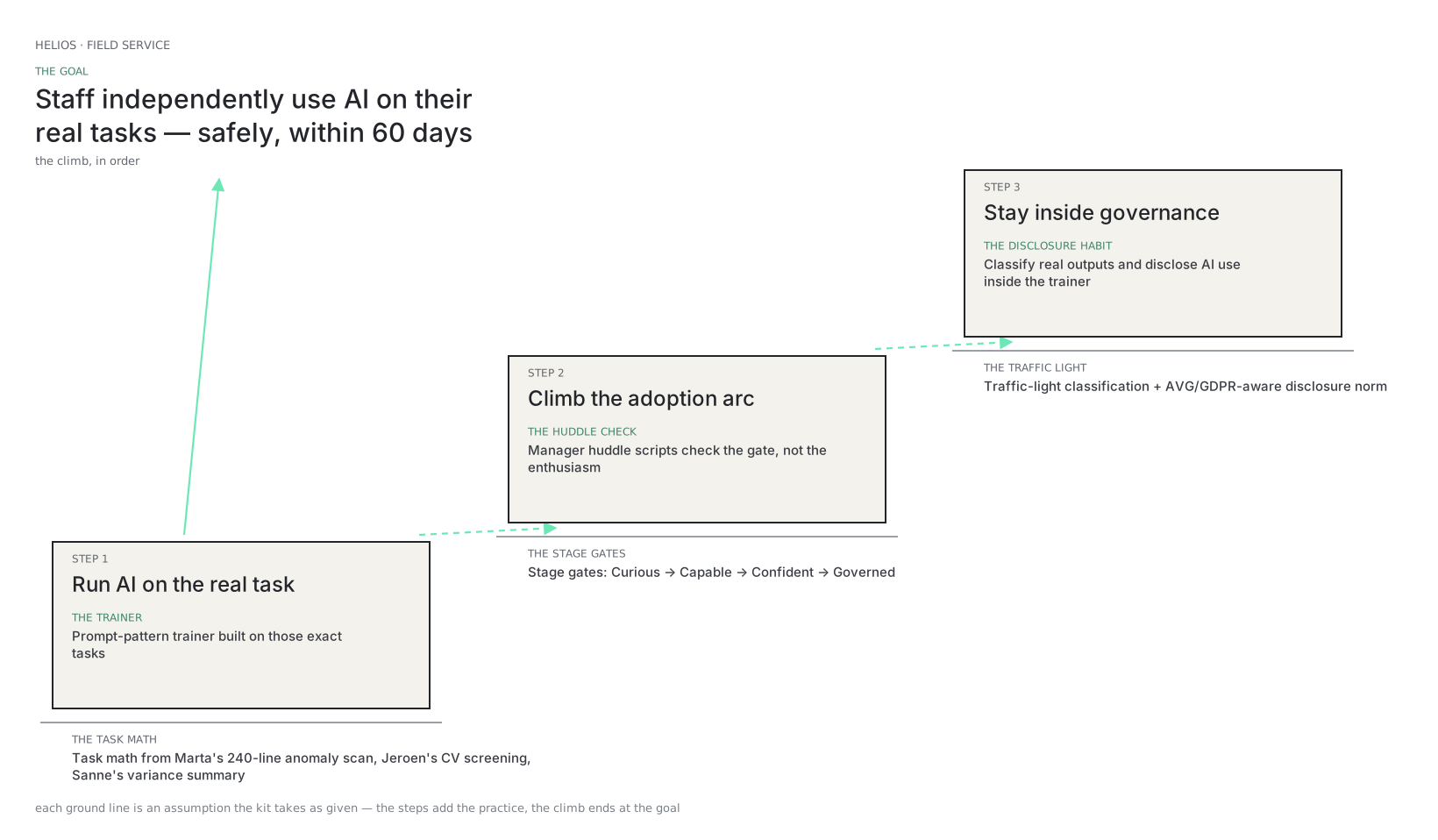
Production Sequence & Traceable Artifacts
From persona research to a 60-day adoption arc — the stages below link the working documents.
What would tell us it worked
A proposed plan. Nothing below has been measured.
| Question | Measure / instrument | When | What we would do with the answer |
|---|---|---|---|
| Do people classify before pasting? | Desk-check results; which item is misclassified most | Pilot with one team per department | If yellow exports go out unstripped, fix the export defaults before retraining |
| Can they write a usable prompt? | Rewrite-check pass rate per department | Same pilot | If the input part fails most, add a redaction example to the cheat sheet |
| Does a governed habit form? | Share of staff with a named weekly AI task by day 60; self-reported incidents | Day 60 | Target 60% (proposed); incidents are reviewed, not punished, per the governance page |
Instructional Design Takeaway
“Why this form wins: the problem is turning enthusiasm into governed weekly habits, so the solution anchors everything to three personas' task math — with stage gates and breach-incident count as the honest metrics.”
'Run AI training' was the request; the needs analysis reframed it. Three hundred desk workers did not need to know what AI is — they needed specific, governed AI habits inside their actual weekly tasks. The proposal was a 60-day adoption program built on three personas with task math: each persona gets named tasks (hours reclaimed, drafts accelerated, errors caught), stage gates, and a governed toolset — so adoption is measured in task-level behavior, not course completions.
Transparent Portfolio Scope
Honest limitation: fictional company and personas; time savings are self-reported estimates from a fictional pilot. The traffic-light rules are a teaching summary, not legal advice.