Pharmacy Double-Check Training: Errors vs Over-Flags
“Dispensing errors don't live in the scary prescriptions — they live in the routine ones.”
A written-check trainer with a twist: for every prescription, some error families are seeded, some are clean — and over-flagging a clean line costs you too. The scoring teaches discrimination, not paranoia: the audit rewards catching the real error AND clearing the correct prescription with confidence.
The Audience
Hospital pharmacy technicians in their first dispensary year — plus experienced techs as a calibration exercise in team huddles.
Responsibilities
Error-family analysis · scenario writing (seeded errors + decoys) · scoring design · over-flag penalty logic — the audit's mental model, made playable.
The Build
Scenario design · free-text keyword scoring · distraction/decoy architecture · AI-assisted drafting (disclosed)
How I used AI in this case
AI drafted prescription-line variants and error-family brainstorming lists, all re-seeded by hand; scenario construction, decoy architecture and over-flag scoring were designed by me. Disclosed.
The build itself, not a video about it — open it, make the calls, and read what each one costs.
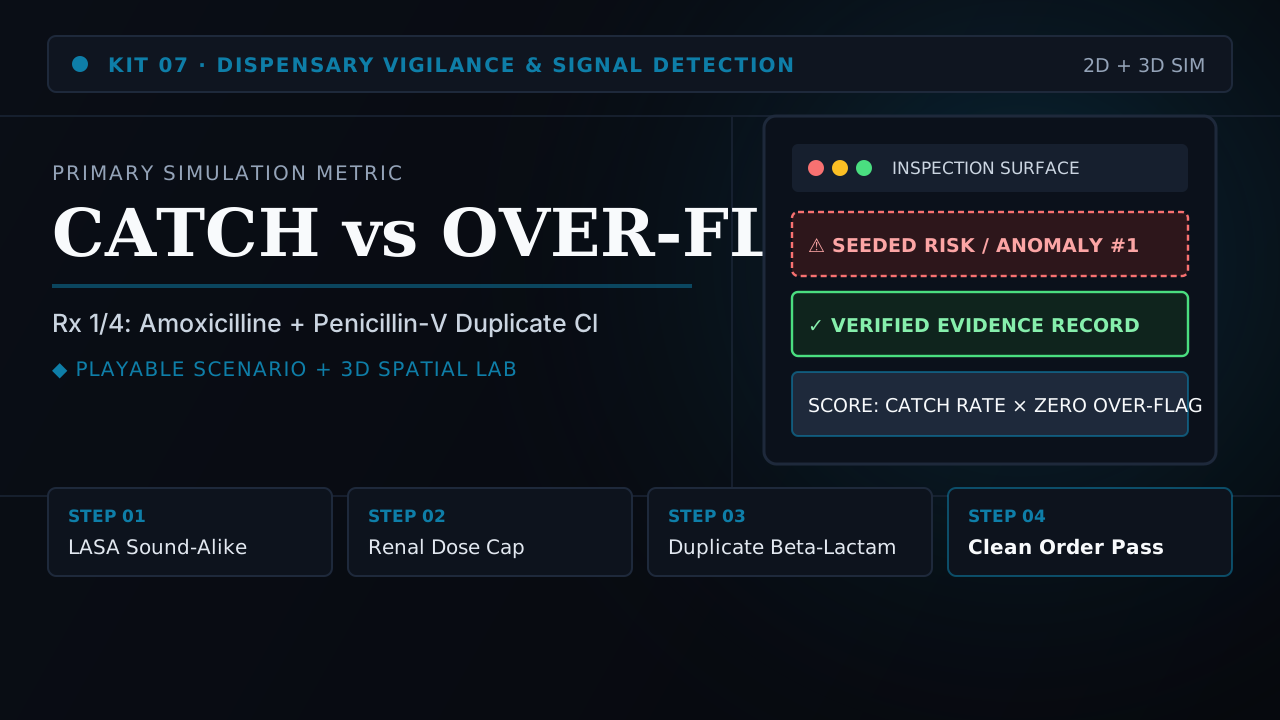
MedCheck — Primary Build
The full trainer: prescription queue, seeded errors, over-flag penalty, debrief
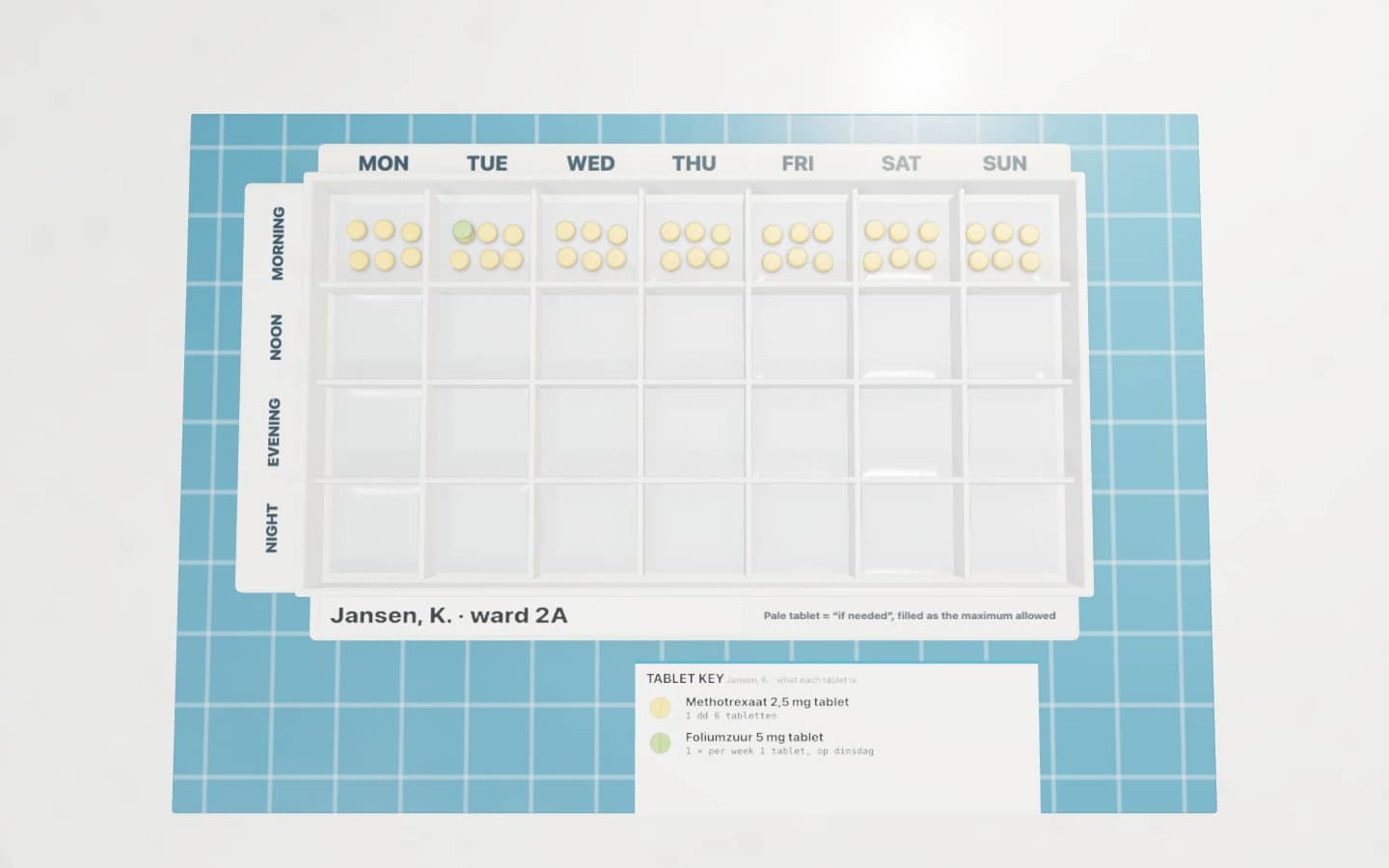
3D dosing week
At a bright hospital pharmacy bench, read the prescription and the chart card, then fill a real-size seven-day organiser and look at the week from above before you flag or clear it. Frequency errors and same-slot interactions show as tablets; the allergy only shows on the chart card. Over-flags cost minutes on the wall clock.
Scene-by-Scene Storyboard & UI Spec
Scene plan for the prescription queue and flag interactions before build. Full branching dialogue, distractor rationales, and visual system tokens.
Why conventional training failed the operational reality
The audit data shows the paradox clearly: technicians know the high-alert drugs cold — the failures cluster in prescriptions that look routine:
Training had taught what to check. It hadn't practiced catching yourself not checking — the moment the routine lull replaces the audit lens.
Core diagnostic finding
In this fictional brief the technicians know the high-alert drugs. The errors that get through are in scripts that read as routine line by line: a daily directive on a weekly drug, two penicillins, an allergy that is on the chart rather than the prescription. The check has to turn each line into what the patient will take, and clear clean scripts without fear.
Over-flagging must cost
Illustrative premise: scripts carry a seeded problem; each one reads as routine line by line
Design Constraint → Build Rule: Paranoid checking is its own error. The scoring penalizes flags on clean lines, teaching discrimination rather than fear — the audit's real mental model.
Seeded, not random
Illustrative premise: methotrexate tablets in one week from a daily directive: a known rule that a quick read misses
Design Constraint → Build Rule: Error families are seeded per prescription with clean decoys mixed in; every flag has a truth value the debrief can prove, so no scoring feels arbitrary.
Confidence as a skill
Illustrative premise: verbal double-check catch rate — written annotation forces the second look
Design Constraint → Build Rule: Clearing a correct prescription with confidence is scored as success — first-year techs must learn to trust a clean check, not just suspect a dirty one.
Routine-looking scripts, checked as a week rather than as lines
Performance problem
In this fictional hospital dispensary, audit findings cluster in prescriptions nobody thought were risky. New technicians either miss these or query everything, which slows the bench and teaches prescribers to ignore queries.
Learners and context
Hospital pharmacy technicians in their first year, plus experienced technicians in calibration huddles. They know the drug names and the high-alert list; checks happen at a busy bench with interruptions, so practice is short (about 10 minutes) and mirrors the real annotation.
Is training the answer? Not on its own
- Decision support. A weekly-only rule for oral methotrexate in the prescribing system would stop the most dangerous error before it reaches the bench. Recommended to the pharmacy informatics lead.
- Interruptions. If the final check happens while answering the phone, training cannot compensate. A protected check zone or a “do not interrupt” signal is a workflow fix.
- Query culture. Prescribers who brush off queries teach technicians not to send them. Feedback on queries, including unnecessary ones, should come from the pharmacist, without blame.
Alignment: every objective has practice, evidence, feedback and a route back to the job
| Objective | Practice | Assessment | Feedback | Transfer |
|---|---|---|---|---|
| LO1 Detect the problem line and its category in a routine-looking script | Five scripts with duplication, allergy, frequency and interaction problems; one clean | Flag 1 + line 1 + category 1 per script; releasing the allergy or the daily methotrexate is critical | Expected answer, why it passes a quick look, model annotation | “Fill the week” habit card at the bench (proposed) |
| LO2 Clear a clean script with confidence | The Visser refill: three ordinary lines | Clear = 3, any flag = 0; over-flags shown in audit minutes | Names the cost of a needless query | Pharmacist reviews one week of queries in the huddle (proposed) |
| LO3 Write an annotation a pharmacist can act on | Free-text annotation on every script | Not auto-scored: compared with a model answer (drug, reason, next step) | Model annotation shown next to the learner’s | Same three-part format as the real query slip |
Evidence register: what is real, what is invented
- Fictional premise De Bloemen Kliniek, its patients and its audit findings.
- Illustrative values Drug regimens are simplified teaching examples, not clinical guidance; the “4 audit minutes” per needless query is a design value.
- Design decision The 12 / 15 pass mark and the two critical prescriptions.
- Not measured Incident rates, catch rates or query rates. The earlier page quoted “2× incident rate” and “60% of methotrexate incidents” without a source; both were removed.
Measurable Performance Objectives
Three objectives, each with its own evidence. The pass rule needs 12 of 15 with neither critical prescription released.
Detect the line that carries the problem in a routine-looking prescription and name its category: duplication, dose or frequency, allergy on the chart, or interaction to confirm.
Evidence in the build: flag, line and category on four seeded scripts (3 points each).
Clear a correct prescription without a defensive query.
Evidence in the build: the clean script: 3 points for clearing, 0 and 4 audit minutes for a flag.
Write an annotation that names the drug, the reason and the next step.
Evidence in the build: free text compared with a model annotation (self-assessed, not auto-scored).
Why This Modality Won (Trade-Off Analysis)
Before committing to the final architecture, we evaluated and rejected lower-transfer alternatives against the workplace constraints:
Fits the existing compliance rhythm. Rejected because the exam format is the problem: verbal or multiple-choice checking does not transfer to the written annotation the audit actually requires. Quizzes check knowledge; the bench practices vigilance.
The obvious safety answer. Rejected because it is unscalable, builds dependence instead of discrimination, and exactly the dependence the written check is meant to remove. Supervision remains for high-alert drugs; the trainer covers the routine prescriptions where incidents breed.
A written-check trainer with a twist: for every prescription, some error families are seeded, some are clean — and over-flagging a clean line costs you too. The scoring teaches discrimination, not paranoia: the audit rewards catching the real error AND clearing the correct prescription with confidence.
Why worked contrasts
Four problems that look routine
Each seeded script is normal on its face. The learner has to change representation (lines → a week, prescription → chart) to see it. That shift is the skill, so it is what the practice repeats.
Why a clean script
Discrimination, not suspicion
Without a clean case the safest strategy is to flag everything. Scoring the clear decision makes the trainer measure judgment and puts a visible price on needless queries.
Why 3D here
A directive is a quantity over time
The organiser turns “1 dd 6 tabletten” into 42 tablets in a week next to one weekly folic-acid tablet. The allergy case deliberately looks normal in the organiser: the chart card is the only place it shows.
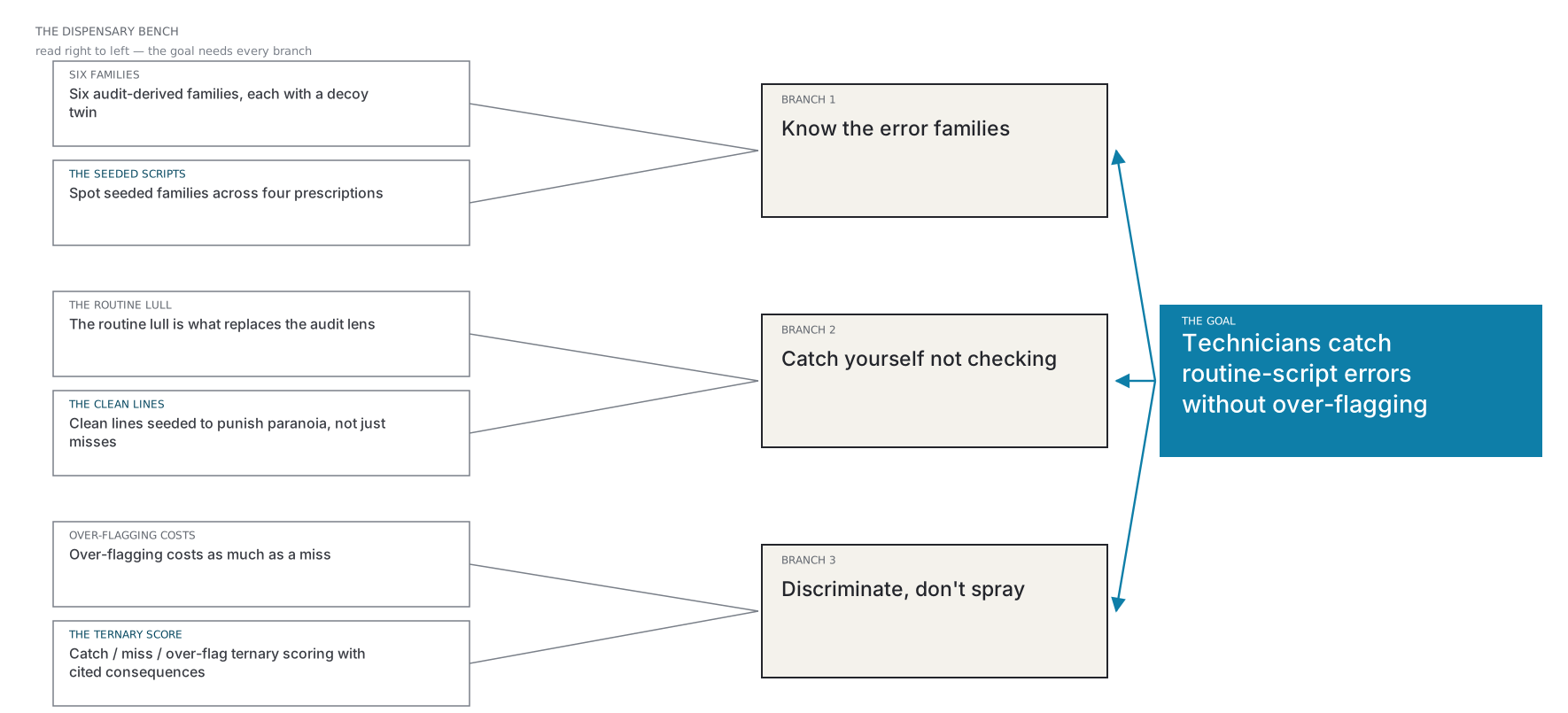
Production Sequence & Traceable Artifacts
The stages below show how the artifacts depend on each other. In this fictional case one designer produced all of them.
What would tell us it worked
A proposed plan. Nothing below has been measured, and no patient data would be used for a portfolio build.
| Question | Measure / instrument | When | What we would do with the answer |
|---|---|---|---|
| Do technicians find the problem line? | Line and category accuracy per script | Pilot with 6–10 first-year technicians | If the allergy case is missed by most, the chart card needs to be part of the standard check sequence in training |
| Are they calibrated? | Over-flag rate on the clean script next to critical misses | Same pilot | Fewer misses with more over-flags is not success; adjust feedback |
| Are annotations usable? | Pharmacist rates a sample of free-text annotations against the three-part model | Same pilot | If annotations are vague, add a structured query template to the bench |
| Does it change audit findings? | Dispensary audit findings by category, before and after | Next two audit cycles | Interpret with the pharmacy manager: decision-support changes would confound any training effect |
Instructional Design Takeaway
“Why this form wins: the problem is vigilance decaying inside routine, so the solution is the real artifact — the written check — practiced against real error families, with the over-flag penalty teaching discrimination instead of paranoia.”
Hospital pharmacy technicians pass the annual check-drug exam and still generate incident reports — clustered in prescriptions that look routine. The exam measures recall; the dispensary bench demands a written, attributable second look. So the proposal was a written-check vigilance trainer: four prescriptions with seeded error families and decoy-clean lines, scored on catches, misses AND over-flags — because paranoid flagging of correct prescriptions is also an audit failure.
Transparent Portfolio Scope
Honest limitation: five simplified prescriptions and fictional patients. Regimens are teaching examples, not clinical guidance. Real checking includes systems and pharmacist review this trainer does not model.