Vetting Adjudication: Weight the Pattern, Not the Story
“One vivid disclosure, one quiet pattern — adjudication is weighting, not counting.”
An evidence-weighting dossier: tag all twelve documents PATTERN / ISOLATED / CONTEXT with immediate contrast feedback, then commit — appointable with conditions or decline. The debrief scores your weight distribution against designed adjudication logic and names both failure modes by name.
The Audience
Screening and vetting adjudicators in trust-critical hiring — plus HR teams building defensible appointment cases.
Responsibilities
Document-family design · converging-evidence architecture · weight-scoring logic · trap calibration — adjudication as a distribution problem.
The Build
Evidence-weighting design · adjudication rubric · decoy calibration · AI-assisted drafting (disclosed)
How I used AI in this case
AI drafted document-family variants and candour phrasings for the dossier set; the converging-evidence architecture, weight-scoring logic and trap calibration were designed by hand. Edited, verified and disclosed.
The build itself, not a video about it — open it, make the calls, and read what each one costs.
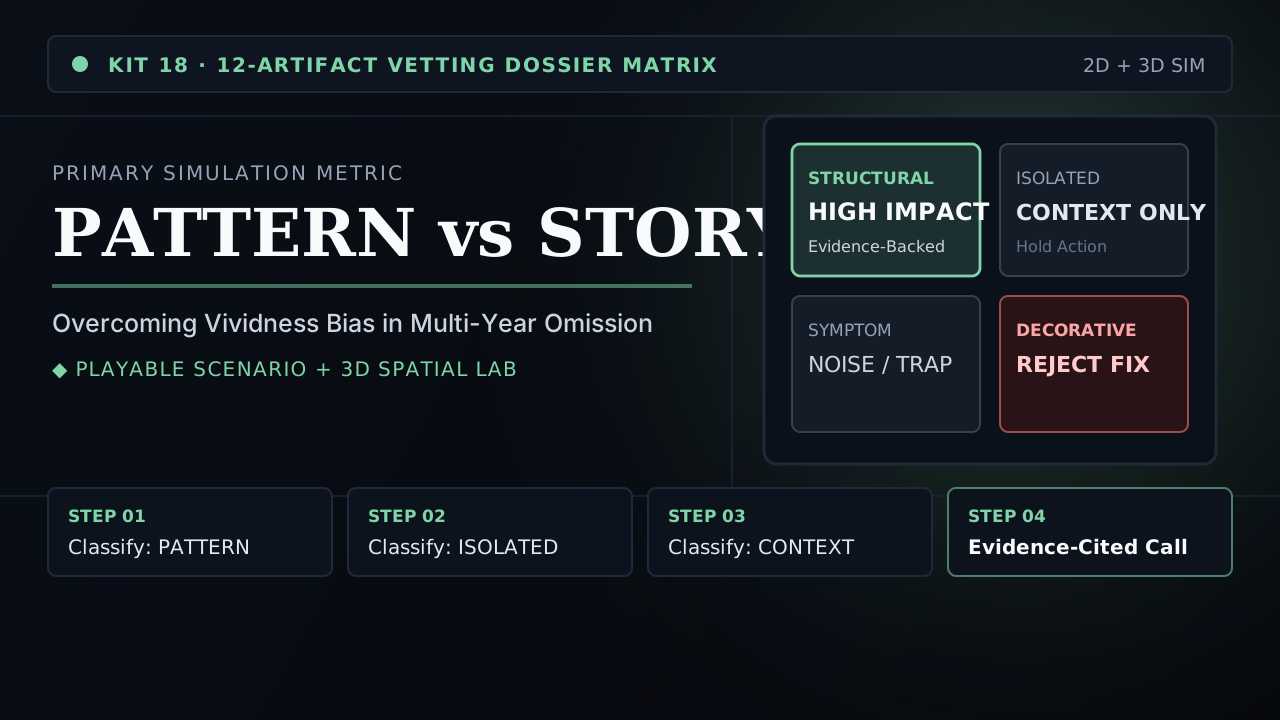
The Faithful Copy — Primary Build
The full dossier: twelve documents, contrast feedback, weight-distribution debrief

3D evidence wall
In a case room at the end of the afternoon, tag eleven documents on the wall and the disclosure letter under the desk lamp; dim the lamp if you want to, and watch pattern tags tie threads to the finding card. Then write the conditions or the reason.
Scene-by-Scene Storyboard & UI Spec
Scene plan: document families, tag feedback, verdict commit, before build. Full branching dialogue, distractor rationales, and visual system tokens.
Why conventional training failed the operational reality
Screening files mislead in a predictable direction: vivid, disclosed events recruit certainty; quiet, repeated omissions hide in plain sight. The designed file shows both:
Rules training produces rule-recall. Adjudication demands weighting: what counts as pattern, what stays isolated, what is merely context — and a verdict the committee can defend line by line.
Core diagnostic finding
In this fictional brief, adjudicators decided on the most vivid document in the file. A candid disclosure of a small, repaid offence pulled decisions towards decline, while a pattern of small self-presentation omissions across years went unweighted because no single item was dramatic. Weighting has to be practised document by document, and vividness has to be named.
Twelve documents, one distribution
Illustrative premise: versions of one "leadership certificate" across three application forms
Design Constraint → Build Rule: The evidence has to converge without a smoking gun: PATTERN, ISOLATED and CONTEXT tags must each matter to the verdict, or tagging becomes decoration.
Both failure modes are real
Illustrative premise: since the repaid train-ticket charge — disclosed, unsolicited, clean since
Design Constraint → Build Rule: Over-flagging an honest anomaly and under-flagging a rehearsed story must both cost. The debrief names each failure mode by name.
The commit is the lesson
Design premise: the verdict only counts if the conditions or the reason are written down
Design Constraint → Build Rule: Tagging is rehearsal; the appointable-with-conditions vs decline verdict is where judgment is scored — and conditions must be written, not clicked.
Weight converging evidence, not the most vivid page
Performance problem
In this fictional screening service, adjudications for trust-critical posts vary between adjudicators on similar files. Reviews show two failure modes: declining on a single dramatic disclosure, and appointing despite a pattern of small omissions.
Learners and context
Screening adjudicators and their team leads. Experienced with procedure and legal frameworks; less practised at weighting mixed evidence explicitly. About 15 minutes, followed by a calibration discussion with a second adjudicator.
Is training the answer? Not on its own
- Second-reader review. A second adjudicator reading the same file blind is the strongest control against vividness bias. Recommended for trust-critical posts.
- File order. Files that open with the candidate’s own disclosure prime the reader. Ordering documents by type rather than by arrival is a process change.
- Conditions follow-up. Conditions only work if someone checks them at six months. That needs an owner, not a training module.
Alignment: every objective has practice, evidence, feedback and a route back to the job
| Objective | Practice | Assessment | Feedback | Transfer |
|---|---|---|---|---|
| LO1 Weight each document as pattern, isolated or context | Twelve documents; verdict locked until all are tagged | 1 point per document weighted as designed | “Weighted” or “re-read” with the reasoning, after each tag | Weight language (pattern / isolated / context) in real case notes |
| LO2 Resist a vivid single event | The disclosure letter, under the desk lamp in 3D | Counting it as pattern fails the reading | Names vividness as the trap | Second-reader review (recommended) |
| LO3 Write conditions or a reason that address the pattern | Free text after the verdict | Required (≥ 10 words); compared with model conditions | Model conditions shown next to yours | Six-month condition check with a named owner (recommended) |
Evidence register: what is real, what is invented
- Fictional premise KBS screening service, candidate “A. Brandt” and all twelve documents.
- Design decision The document key, the sound-reading rule and the 12 / 15 pass mark.
- Not measured Adjudication consistency or outcomes. Earlier targets on this page (70% here, 80% in the action map) were targets and disagreed; both are now stated as proposals in the evaluation plan.
Measurable Performance Objectives
Three objectives. The written-conditions step was described before but not built; it is now required.
Weight each of twelve vetting documents as pattern, isolated or context.
Evidence in the build: one point per document weighted as designed.
Keep a vivid, candid disclosure from outweighing a converging pattern.
Evidence in the build: the sound-reading rule (the disclosure counted as pattern fails it).
Write conditions for an appointment, or a reason for a decline, that address the pattern found.
Evidence in the build: required free text, compared with model conditions.
Why This Modality Won (Trade-Off Analysis)
Before committing to the final architecture, we evaluated and rejected lower-transfer alternatives against the workplace constraints:
The standard response to every adjudication concern. Rejected because the officers knew the rules — the designed trap in the file (the vivid repaid ticket against the curated certificate pattern) defeats rule knowledge by definition: nothing in the file breaks a rule outright.
Rich and honest. Rejected as the core format because panels distribute judgment — each officer can hide inside the consensus. The dossier forces an individual weighting and verdict, which is what committees actually need each member to be able to defend.
An evidence-weighting dossier: tag all twelve documents PATTERN / ISOLATED / CONTEXT with immediate contrast feedback, then commit — appointable with conditions or decline. The debrief scores your weight distribution against designed adjudication logic and names both failure modes by name.
Why tag everything first
Weighting before verdict
Locking the verdict until every document is tagged forces the reader to meet the quiet documents before the conclusion forms, which is where the pattern lives.
Why a vivid decoy
Vividness is not weight
The disclosure letter is the most memorable page and the least diagnostic. Making it the obvious candidate for a wrong tag puts the bias where it can be named in feedback.
Why 3D here
A light you can dim
The letter lies under a warm desk lamp while the daylight on the wall fades, and the learner can dim the lamp. Pattern tags become threads meeting at one finding card. Bias and convergence become visible and controllable.
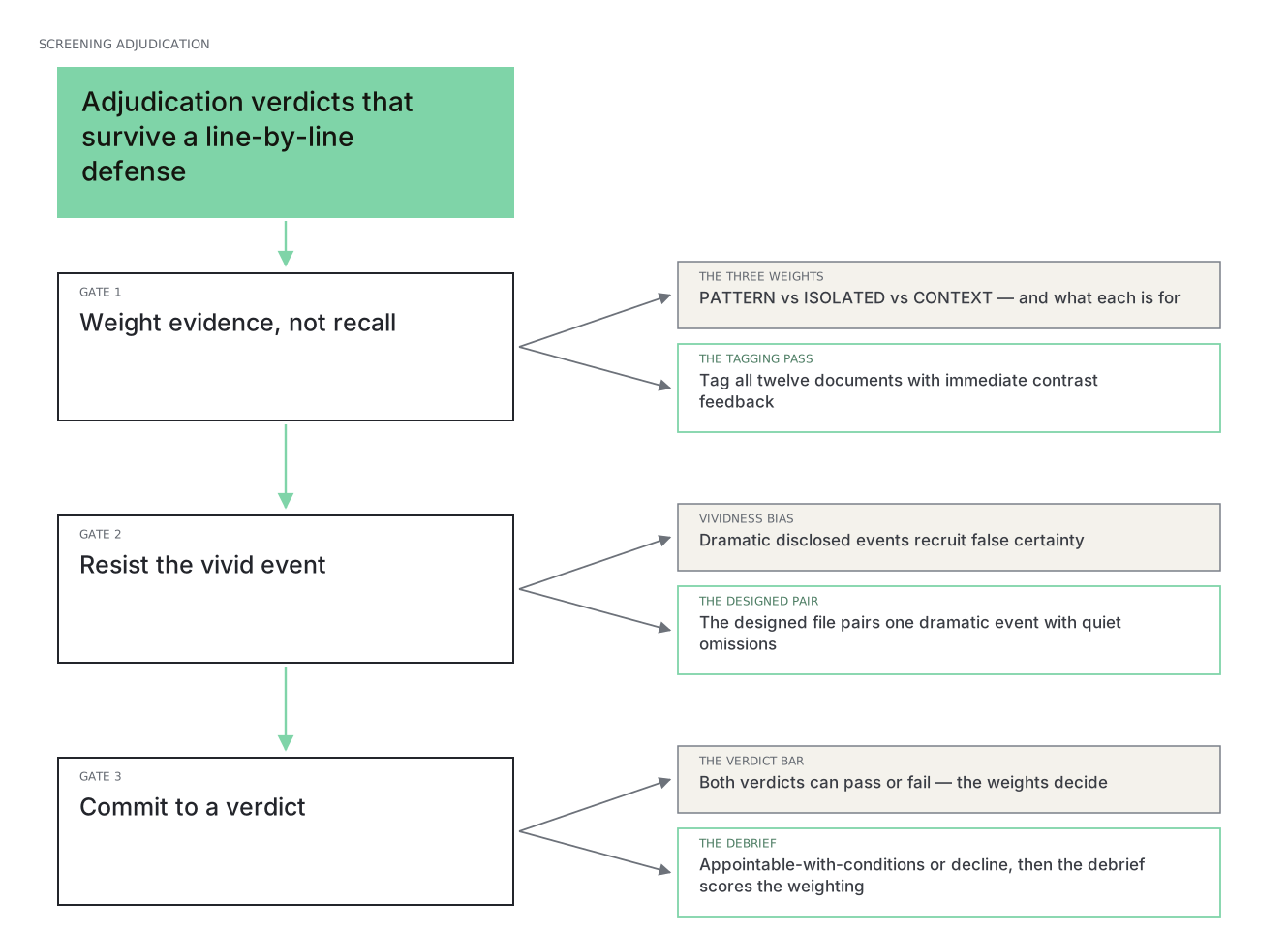
Production Sequence & Traceable Artifacts
The stages below show how the artifacts depend on each other. In this fictional case one designer produced all of them.
What would tell us it worked
A proposed plan. Nothing below has been measured.
| Question | Measure / instrument | When | What we would do with the answer |
|---|---|---|---|
| Do adjudicators weight consistently? | Agreement between two adjudicators’ tags on the same file | Pilot with 6 adjudicators in pairs | Documents with low agreement need clearer feedback or are genuinely ambiguous; discuss in calibration |
| Is the vivid trap still sprung? | Share tagging the disclosure as pattern, with and without the desk lamp dimmed (3D) | Same pilot | If dimming changes tags, bring “read in type order” into the real process |
| Do real case notes change? | Sample of case notes for weight language and written conditions | 1 and 3 months | Target to agree with the team lead (proposed: most notes use weight language) |
Instructional Design Takeaway
“Why this form wins: the problem is weighting under vividness bias, so the solution scores the distribution instead of the outcome — and dismantles the vivid-disclosure trap explicitly, by name, in the debrief.”
Screening files mislead in a predictable direction: one vivid, disclosed event recruits certainty while a quiet pattern of small omissions hides in plain sight. Rules training cannot fix that — the failure is weighting, not rule knowledge. The proposal was an evidence-weighting dossier: twelve documents tagged PATTERN / ISOLATED / CONTEXT, then a verdict — scored on the weight distribution against designed adjudication logic, so a defensible outcome reached on wrong reasoning still fails.
Transparent Portfolio Scope
Honest limitation: one designed file with a key. Real files have no answer key, and the legal framework for screening decisions is out of scope.