E-Learning Scene Budgeting: Teach or Decorate?
“A classroom day becomes e-learning on a Friday deadline — and the easy path is polished click-next.”
A lesson-scene builder with a budget: eight scene types cost 0–3 learner-effort points (overspending is refused), three module briefs each have a required scene and their own failure rules — video-heavy refreshers, scenarios buried after theory, hotspot repetition — and every placement gets an instant TEACHES or DECORATES verdict.
The Audience
Government academy course teams converting classroom days to e-learning — plus ID teams calibrating what 'engaging' means.
Responsibilities
Interaction-type analysis · effort-budget design · brief-specific rule engine · debrief writing — a conversion philosophy made playable.
The Build
Scenario design · budget mechanics · branching feedback · AI-assisted drafting (disclosed)
How I used AI in this case
AI drafted scene-placement commentary variants and brief wording; the interaction-type analysis, the per-brief rule engine and the verdict design were authored by me. Edited, verified and disclosed.
The build itself, not a video about it — open it, make the calls, and read what each one costs.
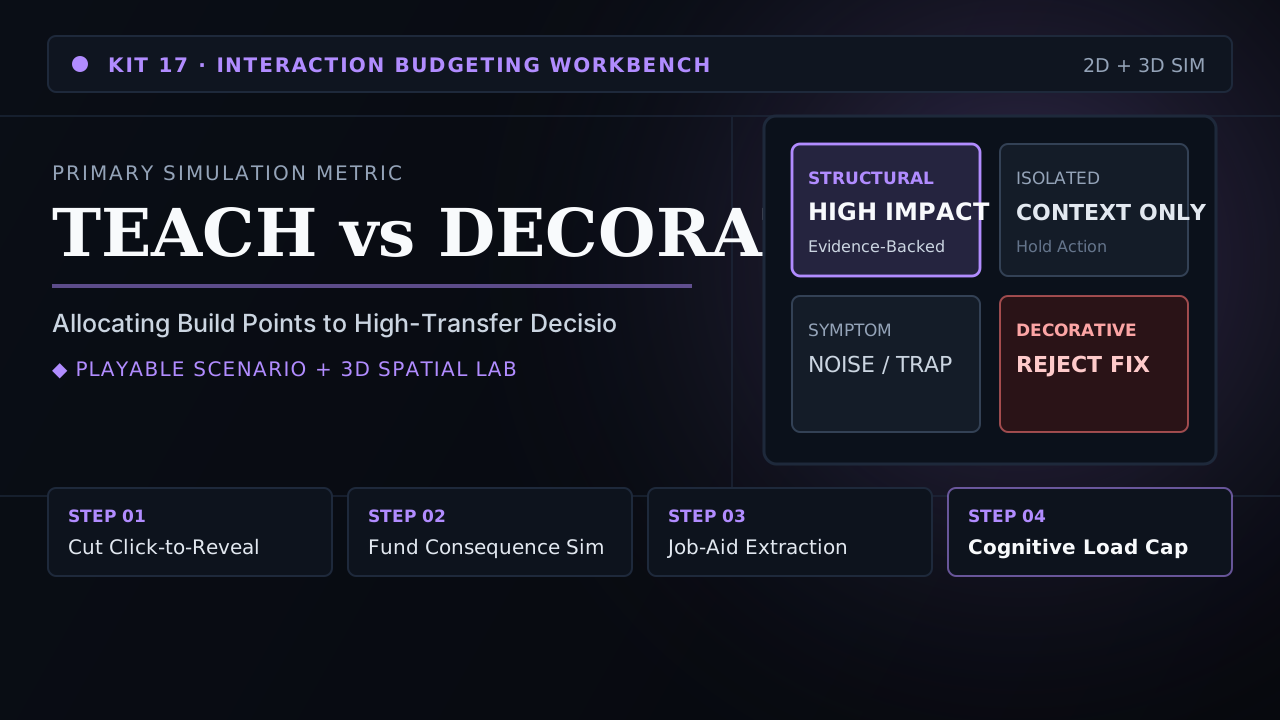
Screen Nine — Primary Build
The full builder: three briefs, rule engine, budget, verdict debrief
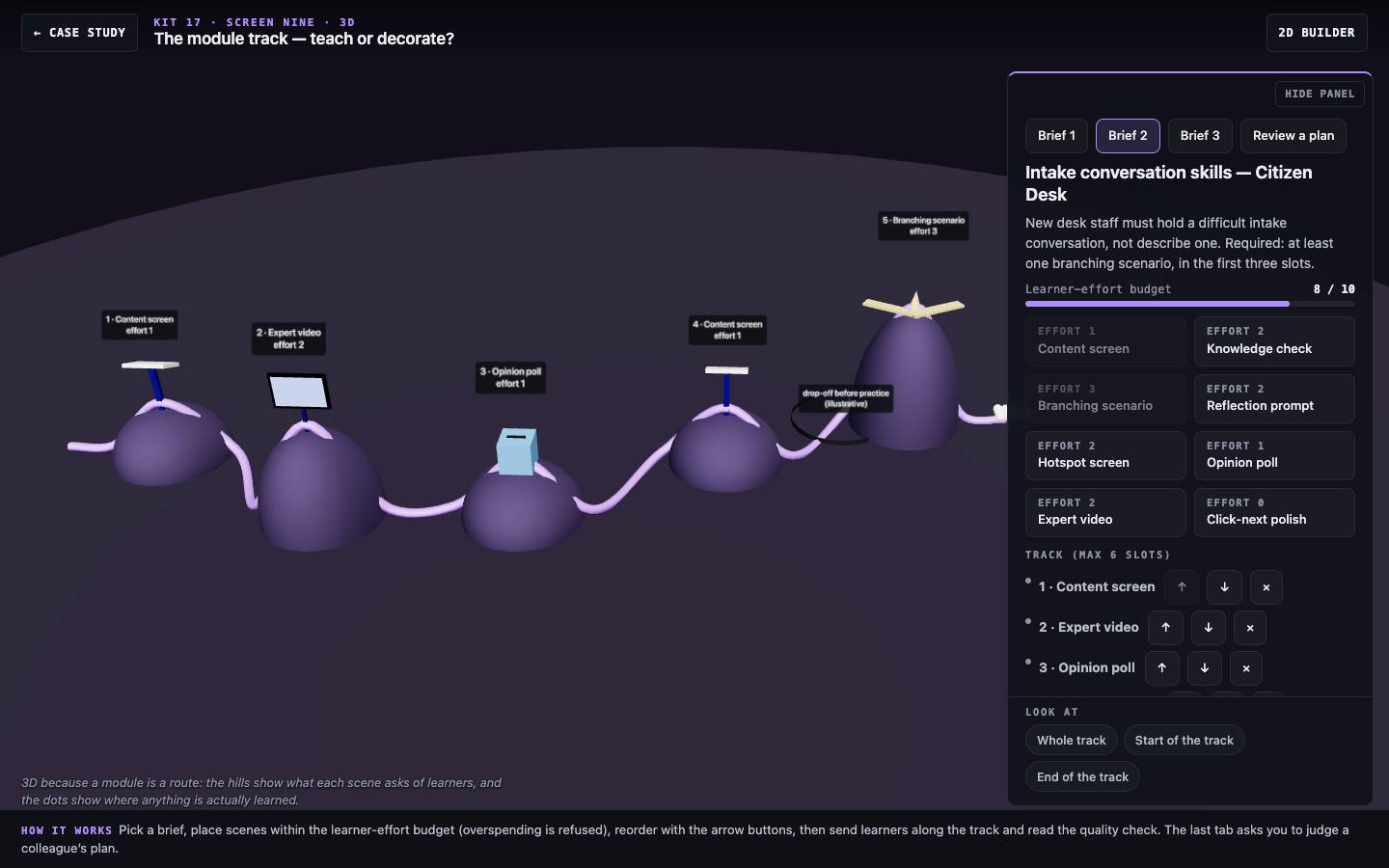
3D module track
Place scenes within the learner-effort budget and send learners along the track. Dots brighten only at teaching stations; in the intake brief a late scenario sits behind an illustrative drop-off.
Scene-by-Scene Storyboard & UI Spec
Scene plan: three briefs, budget rounds, verdict moments, before build. Full branching dialogue, distractor rationales, and visual system tokens.
Why conventional training failed the operational reality
Conversion projects fail in a predictable way: the source day is well-rated, the deadline is Friday, and the module ships as presentation with clicks. Completion looks fine — nothing was asked of anyone:
Training had taught what e-learning tools exist. It never practiced the judgment call on every single screen — does this interaction make learners think, or just keep them busy?
Core diagnostic finding
In this fictional academy the conversion teams knew what a scenario was. Under a Friday deadline they still produced click-next modules with a video and a poll “for engagement”. The missing skill was judging each screen by what it asks the learner to do, and spending a limited effort budget on that.
Effort must mean something
Illustrative premise: learner effort spent by click-next polish — cost: free
Design Constraint → Build Rule: Eight scene types priced 0-3 points: the budget only teaches if the prices reflect real production effort, so the rule engine encodes actual conversion economics.
Every brief fails differently
Illustrative premise: place the knowledge check opens — a pre-test, not a quiz at the end
Design Constraint → Build Rule: Video-heavy refreshers, scenarios buried after theory, hotspot repetition: each module brief needed its own failure rules, not a generic quality score.
Verdicts, not vibes
Design premise: see the design brief below for the constraint this rule answers
Design Constraint → Build Rule: Every placement gets an instant TEACHES or DECORATES verdict with a reason — the debrief names the conversion philosophy behind the rules.
Spend learner effort on screens that make people think
Performance problem
In this fictional government academy, classroom days are converted to e-learning on short deadlines. The resulting modules are polished but passive: content pages, expert videos, polls and a quiz at the end. Desk staff complete them and still cannot hold the conversation or classify the document.
Learners and context
Course teams (trainers, ID staff, subject experts) who convert their own classroom material. They know the content well and are new to designing interaction. A 15-minute builder they can use while planning a real conversion.
Is training the answer? Not on its own
- Deadlines. If a classroom day must become e-learning in a week, click-next is the rational choice. The academy should budget conversion time per module type.
- Authoring tools and templates. If the template only offers content, video and quiz pages, teams will build those. A scenario template lowers the cost of the right choice.
- Review step. A short scene-plan review before production (the judge-a-plan round, done for real) catches decoration when it is cheapest to remove.
Alignment: every objective has practice, evidence, feedback and a route back to the job
| Objective | Practice | Assessment | Feedback | Transfer |
|---|---|---|---|---|
| LO1 Classify each scene type as teaching or decorating, and say why | Eight scene types placed in three briefs | Instant verdict per placement; quality check on the whole build | TEACHES / DECORATES with the reason | Scene-plan template with the eight types (proposed) |
| LO2 Judge a colleague’s plan against the brief | Review round on an intake draft | Three questions, 0–3 | Explains decoration, placement and verdict | Peer scene-plan review before production (recommended) |
| LO3 Build within a learner-effort budget so practice comes early | Budget refusal, reorder buttons, brief rules | STRONG requires no failed rule | Brief-specific rule notes; in 3D, the drop-off before late practice | Conversion checklist: “first practice by slot 3” |
Evidence register: what is real, what is invented
- Fictional premise Rijksacademie, its briefs and its desk staff.
- Design decision Effort costs, budgets, failure rules and the STRONG criteria.
- Illustrative values The 3D drop-off before a late scenario (some learner dots fall away) is a visual premise, not completion data.
- Not measured Module quality or learner outcomes. Earlier figures on this page (“≥80% of rebuilt modules…”) were targets.
Measurable Performance Objectives
Three objectives. LO2 (judging a plan) was listed before but never assessed; it now has its own round.
Classify a scene type as teaching or decorating and give the reason.
Evidence in the build: a verdict on every placement and the quality check on the whole module.
Judge a colleague’s scene plan against its brief and recommend ship, rework or scrap.
Evidence in the build: the review round (3 questions).
Build a module within a learner-effort budget with practice in the first three slots where the brief needs it.
Evidence in the build: the budget refusal and brief rules; STRONG only if no rule fails.
Why This Modality Won (Trade-Off Analysis)
Before committing to the final architecture, we evaluated and rejected lower-transfer alternatives against the workplace constraints:
What the deadline always produces. Rejected because the template IS the failure: it optimizes polish per hour, and polish per hour is exactly what the converted modules already have too much of. A shinier version of the wrong form is still the wrong form.
Useful skills, honestly. Rejected as the fix because tool skill does not make the teach-or-decorate call — the converted modules were already built by people who knew the tools. The judgment layer above the toolbar was the gap.
A lesson-scene builder with a budget: eight scene types cost 0–3 learner-effort points (overspending is refused), three module briefs each have a required scene and their own failure rules — video-heavy refreshers, scenarios buried after theory, hotspot repetition — and every placement gets an instant TEACHES or DECORATES verdict.
Why one budget
Learner effort, not production effort
Calling the same number “effort” in two senses hid the point. The budget is the learner’s attention; decoration costs it without returning learning, and click-next costs nothing and returns nothing.
Why rules per brief
Good design depends on the goal
A refresher needs retrieval, a conversation skill needs early practice, classification needs the learner’s own documents. The same scene can be fine in one brief and a failure in another.
Why 3D here
A module is a route
Hills show what each screen asks; learner dots brighten only where they do something. A late scenario is visibly behind a drop-off, so placement becomes something you see rather than a rule you read.
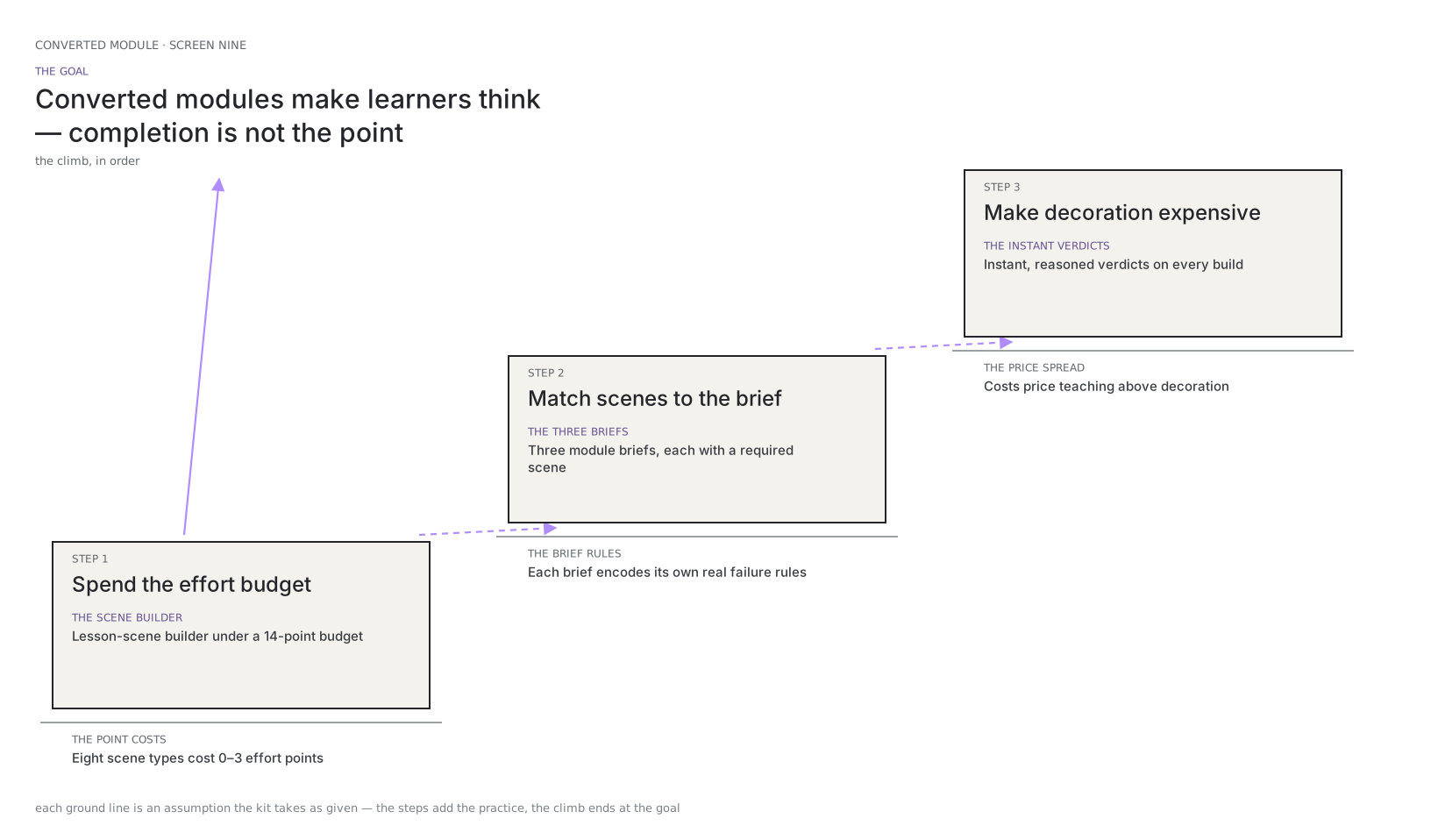
Production Sequence & Traceable Artifacts
The stages below show how the artifacts depend on each other. In this fictional case one designer produced all of them.
What would tell us it worked
A proposed plan. Nothing below has been measured.
| Question | Measure / instrument | When | What we would do with the answer |
|---|---|---|---|
| Can teams tell teaching from decorating? | Verdict accuracy in the review round; share of STRONG builds per brief | Pilot with two course teams | If the intake brief is rarely STRONG, the early-practice rule needs a worked example |
| Do real scene plans change? | Scene plans submitted for the next three conversions: practice scenes and their slot | Next quarter | Review with the academy lead; plans are the evidence, not the builder score |
| Do learners do better? | Performance on the conversation or classification task after the converted module | After the first converted module runs | Compare with the previous click-next version where one exists |
Instructional Design Takeaway
“Why this form wins: the problem is a design decision repeated on every screen under time pressure, so the solution prices that decision into a builder — the budget exposes which kind of interaction you actually believe in.”
Government academies convert classroom days under deadline, and the standing answer is a polished click-next module — completion looks fine, nothing was asked of anyone. The proposal was a lesson-scene builder with an engagement budget: eight scene types priced by learner effort, three module briefs with their own failure rules, and every placement scored on one lens — does this interaction teach, or decorate? The budget makes the design philosophy physical: decoration is free, teaching costs points.
Transparent Portfolio Scope
Honest limitation: eight scene types and three briefs simplify real conversion work. The verdicts are rules of thumb; a good designer can make a video teach.