Docent Conversation Training: Four Visitor Types
“Docents memorise the catalogue and still freeze when a child asks if the painter used a photo.”
A conversation trainer built on four visitor archetypes, each with three docent moves: the best (joins the visitor's actual move), the plausible (correct content, wrong posture), and the tempting failure (manages instead of meets). Feedback names the behavioral principle, never just the ranking.
The Audience
New museum docents (volunteers, mixed ages) at a mid-size art museum — plus education staff redesigning their volunteer training around conversation rather than content delivery.
Responsibilities
Visitor-archetype research · conversation design · distractor crafting (the plausible-but-wrong docent move) · scoring rubric — joining behavior made visible and trainable.
The Build
Branching scenario design · archetype modelling · feedback writing with behavioral rationale · AI-assisted drafting (disclosed)
How I used AI in this case
AI drafted visitor-dialogue variants for the four archetypes; archetype research, distractor crafting and the behavioral-rubric feedback were authored by me. Edited, verified and disclosed.
The build itself, not a video about it — open it, make the calls, and read what each one costs.
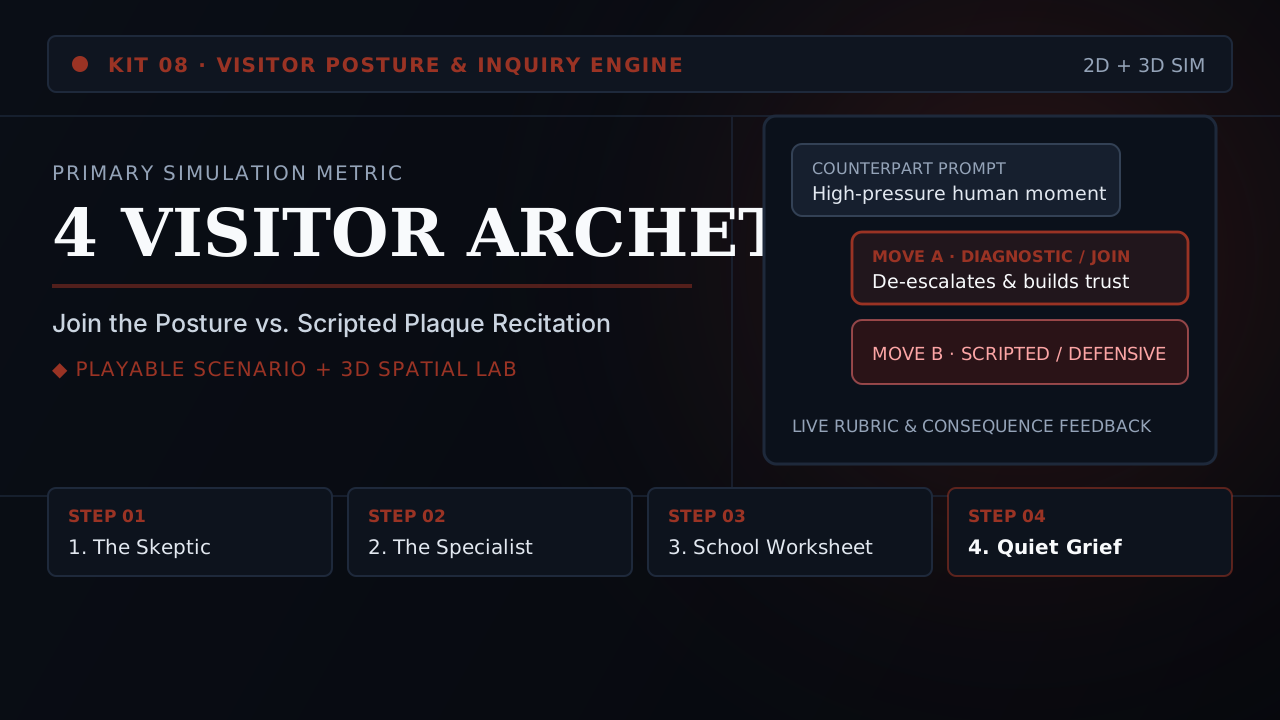
Gallery Hours — Primary Build
The full trainer: four archetypes, three moves each, principle-naming feedback
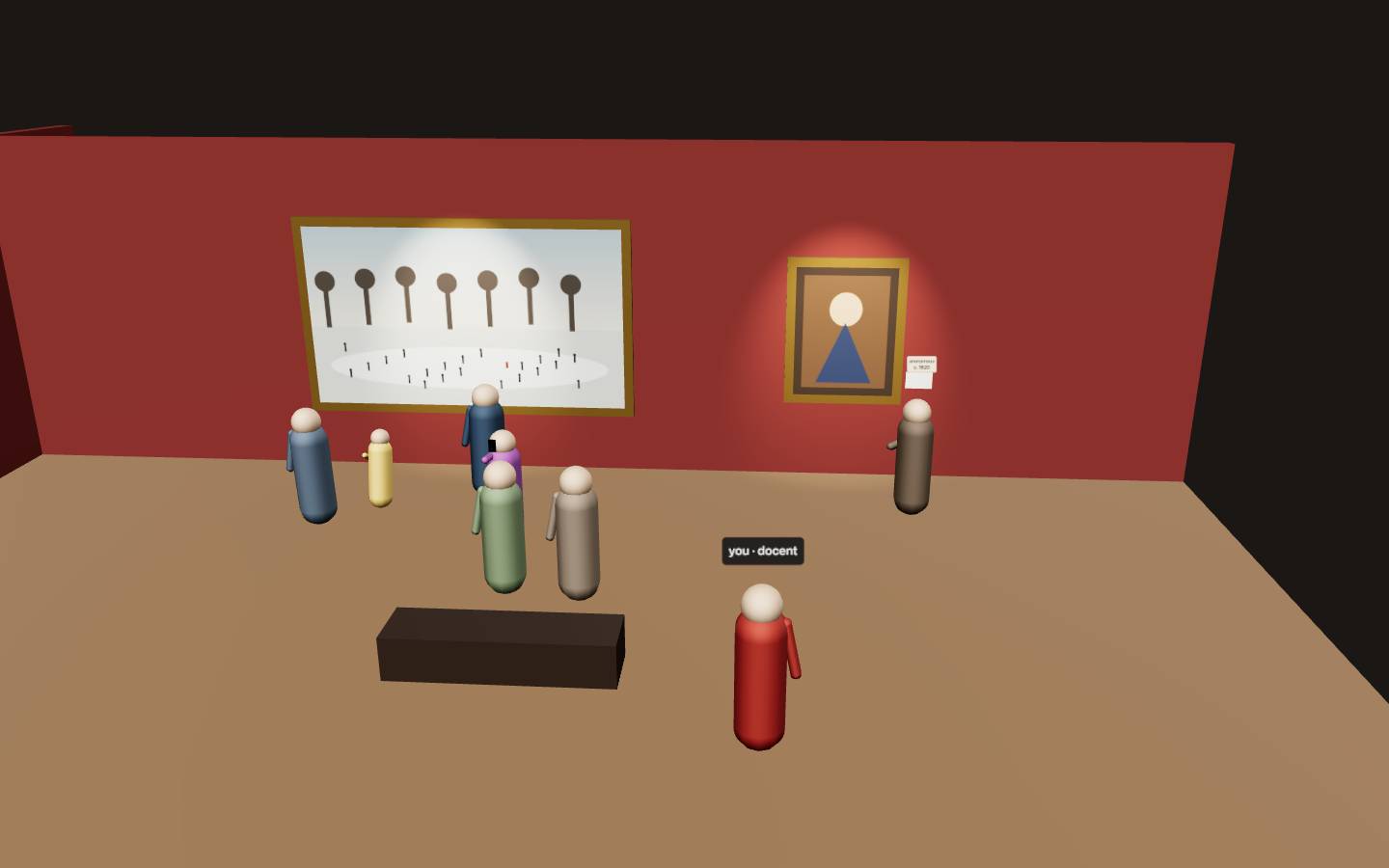
3D gallery floor
Walk to each of four visitors, read their move from body language, then reply. They step closer, stay or turn away; the floor map shows what you joined and what you managed.
Scene-by-Scene Storyboard & UI Spec
Scene plan: four archetypes, three moves each, before build. Full branching dialogue, distractor rationales, and visual system tokens.
Why conventional training failed the operational reality
Docent training covers the collection thoroughly and the visitors not at all. The gaps show up in the galleries:
The training gap isn't knowledge; it's a lens: seeing what move the visitor is making (curiosity, expertise, project, mourning) and joining it — instead of delivering the memorised talk.
Core diagnostic finding
In this fictional brief, docent training covered the collection and not the visitors. The difficult moments were never about facts: a child’s question, an expert’s challenge, a phone in the sightline, someone grieving. Each visitor is making a move; the docent has to see it before deciding what to say.
Correct content, wrong posture
Illustrative premise: questions get corrected instead of answered — the family leaves
Design Constraint → Build Rule: The plausible move knows the painting and misses the visitor. Writing content-accurate distractors was harder than writing failures — they must be genuinely good docenting, one posture away.
Archetypes without caricature
Illustrative premise: get managed as threats instead of recruited as allies
Design Constraint → Build Rule: Four visitor types must feel like Saturday visitors, not demographics; each needs a genuine motivation the docent can join rather than manage.
Feedback names the principle
Illustrative premise: gets deflected — the moment the visit was actually for
Design Constraint → Build Rule: Ranking moves teaches obedience; naming the behavioral principle — meet before manage — teaches judgment that transfers to the next visitor.
Read the visitor’s move, then join it
Performance problem
In this fictional museum, visitor comments and docent self-reports describe the same pattern: knowledgeable docents lecture, correct or manage, and visitors leave conversations early. The hardest moments, grief in particular, are the ones docents avoid.
Learners and context
New and volunteer docents, many retired professionals with deep subject knowledge. Comfortable presenting, less practised at reading people. The trainer takes about 10 minutes and is meant for a pre-shift huddle.
Is training the answer? Not on its own
- Debrief time. Conversations with grieving visitors stay with docents. A short, regular debrief with the volunteer coordinator matters more than any module.
- Floor design. If filming visitors block the main work every Saturday, a marked filming spot is a cheap fix.
- Feedback loop. The mystery-visitor programme should feed back to individual docents, not only to management, or it becomes a judgement rather than a practice tool.
Alignment: every objective has practice, evidence, feedback and a route back to the job
| Objective | Practice | Assessment | Feedback | Transfer |
|---|---|---|---|---|
| LO1 Read the visitor’s move from what they do and say | Four visitors with body-language cues | 1 point per visitor | Names the move when it is misread | One-word pre-speech check: “which move?” |
| LO2 Join the move before redirecting it | Three replies per visitor: join, plausible, manage | 2 / 1 / 0 | Names the posture behind each reply; in 3D the visitor steps closer or turns away | Mystery-visitor observation (proposed) |
| LO3 Stay with a grieving visitor | The woman at the ice | Managing her away fails the shift | Explains why presence beats redirection | Debrief with the coordinator after hard conversations (recommended) |
Evidence register: what is real, what is invented
- Fictional premise Museum Het Noorderlicht, its docents and its visitor comments.
- Design decision The four archetypes, the scoring and the critical grief rule.
- Not measured Visitor satisfaction or docent behaviour. A “docent-council pilot” quote on the earlier page described a pilot that never happened.
Measurable Performance Objectives
Three objectives. The reading step is new: the earlier build went straight to replies, so the lens it named (see the move) was never assessed.
Read the move a visitor is making — curiosity, expertise, a project, mourning — from what they do and say.
Evidence in the build: the read step for each of four visitors (1 point each).
Reply in a way that joins that move before redirecting it.
Evidence in the build: the reply (2 / 1 / 0).
Stay present with a grieving visitor instead of moving them on.
Evidence in the build: the grief moment; a managing reply fails the shift.
Why This Modality Won (Trade-Off Analysis)
Before committing to the final architecture, we evaluated and rejected lower-transfer alternatives against the workplace constraints:
The department's reflex request. Rejected because, in the fictional brief, the reported problems were all interpersonal, not factual — and more art history gives the docent more material to lecture with, which is the failure mode itself.
Real measurement, real stakes. Rejected as a standalone because it scores the failure without building the skill — docents would be measured on moments they were never safe to practice. The trainer becomes the practice surface; the mystery program stays as the L3/L4 instrument.
A conversation trainer built on four visitor archetypes, each with three docent moves: the best (joins the visitor's actual move), the plausible (correct content, wrong posture), and the tempting failure (manages instead of meets). Feedback names the behavioral principle, never just the ranking.
Why archetypes
Four moves, not four demographics
Each visitor stands for a move a docent will meet every Saturday. One canonical set across all artifacts keeps the practice, the feedback and the case page talking about the same people.
Why plausible distractors
Right content, wrong posture
The middle option is good docenting one posture away: correct information delivered as a lecture or a rule. That is the realistic failure, and it is scored as half, not zero.
Why 3D here
Moves are visible first
Distance, folded arms, a raised phone, stillness: the floor shows the move before anyone speaks, and the reply is answered by how the visitor moves.
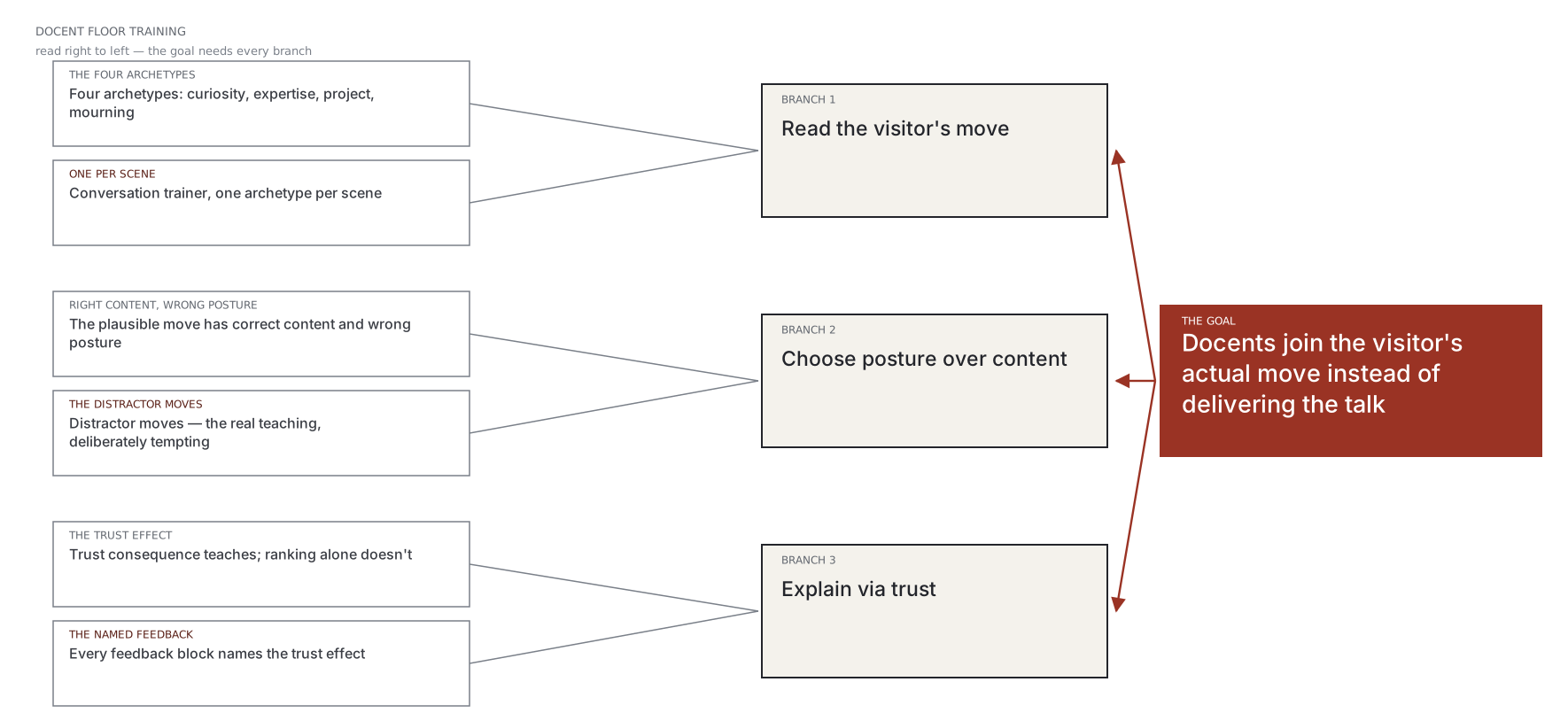
Production Sequence & Traceable Artifacts
The stages below show how the artifacts depend on each other. In this fictional case one designer produced all of them.
What would tell us it worked
A proposed plan. Nothing below has been measured.
| Question | Measure / instrument | When | What we would do with the answer |
|---|---|---|---|
| Can docents read the move? | Read-step accuracy per visitor | Pilot with 8–10 docents in pre-shift huddles | If “expertise” is read as “complaint”, add a contrasting example |
| Do they join on the floor? | Mystery-visitor scenarios scored on join vs manage | 1–2 months | Feed results back to each docent privately |
| Do visitors notice? | Visitor comments mentioning docents, before and after | Two seasons | Comments are sparse; treat as qualitative signal, not a rate |
Instructional Design Takeaway
“Why this form wins: the problem is conversational posture under emotional variety, so the solution is branching dialogue with named failure modes — measured in the field by the mystery-visitor instrument the trainer explicitly feeds.”
Docents aced the collection training and still struggled with the collection's visitors — the child's question, the visiting expert's challenge, the mourner in front of one painting. The gap was conversational: joining a visitor's move rather than managing them. The proposal was a branching conversation trainer: four visitor archetypes, three docent moves each, scored on one lens — did you join, or manage? — with the grieving visitor as the deliberate emotional center.
Transparent Portfolio Scope
Honest limitation: four scripted visitors. Real conversations branch further, and grief in particular cannot be scripted; the trainer only rehearses the first response.