Differentiation Practice: Diagnose the Barrier First
“One lesson plan, four learning needs, forty minutes. Differentiation theory is easy — the fork is hard.”
A decision coach built on four barrier types, each embedded in a real lesson moment with three plausible moves. The scoring lens is a single question — did you diagnose or did you add a task? — and feedback names what each choice cost each student.
The Audience
Early-career secondary teachers (and their mentors) — especially in mixed-preparation classrooms; also teacher-PD programs seeking practice-based rather than theory-based training.
Responsibilities
Barrier taxonomy · classroom-moment design · pedagogically-defensible distractors · feedback that names costs — the diagnosis habit made practicable.
The Build
Classroom scenario design · misconception modelling (fractions, circuits) · feedback writing · AI-assisted drafting (disclosed)
How I used AI in this case
AI drafted classroom-moment variants and misconception phrasings; the barrier taxonomy, pedagogically-defensible distractors and cost-naming feedback were authored by me. Edited, verified and disclosed.
The build itself, not a video about it — open it, make the calls, and read what each one costs.
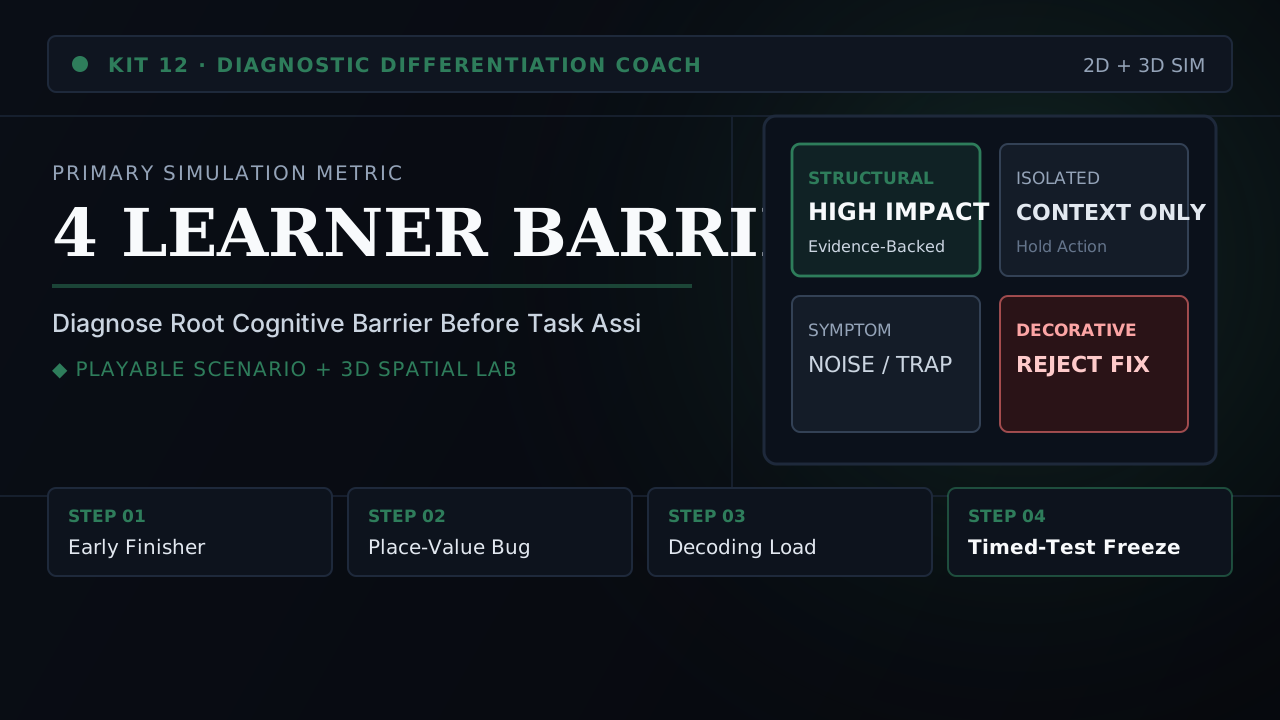
The Mixed Classroom — Primary Build
The full coach: four barriers, moment forks, cost-naming debrief
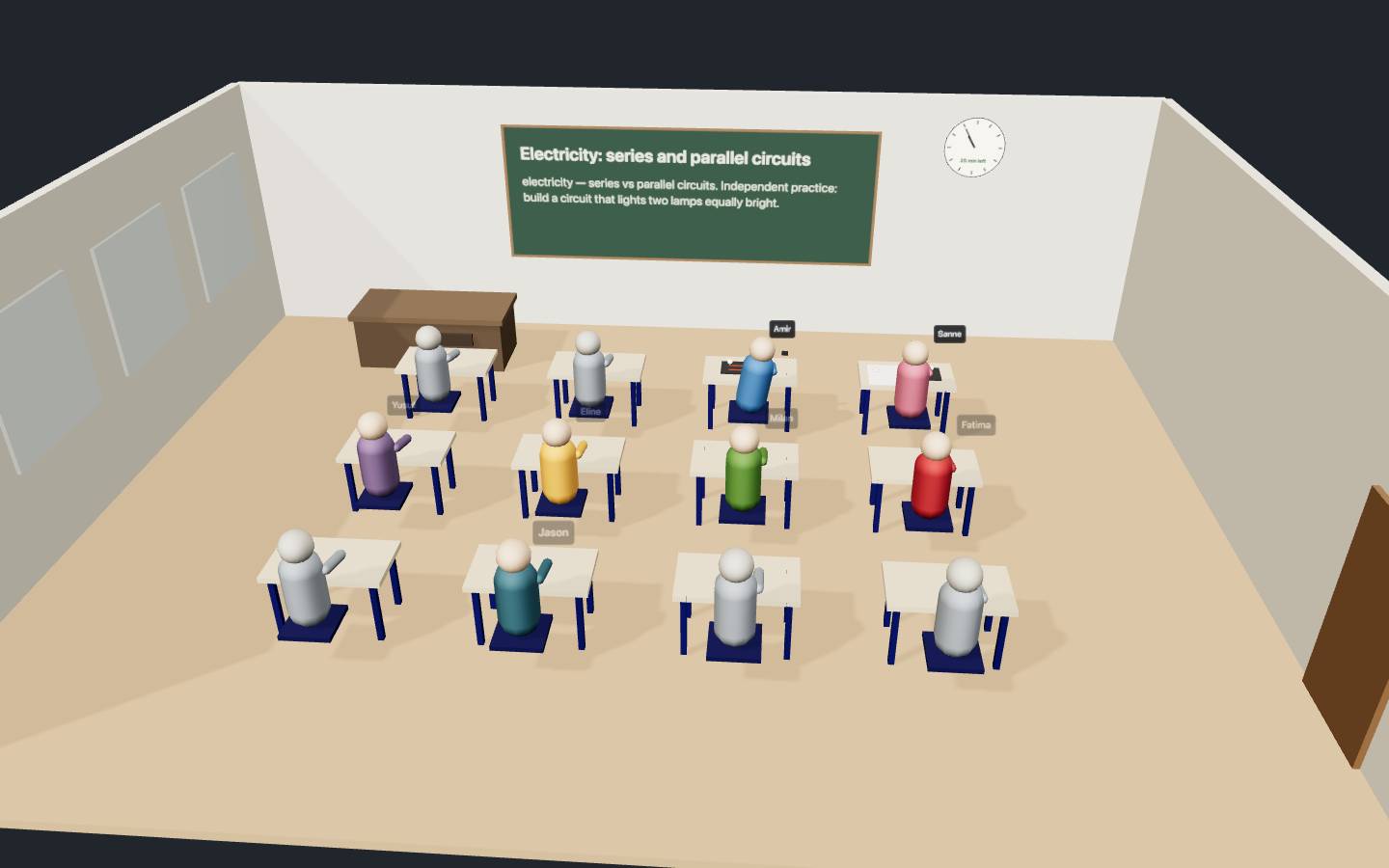
3D classroom at 10:40
Select a student to see what they are doing, name the barrier, then choose one move. Postures show what the move did; the wall clock shows the lesson time it cost. No student is labelled.
Scene-by-Scene Storyboard & UI Spec
Scene plan: four barrier types, three-move forks, before build. Full branching dialogue, distractor rationales, and visual system tokens.
Why conventional training failed the operational reality
Differentiation training teaches frameworks; the classroom demands split-second diagnosis. The predictable failures:
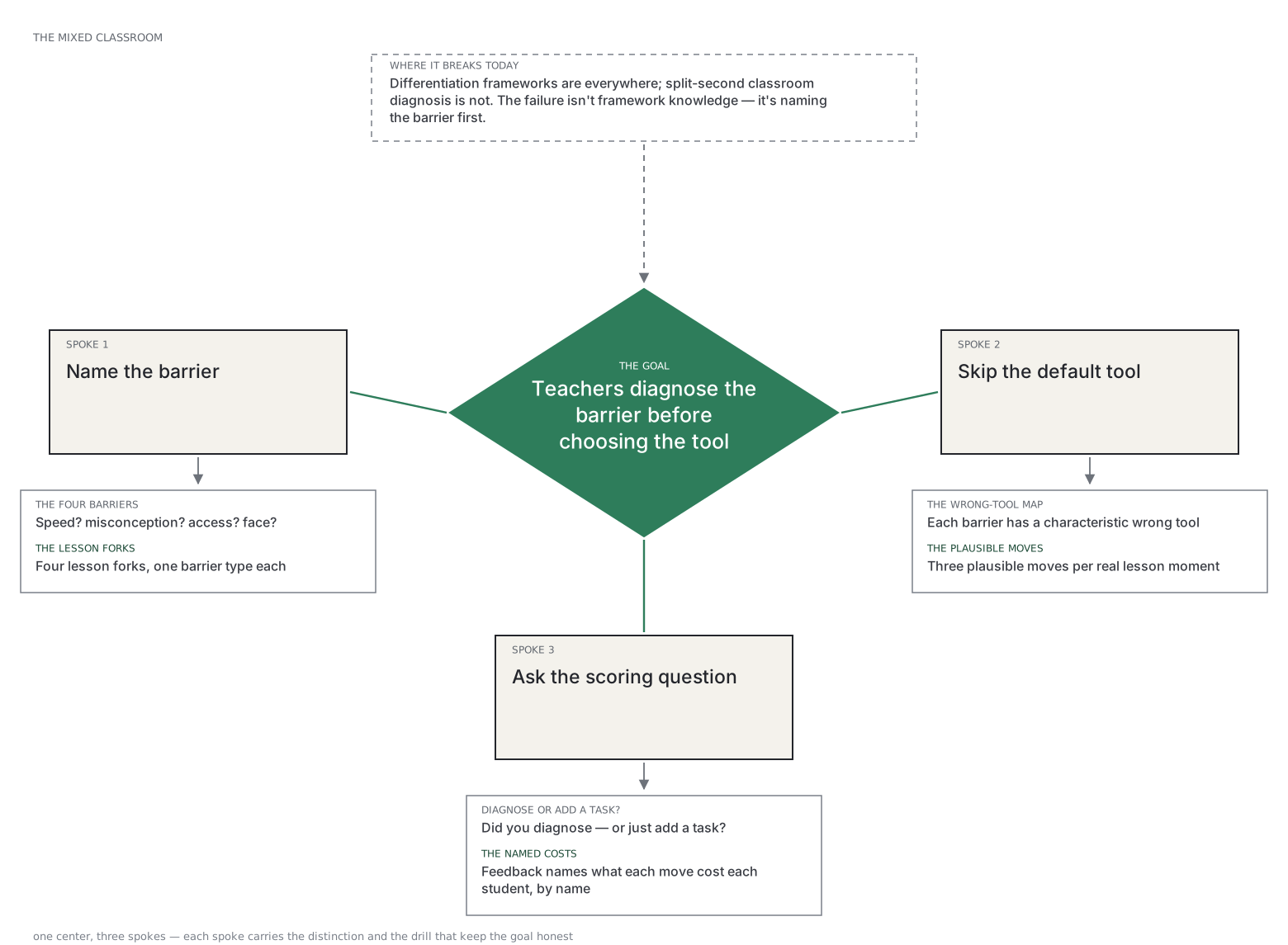
The gap isn't framework knowledge. It's the diagnosis habit: naming the barrier (speed? misconception? access? face?) before choosing the tool.
Core diagnostic finding
Early-career teachers in this fictional brief knew the differentiation vocabulary, but in the moment they added a task instead of diagnosing: harder sums, peer help, extra time. The same move was applied to different barriers. So the practice has to make diagnosis an explicit, scored step before any move is available.
Diagnose or add a task
Illustrative premise: tutoring as default — the fast student manages, the stuck one waits for rescue
Design Constraint → Build Rule: The scoring lens is one question: did you diagnose the barrier or pile on another worksheet? Every distractor is a plausible task that skips the diagnosis.
Misconceptions as they are really taught
Illustrative premise: only — misconceptions survive beneath procedures and resurface later
Design Constraint → Build Rule: The fractions and circuits barriers must match how the misconception actually forms, so feedback lands for teachers who know the content cold.
Costs to real students
Illustrative premise: for coping — avoidance gets decorated, and the wrong lesson lands
Design Constraint → Build Rule: Feedback names what each choice cost each student — never a generic try-again. That specificity is what makes the habit practicable.
Diagnose the barrier first, then choose the move
Performance problem
In this fictional school, lesson observations of first- and second-year teachers show the same pattern: when several students struggle at once, teachers reach for generic moves. Students who finish early are used as helpers; students with a misconception get the rule; a student with dyslexia gets more time.
Learners and context
Early-career secondary teachers in Dutch vmbo classrooms and their mentors. Busy, practical, sceptical of theory-first PD. The coach takes about 12 minutes and is designed to be discussed with a mentor afterwards.
Is training the answer? Not on its own
- Mentor time. Diagnosis improves fastest with a mentor who observes and asks “what did you see?”. The school timetable has to protect that time; the coach is a shared reference, not a replacement.
- Class composition and size. 22 students with very different preparation is a timetabling and grouping decision. Training helps teachers cope; it does not make the load reasonable.
- Access tools. Scribing and read-aloud work best when the school already provides them (speech-to-text, a quiet room). Without them, “remove the access barrier” becomes the teacher’s private burden.
Alignment: every objective has practice, evidence, feedback and a route back to the job
| Objective | Practice | Assessment | Feedback | Transfer |
|---|---|---|---|---|
| LO1 Name the barrier from observable behaviour | Seven students, each with a behavioural cue; no labels | 1 point per student; moves locked until every student in the moment is diagnosed | Explains what the behaviour shows and why | Mentor observation prompt: “what barrier did you see before you intervened?” |
| LO2 Choose a move that fits both students in the moment | Three moves per moment: best, workable, harmful | 2 / 1 / 0; public exposure of a failed test is critical | Names what the move cost each student; in 3D posture and lesson time respond | “Try it tomorrow” task in the debrief |
| LO3 Protect face when failure is public | Moment 4: Jason arrives late on results day | Critical-error rule | Separates the behaviour from the result | Private-feedback routine agreed with the mentor |
Evidence register: what is real, what is invented
- Fictional premise The school, class 3A, the seven students and the observation findings.
- Design decision The four-barrier taxonomy (a simplification for practice, not a validated instrument) and the 11 / 15 pass mark.
- Illustrative values Lesson minutes lost per move in the 3D scene (3, 6, 9) are a visual device.
- Not measured Any change in teaching or pupil outcomes. No teachers have used this coach.
Measurable Performance Objectives
Three objectives. The diagnosis step is scored on its own and must come before the move, because the earlier version never asked teachers to name the barrier at all.
Name the barrier — speed, misconception, access or face — from what a student is visibly doing.
Evidence in the build: the diagnose step for seven students (1 point each).
Choose one move that fits the barriers of the students in the moment, rather than a generic extra task.
Evidence in the build: the move in each of four moments (2 / 1 / 0).
Handle a student’s failure privately when the class is watching.
Evidence in the build: moment 4; a public mention of the result is a critical error.
Why This Modality Won (Trade-Off Analysis)
Before committing to the final architecture, we evaluated and rejected lower-transfer alternatives against the workplace constraints:
The default request every term. Rejected because the frameworks were already known — the failure happened in the three seconds between noticing a barrier and choosing a response, which no framework slide reaches. Knowledge is upstream of the gap.
Concrete and auditable. Rejected because templates are filled in the evening for an imagined class; the skill needed is for the real child in front of you at 10:40 on a Tuesday. Planning supports diagnosis — it cannot replace it.
A decision coach built on four barrier types, each embedded in a real lesson moment with three plausible moves. The scoring lens is a single question — did you diagnose or did you add a task? — and feedback names what each choice cost each student.
Why behaviour, not labels
Diagnosis is the skill
Real students do not arrive with “misconception” written above them. The coach gives cues only, so naming the barrier is the learner’s work and can be scored.
Why defensible wrong answers
Generic moves are tempting because they often work
Peer tutoring, extra time and harder tasks are legitimate tools. The point is not that they are bad, but that they are chosen without looking. The feedback names the cost for each student.
Why 3D here
Cues compete for attention
In the 3D classroom several students act at once and the lesson clock keeps running. Selecting a student, reading the cue and only then moving mirrors the order the real decision needs.
Production Sequence & Traceable Artifacts
The stages below show how the artifacts depend on each other. In this fictional case one designer produced all of them.
What would tell us it worked
A proposed plan. Nothing below has been measured.
| Question | Measure / instrument | When | What we would do with the answer |
|---|---|---|---|
| Can teachers name barriers from cues? | Diagnosis accuracy per student and barrier type | Pilot with 6–10 early-career teachers and their mentors | If “face” is mostly called “speed” or “misconception”, add a contrasting example |
| Do moves follow diagnoses? | Share of moments where a correct diagnosis is followed by the best move | Same pilot | Correct diagnoses with generic moves mean the move library needs worked examples |
| Does it show up in lessons? | Mentor observation: does the teacher state a barrier before intervening? (two observed lessons) | 4–6 weeks later | Agree the observation prompt with mentors; it is a coaching tool, not an appraisal |
Instructional Design Takeaway
“Why this form wins: the problem is split-second diagnosis, not framework knowledge, so the solution drills the forks where real classrooms actually fork — with pedagogically defensible wrong answers doing the teaching.”
Early-career teachers could recite every differentiation framework and still, mid-lesson, respond to a struggling student by adding a task. The gap was diagnostic: reading the barrier in the moment, under time pressure, with twenty-nine other children waiting. The proposal was a differentiation decision coach: one teaching day, four forks, three moves each — scored on a single question, did you diagnose the barrier or just add a task? — with feedback that names what each choice cost each student.
Transparent Portfolio Scope
Honest limitation: four moments and a simplified taxonomy. Real classrooms are messier, and the right move depends on relationships the coach cannot model.