Week-One Cashier Training: Dignity Under Queue Pressure
“The scanner knows prices. The queue doesn't forgive. Week-one cashiers quit over moments no POS manual covers.”
A register simulator where each customer embodies one moment, the queue stays visible, and the scoring explicitly separates dignity from speed — teaching that the two usually align (calm pace beats panicked pace for both). Feedback names the trust consequence of each move.
The Audience
First-week supermarket cashiers (often student or returning workers) — plus team leads who need a shared language for the moments that drive early quits.
Responsibilities
Moment taxonomy · queue-pressure simulation · dignity-vs-speed scoring · feedback writing — early attrition treated as a design problem.
The Build
Branching scenario design · pressure pacing · behavioral feedback writing · AI-assisted drafting (disclosed)
How I used AI in this case
AI drafted customer-moment dialogue variants and queue-pacing notes; the moment taxonomy, dignity-vs-speed scoring and feedback writing were authored by me. Edited, verified and disclosed.
The build itself, not a video about it — open it, make the calls, and read what each one costs.
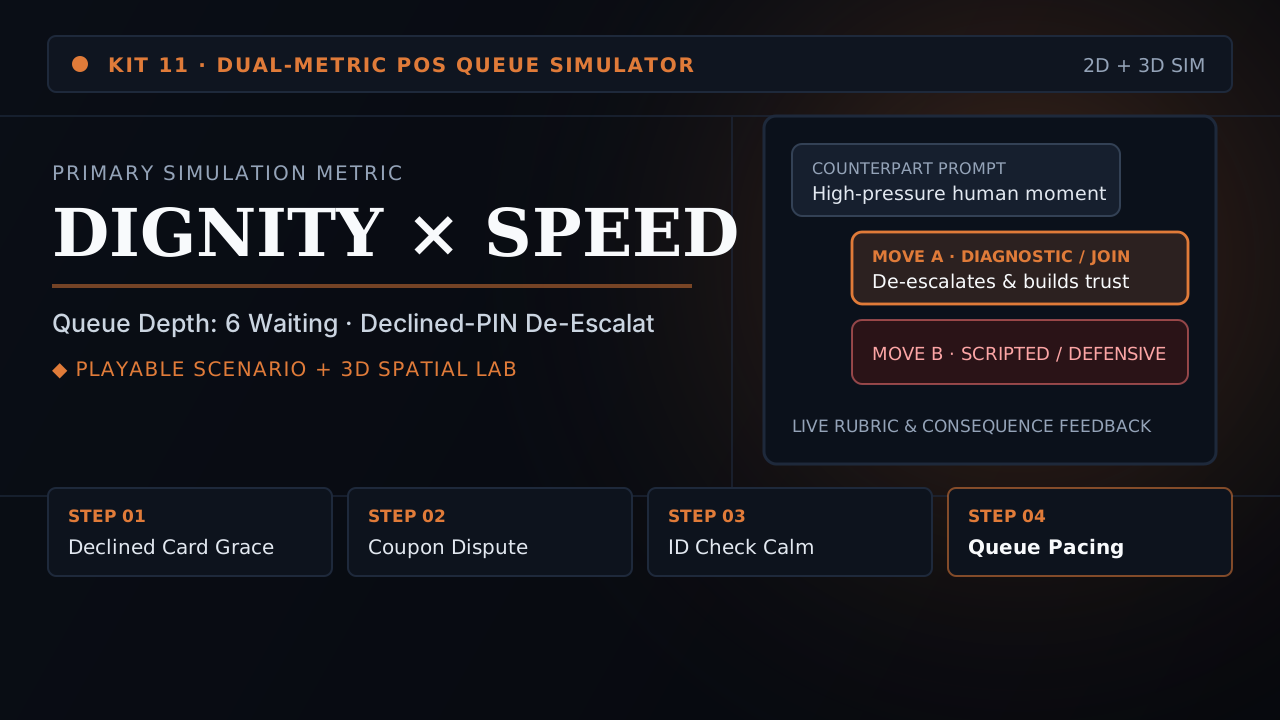
Checkout Zero — Primary Build
The full simulator: four customer moments, live queue, dignity-speed feedback
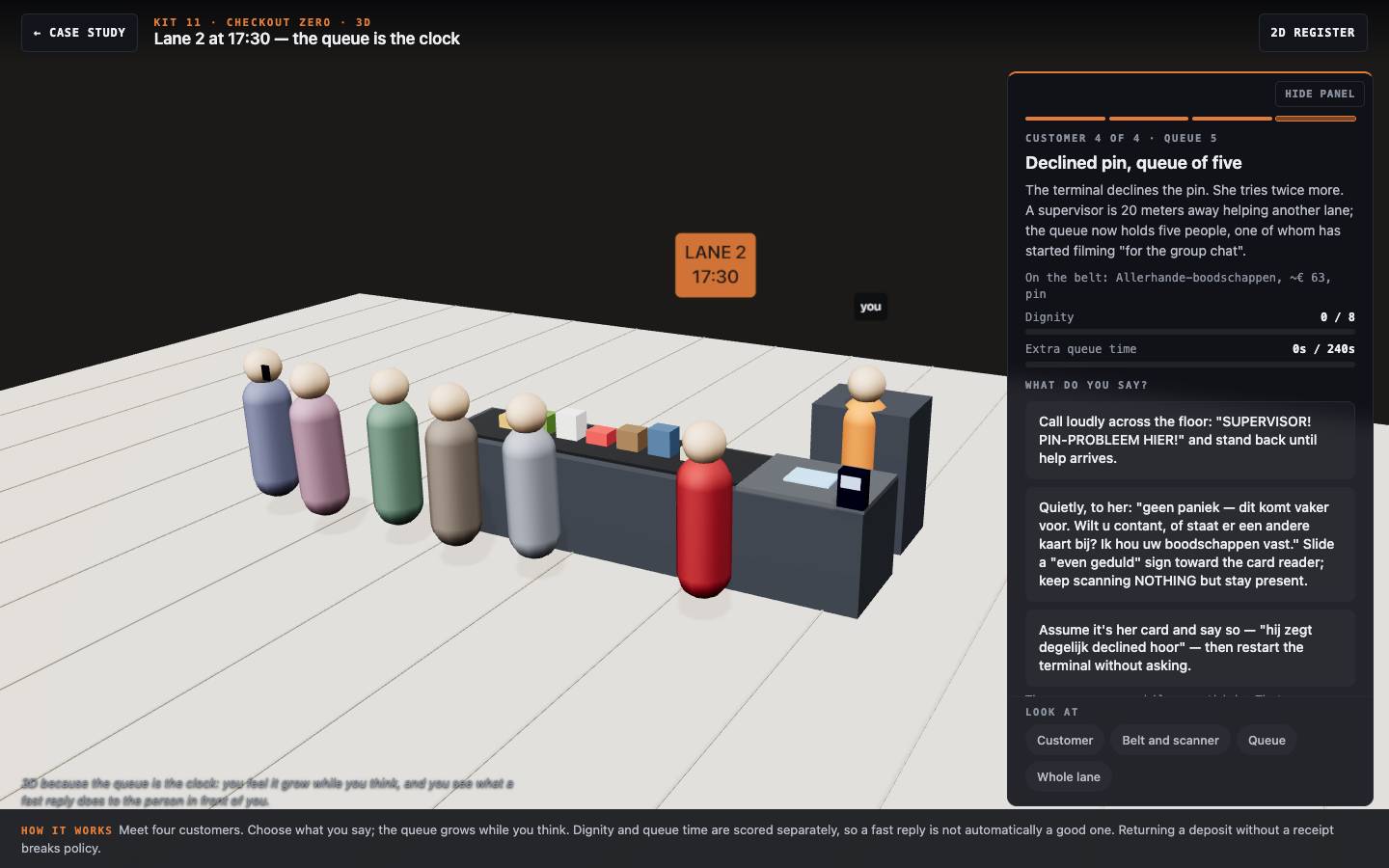
3D Lane 2 at 17:30
Serve four customers at a checkout lane whose queue grows while you think. Dignity and queue time move separately; the customer’s posture and the queue show what your reply did.
Scene-by-Scene Storyboard & UI Spec
Scene plan: customer moments, queue states, dignity-speed scoring, before build. Full branching dialogue, distractor rationales, and visual system tokens.
Why conventional training failed the operational reality
Exit interviews from week-one leavers cluster on four untrained moments, not on scan speed:
Training covers till mechanics and fraud rules. It never practices holding dignity and queue pressure in the same moment — which is what the job actually is.
Core diagnostic finding
In this fictional brief, the new cashiers who left in week one could all operate the till. What broke them were four moments no manual covers: a slow payer with a sighing queue, a rule to enforce, a chaotic family, a declined card in front of an audience. In each, the fast reply and the dignified reply pull apart, so the trainer has to score them apart.
Dignity without sermon
Illustrative premise: the slow elderly payer — humiliation is contagious to the queue
Design Constraint → Build Rule: The scoring had to prove calm pace beats panicked pace for both dignity and speed — showing, not telling, so the lesson survives contact with a real Saturday rush.
The queue is the clock
Illustrative premise: no-receipt returns — rule enforcement with or without a door
Design Constraint → Build Rule: Pressure must be felt, not narrated. The visible queue drives urgency honestly, so speed-panic stays tempting — and stays wrong.
Moments a team lead recognizes
Illustrative premise: declined payments — the loudest failure a first-weeker fears
Design Constraint → Build Rule: Each customer embodies a real early-quit moment drawn from attrition patterns, not imagination — team leads should hear their own floor in the feedback.
Dignity and speed are two different scores
Performance problem
In this fictional supermarket chain, too many new cashiers leave in their first week. Onboarding drills scanning speed and the POS menu, which were never the problem.
Learners and context
New cashiers, often students or first jobs, mixed Dutch and English. Short attention window before their first shift; the trainer takes about 8 minutes and runs on a phone.
Is training the answer? Not on its own
- Supervisor availability. If the only supervisor is 20 metres away with another lane, declined payments become public scenes. A “call button” or a floor rota is a store decision.
- Terminal reliability. If card readers fail often, cashiers absorb the blame. Track terminal declines separately from card declines.
- First-week rostering. Putting new cashiers alone on the busiest evening lane in week one is a rostering choice.
Alignment: every objective has practice, evidence, feedback and a route back to the job
| Objective | Practice | Assessment | Feedback | Transfer |
|---|---|---|---|---|
| LO1 Protect the customer’s face at moments that stall the line | Four customers at the belt | Dignity 0–2 per reply; pass needs 6/8 | Explains what the customer and the queue heard | “One sentence to them, one to the queue” prompt card at the till (proposed) |
| LO2 Manage the queue’s time without making the customer pay for it | Each reply costs illustrative seconds; budget 240 s | Queue-time gauge, separate from dignity | The fastest set fails; the best set fits the budget | Buddy shift with an experienced cashier (proposed) |
| LO3 Keep the rule and offer a way through | Deposit without a receipt | Manual override is a breach that fails the shift | Shows the machine route | Rules card with the “door” for each rule |
Evidence register: what is real, what is invented
- Fictional premise The chain, the leavers and their “exit interviews”.
- Illustrative values Seconds per reply and the 240 s queue budget.
- Design decision Dignity points per reply and the pass rule.
- Not measured Week-one attrition or customer complaints. The earlier “≥7/8 dignity” was a target.
Measurable Performance Objectives
Three objectives. The case promised two separate axes; the build now has them (it previously added both into one score out of 8).
Protect the customer’s face when their payment or shopping stalls the line.
Evidence in the build: dignity per reply (0–2), 6/8 to pass.
Manage the queue’s waiting time with a sentence or a sign, without rushing the customer.
Evidence in the build: extra queue time, kept within 240 s.
Enforce a till rule while offering the customer a legitimate way through.
Evidence in the build: the deposit moment; a manual override fails the shift.
Why This Modality Won (Trade-Off Analysis)
Before committing to the final architecture, we evaluated and rejected lower-transfer alternatives against the workplace constraints:
The obvious operational fix. Rejected because, in the brief’s premise, leavers never mentioned the till — adding scanning drills addresses the one thing that wasn't failing while the queue keeps burning new hires.
Well-intentioned and cheap. Rejected because dignity under pressure cannot be conveyed as content — it has to be felt with the queue visibly growing. The module would teach the value; the simulator trains the moment where the value survives or dies.
A register simulator where each customer embodies one moment, the queue stays visible, and the scoring explicitly separates dignity from speed — teaching that the two usually align (calm pace beats panicked pace for both). Feedback names the trust consequence of each move.
Why two axes
A trade-off you can see
One combined score hides that the fastest reply often costs the most. Two gauges make the trade-off visible, and the debrief shows the fastest set failing.
Why defensible wrong answers
Kind, fast or by the book
Paying the 48 cents yourself or calling the supervisor are well-meant. They are scored as workable, not wrong, with the cost named.
Why 3D here
The queue is the clock
The lane makes the pressure physical: shoppers join while you read. Posture shows the dignity outcome; the queue shows the time cost.
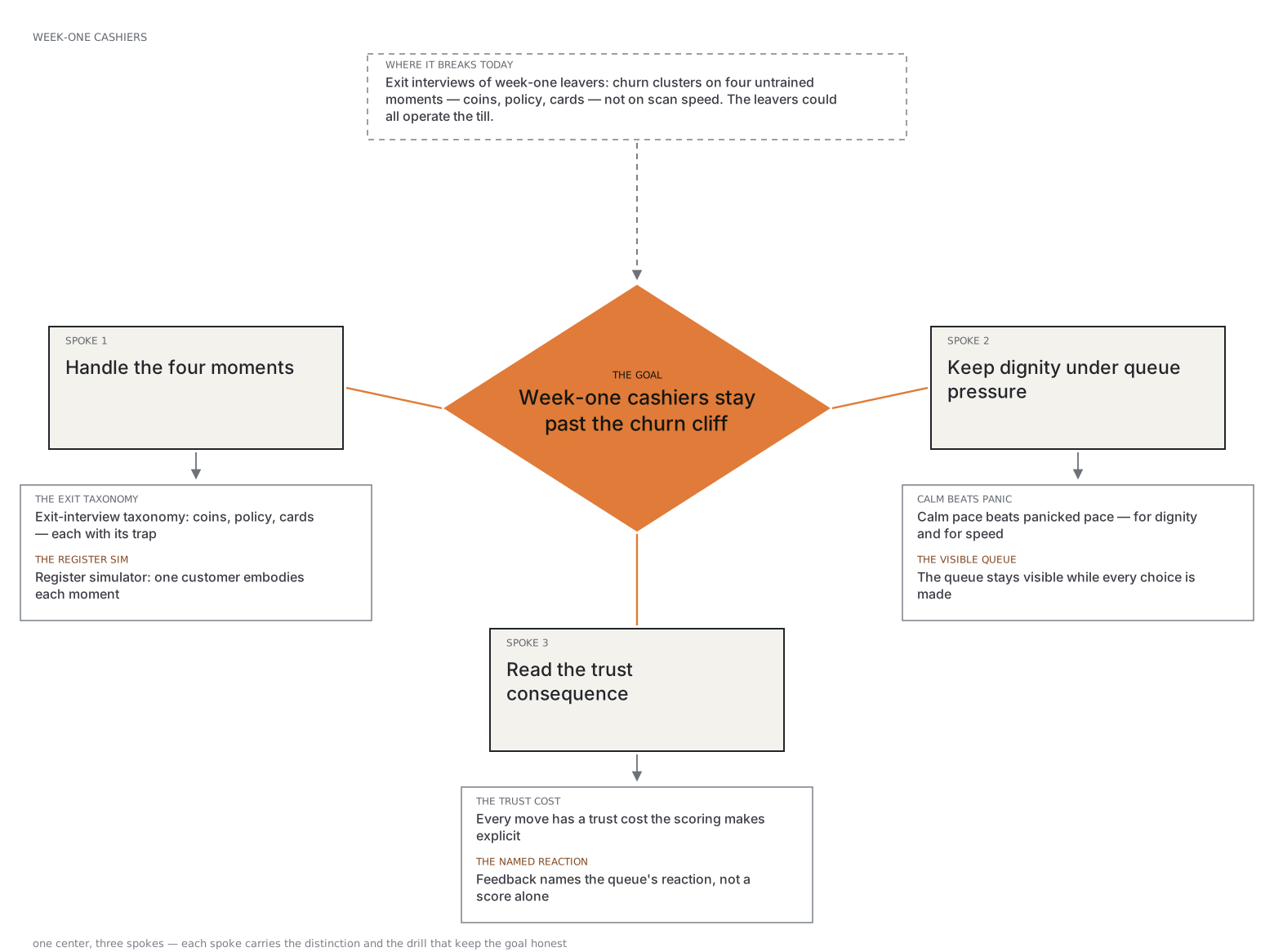
Production Sequence & Traceable Artifacts
The stages below show how the artifacts depend on each other. In this fictional case one designer produced all of them.
What would tell us it worked
A proposed plan. Nothing below has been measured.
| Question | Measure / instrument | When | What we would do with the answer |
|---|---|---|---|
| Do new cashiers choose dignified replies? | Dignity score and the share choosing the fastest reply per moment | Pilot with one store’s new starters | If the pin moment is mostly failed, add a short in-store role-play with the supervisor |
| Does it help in week one? | New starters’ confidence rating after shift 1 and 3 (short pulse) | First two weeks | Compare with a store that has not used the trainer yet |
| Does attrition change? | Week-one leavers per store | Two quarters | Too many causes to credit training alone; review with store managers alongside rostering changes |
Instructional Design Takeaway
“Why this form wins: the problem is dignity collapsing under visible time pressure, so the solution puts the queue on-screen and scores the two things separately — because decoupling them is the design thesis: week-one quits are dignity events.”
Week-one cashier churn was not a scanning problem — the leavers could all operate the till. The exits clustered on four untrained moments: the slow payer, the no-receipt return, the party cart, the declined card. Each is a dignity event under queue pressure. The proposal was a register simulator with a visible queue: those four customers, live, with dignity scored separately from speed — teaching that calm is usually also the fast path.
Transparent Portfolio Scope
Honest limitation: four moments and illustrative seconds. Real queues and customers vary; the trainer rehearses first reactions, not every situation.