Finance Judgment: The Rule-Adjacent Moments
“Compliance training teaches rules. The hard moments are rule-adjacent: legal-ish, deniable, pressure-laden.”
A memo-file trainer where the reviewer marks the sentence that carries the issue, then chooses between five responses: sign, sign with a note of reservation (the trap), engage, propose or escalate. Feedback teaches the full ladder — engage, propose, document, escalate — with the professional consequences named.
The Audience
Finance professionals with review authority — controllers, reviewers, senior accountants — plus compliance teams redesigning training beyond rule-recall toward judgment.
Responsibilities
Dilemma architecture · professional-wrong-answer crafting · escalation-ladder design · feedback philosophy (proportionate, named, actionable) — judgment made trainable.
The Build
Ethical dilemma design · distractor engineering · escalation-path modelling · AI-assisted drafting (disclosed)
How I used AI in this case
AI drafted memo variants and dilemma phrasings; the dilemma architecture, escalation-ladder design and proportionate-feedback philosophy were authored by me. Edited, verified and disclosed.
The build itself, not a video about it — open it, make the calls, and read what each one costs.
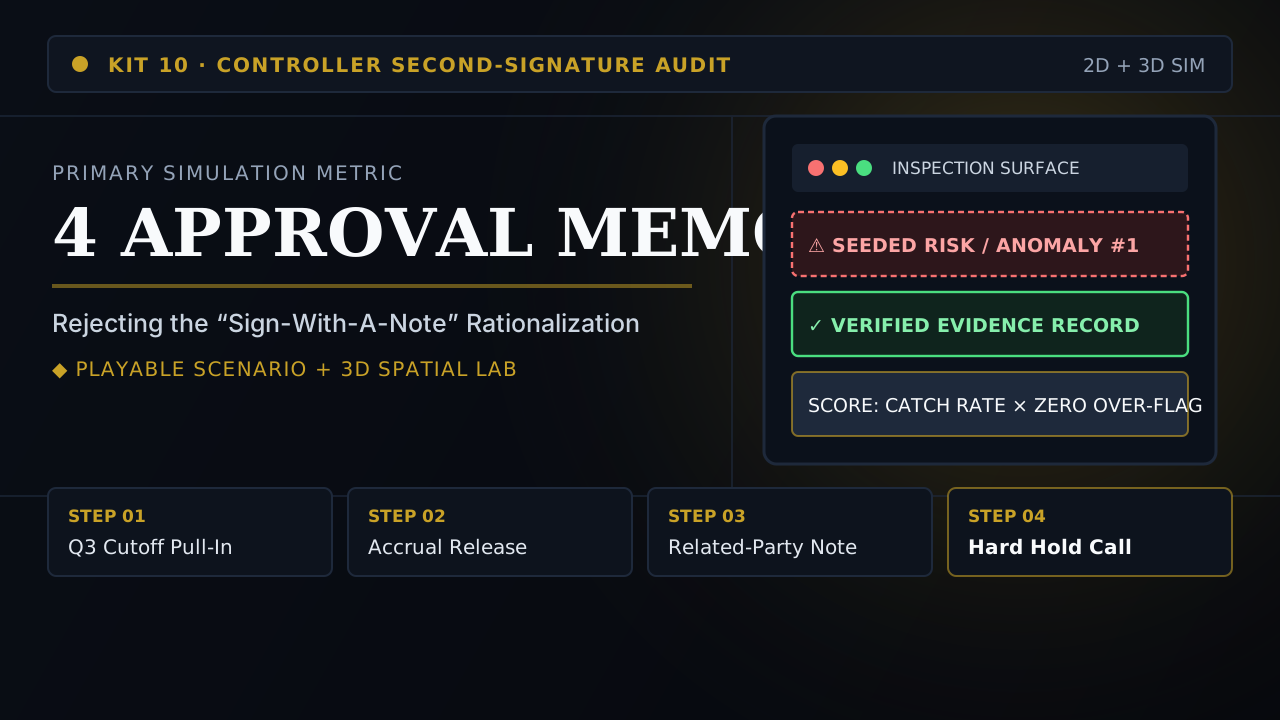
The Second Signature — Primary Build
The full trainer: memo file, three-response forks, ladder-teaching debrief

3D finance tower
Mark the issue, choose a response, and watch the memo ride the lift to engage, propose or escalate. Skipped floors flash; approved memos leave by the front door; signed reservations pile up in the basement archive.
Scene-by-Scene Storyboard & UI Spec
Scene plan: memos, three-response forks, ladder feedback, before build. Full branching dialogue, distractor rationales, and visual system tokens.
Why conventional training failed the operational reality
Annual compliance training produces rule-recall and zero judgment transfer, because the real moments don't violate rules — they stretch them:
The failure isn't knowledge of the rules. It's that nobody practiced saying no constructively — with a workable path, in the right gear, at the right altitude.
Core diagnostic finding
In this fictional brief the reviewers knew the rules. The failure pattern was the signature with a private note of reservation: it feels like judgment, and it is the most damaging page in the file because it proves the reviewer knew. Its mirror is escalating everything, which stops honest questions reaching the reviewer at all.
The plausible is the test
Illustrative premise: the range" — accrual rounding to the flattering end, fully disclosed
Design Constraint → Build Rule: Defensible-in-a-memo, corrosive-in-a-culture: the plausible answer had to survive an audit on paper while failing the professional standard — otherwise nobody learns why it corrodes.
Overcorrection is malpractice too
Illustrative premise: annotate — approving while noting doubt: the failure pattern this case is built around (a design premise)
Design Constraint → Build Rule: Escalating everything is escalation malpractice. The overcorrected response had to be genuinely harmful to the team and the process, not a strawman nobody would pick.
A ladder, not a line
Illustrative premise: everything — the mirror failure that makes honest questions go underground
Design Constraint → Build Rule: Engage, propose, document, escalate: feedback teaches the full ladder with the professional consequence of each rung named — judgment has more than two settings.
Proportionate responses to rule-adjacent pressure
Performance problem
In this fictional finance department, reviewers sign memos that are legal-ish and pressure-laden, and protect themselves with a note of reservation in the file. When they do push back, it is often straight to the audit committee, which damages the working relationships that bring problems to them early.
Learners and context
Controllers, reviewers and senior accountants with signing authority. They know the standards; what they lack is practice saying no proportionately to more senior people. Short sessions (about 15 minutes) that can be discussed in a team meeting afterwards.
Is training the answer? Not on its own
- Safe escalation. If raising an issue to the audit committee carries career risk, people will annotate instead. The organisation needs a protected route (a named contact, a speak-up policy that is actually used).
- Sign-off design. A review form with “approved with reservations” as an option invites the trap. Recommendation: remove that option; reservations must be resolved or escalated.
- Target pressure. Two memos are driven by quarter-end targets. Finance leadership, not training, decides whether targets reward timing games.
Alignment: every objective has practice, evidence, feedback and a route back to the job
| Objective | Practice | Assessment | Feedback | Transfer |
|---|---|---|---|---|
| LO1 Identify the sentence that carries the issue in a pressure-laden memo | Four sentences per memo: the issue, pressure, context and true-but-irrelevant facts | 1 point per memo | Explains why the issue decides and the rest is pressure | Review prompt: “which sentence bothers me, and what evidence would remove the doubt?” |
| LO2 Choose the proportionate rung: engage, propose or escalate | Five memo-specific responses; the best rung differs per memo | 2 / 1 / 0; signing as presented is critical on two memos | Names the rung after commitment and why it fits this memo | Ladder card next to the sign-off form (proposed) |
| LO3 Refuse to sign with a private reservation | A plausible reservation option on every memo | Critical error on any memo | The note proves you knew; in 3D it piles up in the archive | Remove “approved with reservations” from the sign-off form (recommended) |
Evidence register: what is real, what is invented
- Fictional premise The company, the four memos and the people in them.
- Illustrative values Deal sizes, accrual ranges and dates are realistic but invented.
- Design decision The 9 / 12 pass mark and treating any signed reservation as a fail.
- Not measured How often reviewers annotate or escalate. “The most common failure pattern” on the earlier page was a premise, not a finding.
Measurable Performance Objectives
Three objectives, each with its own evidence. The earlier LO2 listed “annotate” as a proportionate response; it is now the trap the case is built around.
Identify the sentence that carries the issue in a rule-adjacent memo, separating it from the pressure around it.
Evidence in the build: the issue step on each of four memos (1 point each).
Choose the proportionate response: engage with the evidence you need, propose a supported alternative, or escalate above the decision-maker.
Evidence in the build: the response on each memo (2 / 1 / 0); the best rung differs per memo.
Refuse to sign with a private reservation; either the doubt is resolved or the item is not signed.
Evidence in the build: a reservation option on every memo; choosing it fails the review.
Why This Modality Won (Trade-Off Analysis)
Before committing to the final architecture, we evaluated and rejected lower-transfer alternatives against the workplace constraints:
Mandated and expected. Rejected because it teaches the rules that were never broken — the dilemmas live in the space the rules don't name, and a rules course leaves that space exactly as ambiguous as before, just with better attendance records.
Visible leadership signal. Rejected because it addresses the end of the chain, not the moment of choice: the reviewer who annotates doubt instead of escalating never reaches the hotline — the poster is downstream of the failure.
A memo-file trainer where the reviewer marks the sentence that carries the issue, then chooses between five responses: sign, sign with a note of reservation (the trap), engage, propose or escalate. Feedback teaches the full ladder — engage, propose, document, escalate — with the professional consequences named.
Why near-miss options
Wrong answers that sound professional
Each memo’s wrong options are what a competent person under pressure would plausibly do. Easy-to-dismiss distractors would teach nothing about the actual temptation.
Why the rung varies
No single safe strategy
Engage is best on one memo, propose on two, escalate on one. A learner who always escalates or always engages cannot pass, so the score reflects judgment rather than a rule of thumb.
Why 3D here
The ladder as a building
Escalating first visibly skips floors; signed reservations accumulate in the basement. The archive pile makes the hidden cost of “sign with a note” something the learner sees build up.
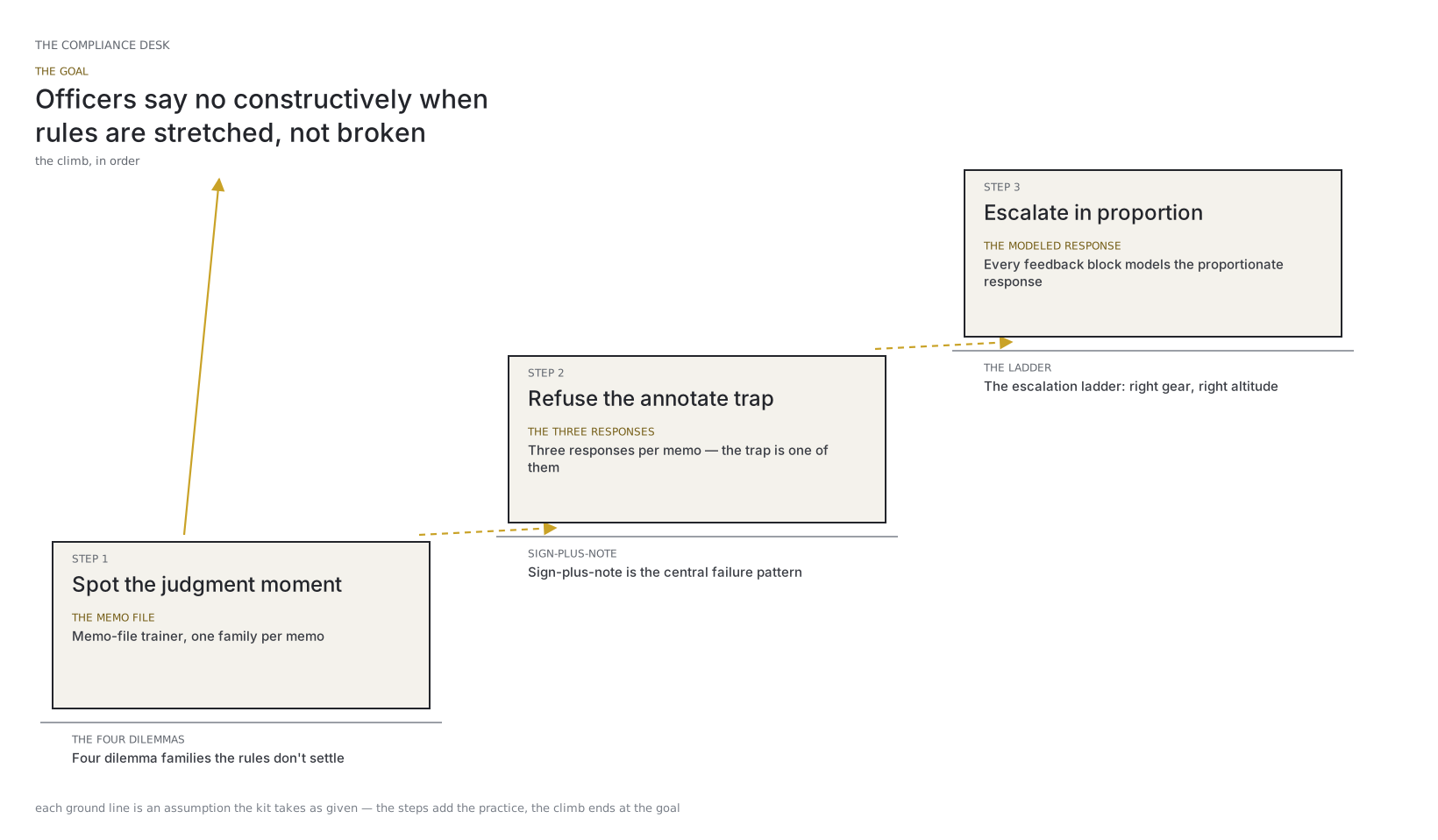
Production Sequence & Traceable Artifacts
The stages below show how the artifacts depend on each other. In this fictional case one designer produced all of them.
What would tell us it worked
A proposed plan. Nothing below has been measured.
| Question | Measure / instrument | When | What we would do with the answer |
|---|---|---|---|
| Do reviewers find the issue? | Issue-sentence accuracy per memo | Pilot with one finance team (8–12 people) | If one memo’s issue is mostly missed, its distractor sentences may be unfair; rewrite |
| Do they choose proportionately? | Distribution of rungs per memo; share choosing a signed reservation | Same pilot | If most choose escalate everywhere, add a worked example of engaging first |
| Do reasons hold up? | Controller reads a sample of one-line reasons against the memo facts | Same pilot | Vague reasons suggest the issue step needs more practice |
| Does sign-off behaviour change? | Count of “approved with reservations” sign-offs, or items raised before quarter-end | Two quarters | Only meaningful if the sign-off form changes too; review with the finance director |
Instructional Design Takeaway
“Why this form wins: the problem is judgment inside professional gray zones, so the solution trains the actual artifact — the memo response — with the defensible-but-corrosive option given its own named wrong answer.”
The compliance failures that scared the firm were not rule violations — they were rule-adjacent: a rounding here, an annotation of doubt there, a forecast letter that was technically defensible. Nobody fails these moments loudly; they fail by signing while noting the doubt. The proposal was a memo-file ethics trainer: four memos, three responses each, teaching the escalation ladder and the sign-plus-annotate trap explicitly — in the register of professional documents, not slogans.
Transparent Portfolio Scope
Honest limitation: four memos and simplified facts. No accounting standard is quoted or applied in detail; the trainer rehearses the reviewer’s response, not the technical accounting.