Cabin-Crew Briefings: Rebuild the Sequence in SOP Order
“Briefings fail in the order, not the content: safety items buried between chit-chat, the security question asked after the purser arrived.”
A sequence builder: two fixed items (punctuality, roll call) anchor the briefing; six more must be placed in SOP order. Checking produces position-level feedback — not "wrong", but "here's what belongs in position 4 and why, and here's the rationale for the item you placed there." Rebuild until fluent; the retry costs nothing.
The Audience
New cabin crew in type-rating or recurrent training — plus instructors who want the briefing sequence practiced interactively instead of lectured.
Responsibilities
SOP-sequence modelling · item-position rationale writing · position-level feedback design — the order made tactile.
The Build
Sequence-builder interaction design · SOP rationale writing · AI-assisted drafting (disclosed)
How I used AI in this case
AI drafted SOP-rationale sentence variants for the feedback layer; the sequence model, break-point logic and position-level feedback design were authored by me. Edited, verified and disclosed.
The build itself, not a video about it — open it, make the calls, and read what each one costs.
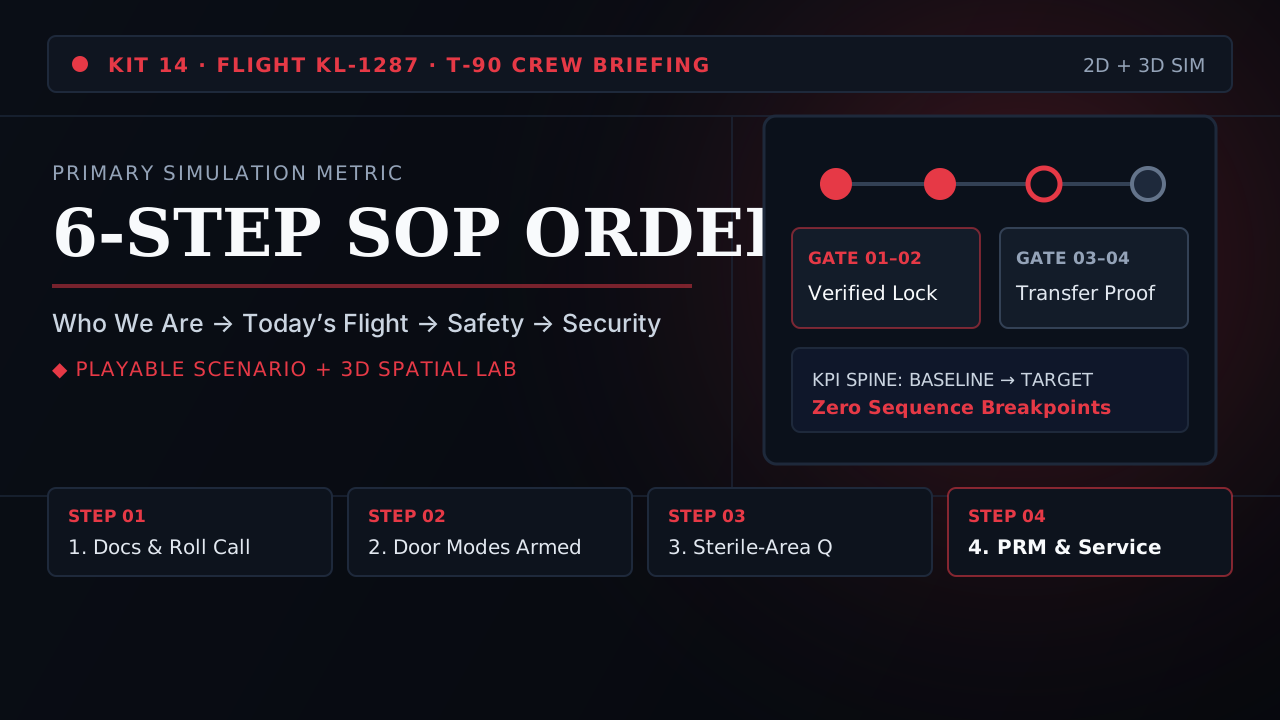
Boarding Now — Primary Build
The full builder: SOP order, rationale feedback, fluency loop
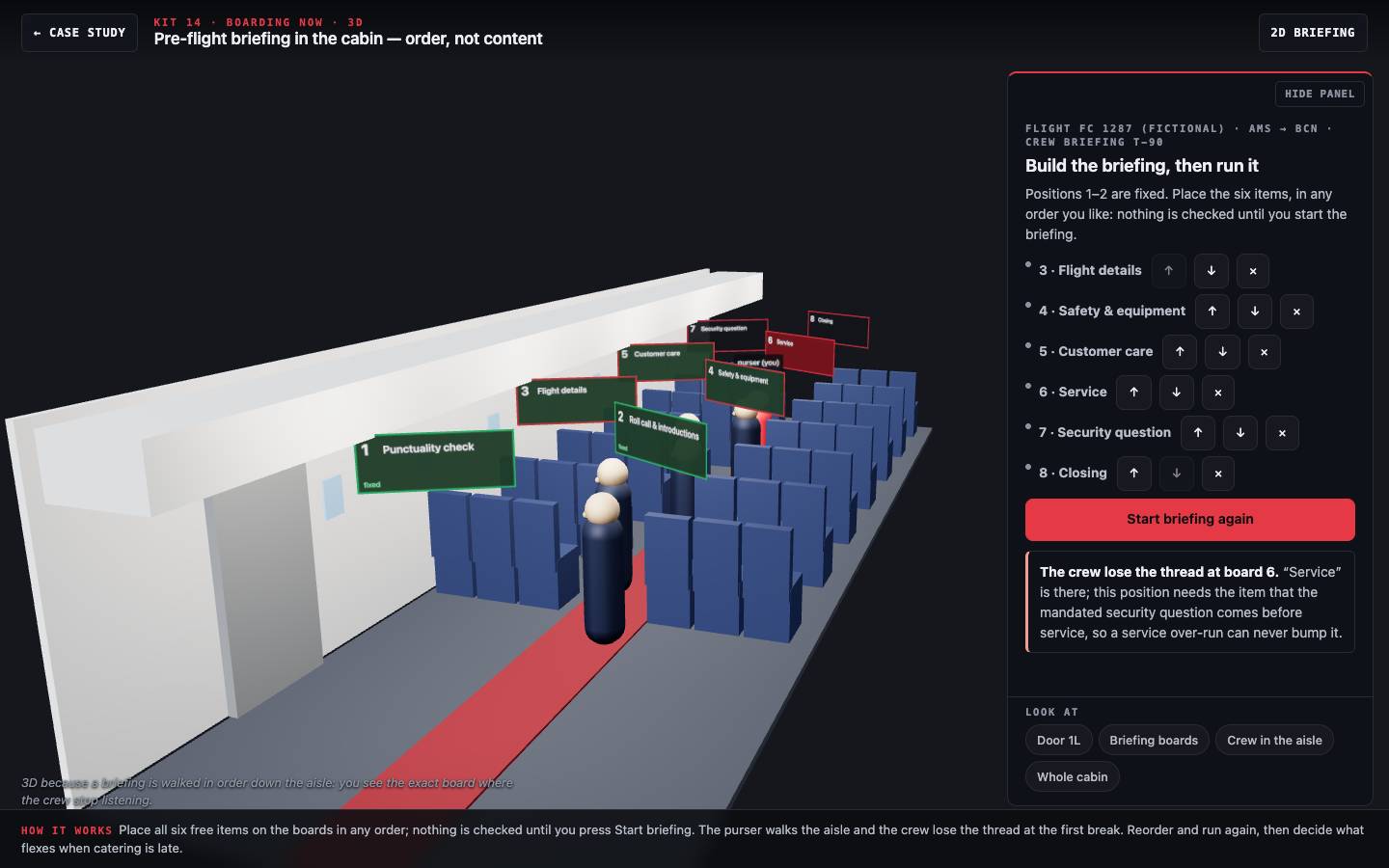
3D cabin briefing
Place six briefing items on the aisle boards, start the briefing and watch where the crew lose the thread. Then decide what flexes when catering is late.
Scene-by-Scene Storyboard & UI Spec
Scene plan: placement rounds, break-point feedback, fluency loop, before build. Full branching dialogue, distractor rationales, and visual system tokens.
Why conventional training failed the operational reality
Briefing quality is consistent in content and inconsistent in order — and order is where the failures live:
The sequence isn't bureaucratic preference: it encodes attention management (safety while fresh), flexibility (service as the compressible block), and recency (security question last-but-one). Training lectures it; nobody gets to feel the order break.
Core diagnostic finding
In this fictional brief, cabin crew knew every briefing item. Under time pressure the order drifted: safety squeezed between service notes, the security question tacked on after the close. The skill is holding the sequence and knowing which item is allowed to flex.
Order as the skill
Illustrative premise: safety items between service chatter — attention decay is predictable
Design Constraint → Build Rule: Cabin briefings are memorized as lists. The design had to make position meaningful — why punctuality anchors, why roll call precedes safety — or placement is just quiz trivia.
Feedback at the position, not the list
Illustrative premise: security question after closing — loses its freshness advantage
Design Constraint → Build Rule: Saying wrong teaches nothing. Every check produces what belongs in that position and why, plus the rationale for what the learner placed there.
Two anchors, six free
Illustrative premise: service over-runs safety blocks — the one direction SOP forbids
Design Constraint → Build Rule: Fixing punctuality and roll call mirrors the SOP, but the six remaining items needed orderings an instructor would defend in a classroom.
Order, not content
Performance problem
In this fictional airline, line checks found pre-flight briefings that covered every item but in an order that let safety and the security question get squeezed when departures were tight.
Learners and context
Pursers and senior cabin crew who lead briefings, and new crew who will. Experienced, time-poor; the trainer takes about 6 minutes and could sit in the crew app.
Is training the answer? Not on its own
- Briefing card. A printed or in-app card with the eight positions in order does more on a rushed morning than memory.
- Time protection. If ground operations routinely cut the briefing window, the order will suffer whatever the training. The T-90 slot should be protected.
- Delay protocol. “What flexes first” should be written into the operations manual, not left to each purser.
Alignment: every objective has practice, evidence, feedback and a route back to the job
| Objective | Practice | Assessment | Feedback | Transfer |
|---|---|---|---|---|
| LO1 Sequence the briefing in SOP order, including the security question before service | Six items, free placement, run-and-fix loop | Six positions; runs counted | First break with the reason that position exists | Briefing card with the eight positions (recommended) |
| LO2 Choose what to compress under time pressure | Catering-delay decision | Service best, closing okay, safety or security critical | Explains the designed flex item | Delay protocol in the operations manual (recommended) |
Evidence register: what is real, what is invented
- Fictional premise The airline, flight FC 1287 and the line-check findings. The earlier page used KL 1287, a real airline code; replaced.
- Design decision The SOP order shown here (a teaching sequence, not any real carrier’s manual) and the scoring.
- Not measured Briefing quality on the line. A “crew pilot” quote and a 100% target on the earlier page were not results.
Measurable Performance Objectives
Two objectives. The earlier LO1 sequence left out the security question; it is now part of the order and of the disruption decision.
Sequence the pre-flight briefing in SOP order, with safety early and the security question before service.
Evidence in the build: six positions, checked when the briefing runs.
Under time pressure, compress the item designed to flex (service) and never safety or the security question.
Evidence in the build: the catering-delay decision; cutting safety or security fails.
Why This Modality Won (Trade-Off Analysis)
Before committing to the final architecture, we evaluated and rejected lower-transfer alternatives against the workplace constraints:
Fast to build, easy to schedule. Rejected because reading a sequence and producing one under pressure are different skills — the deck teaches recognition, and recognition is precisely what the failures already had.
Trackable in the LMS. Rejected because '4/6 correct' teaches nothing about WHERE the order broke or why service sits where safety belongs. Position-level feedback is the design; a score is just a score.
A sequence builder: two fixed items (punctuality, roll call) anchor the briefing; six more must be placed in SOP order. Checking produces position-level feedback — not "wrong", but "here's what belongs in position 4 and why, and here's the rationale for the item you placed there." Rebuild until fluent; the retry costs nothing.
Why run-then-fix
No brute force
Checking each item as it is placed lets learners guess their way through. Building the whole briefing first and then running it tests the sequence as a sequence.
Why a disruption
Order under pressure
A correct order on a calm day proves little. The catering delay tests whether the learner knows which item is allowed to give way.
Why 3D here
Walked down the aisle
The briefing boards run down the cabin; the purser walks them and the crew turn away at the exact board where the order breaks.
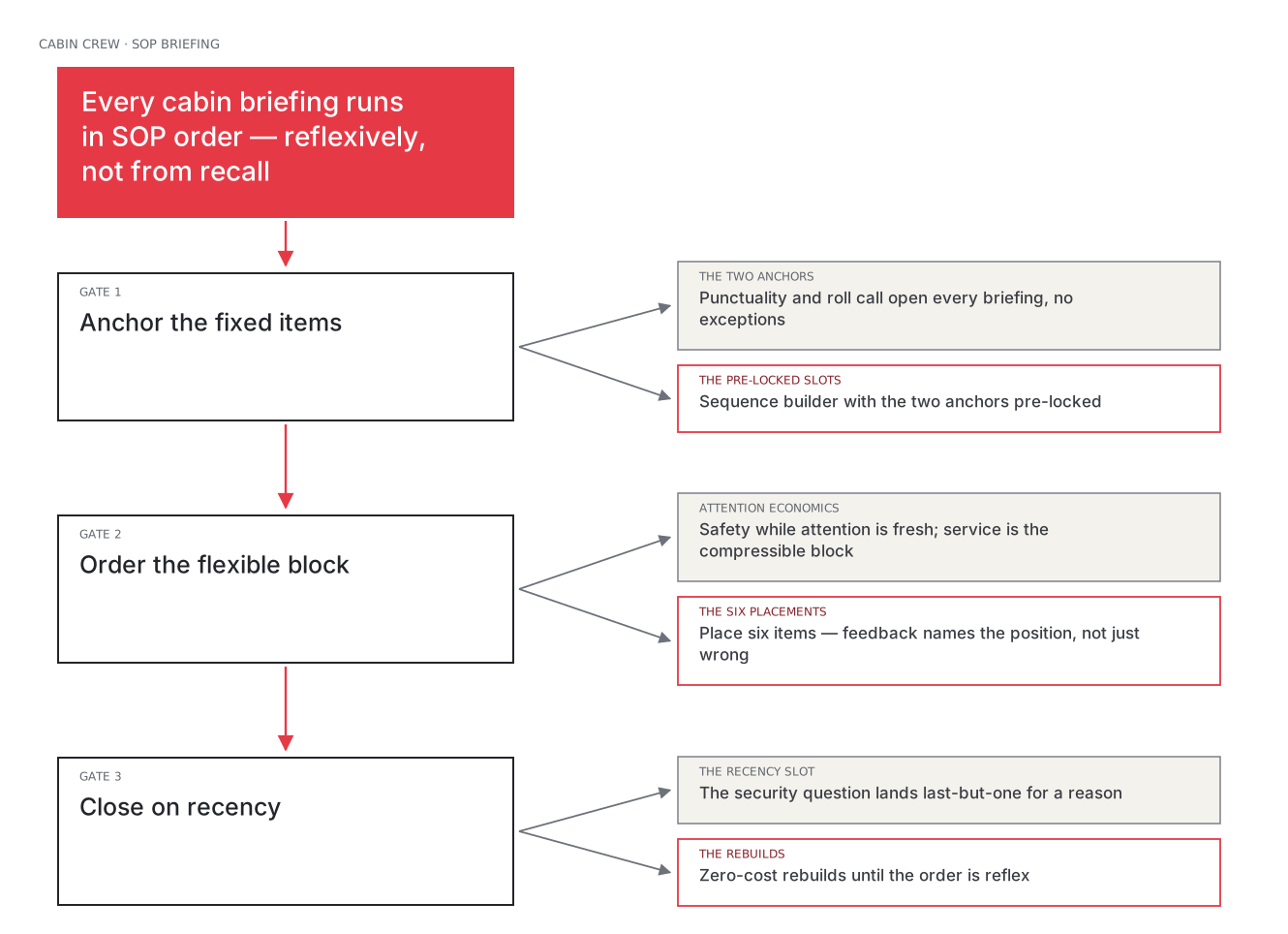
Production Sequence & Traceable Artifacts
The stages below show how the artifacts depend on each other. In this fictional case one designer produced all of them.
What would tell us it worked
A proposed plan. Nothing below has been measured.
| Question | Measure / instrument | When | What we would do with the answer |
|---|---|---|---|
| Can pursers hold the order? | Runs needed to a clean order; which position breaks most | Pilot with one base | If position 6 (security) breaks most, put it on the briefing card in bold |
| Do they flex the right item? | Disruption choices | Same pilot | Any safety or security cut leads to a conversation, not a score |
| Does the line change? | Line-check observation of briefing order on delayed departures | Next line-check cycle | Agree the observation item with line training |
Instructional Design Takeaway
“Why this form wins: the problem is sequence as reflex, so the solution rehearses the order itself with zero-cost rebuilds — fluency over luck — and feedback at the exact position where the model breaks.”
New cabin crew knew every briefing item and still delivered broken briefings — safety buried in service chatter, the security question asked too late. The failure was order, and order is SOP: identity → picture → safety → care flows → service → security → close. The proposal was a briefing-order builder: two anchor items fixed, six to place, position-level feedback at the first break-point explaining both items — yours and the one that belongs there.
Transparent Portfolio Scope
Honest limitation: an illustrative briefing order for teaching, not a real carrier’s SOP. Real briefings vary by operator, aircraft and route.