Dementia Communication: Join Her Reality
“She asks for her children every morning. The facts are gone; the feeling is the client.”
A reaction trainer with four moments, each scored on a single lens: did you join her reality or abandon it? The feedback explicitly teaches the anatomy — honour the emotion, skip the false fact, give the feeling somewhere to go (a walk, a story, a joint search, a window) — and names the therapeutic-fib debate honestly rather than pretending clean answers exist.
The Audience
Care staff on dementia wards — new caregivers, activity coordinators, ward hosts — plus family caregivers in informal-care training programs.
Responsibilities
Moment taxonomy · response design (validation vs correction vs deflection) · feedback philosophy (the feeling is the client) — presence made discussable.
The Build
Validation-approach (informed) scenario design · grief-modeling · ethical-dilemma feedback · AI-assisted drafting (disclosed)
How I used AI in this case
AI drafted moment variants and response phrasings for review against validation-approach literature; the moment taxonomy, the response anatomy and the ethical framing were authored by me. Edited, verified and disclosed.
The build itself, not a video about it — open it, make the calls, and read what each one costs.
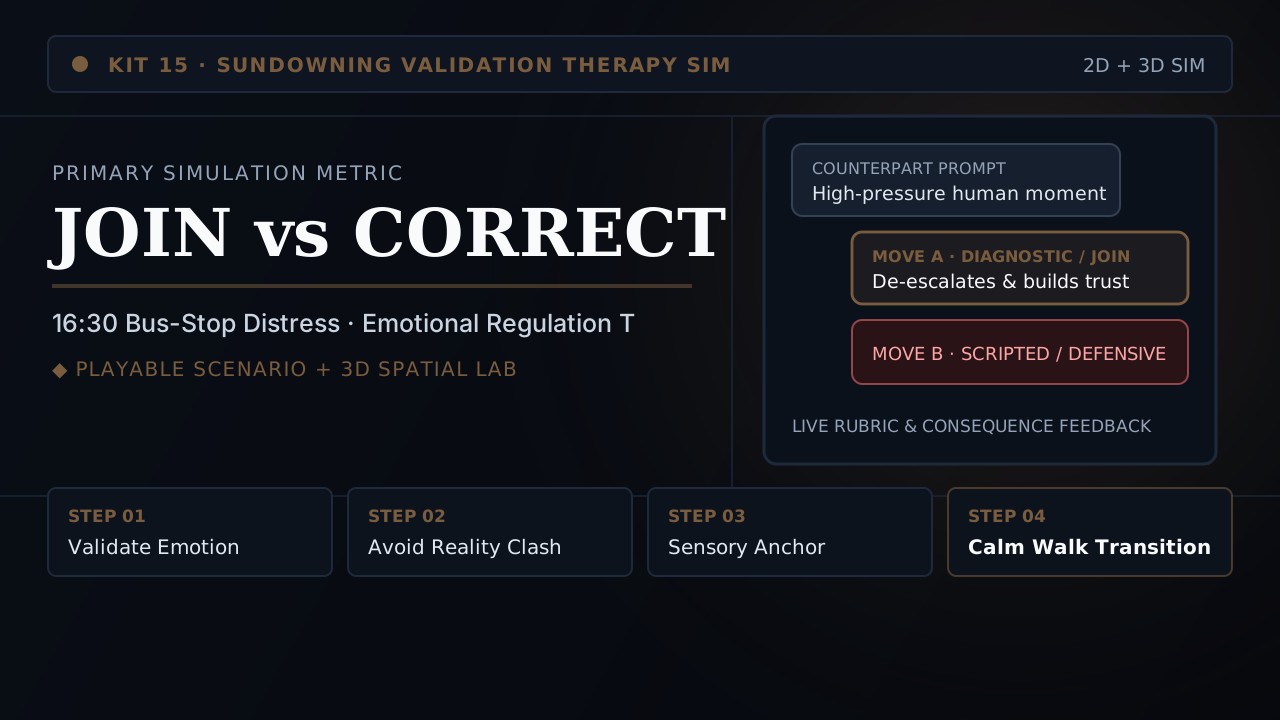
The Long Goodbye — Primary Build
The full trainer: four moments, single-lens scoring, anatomy debrief
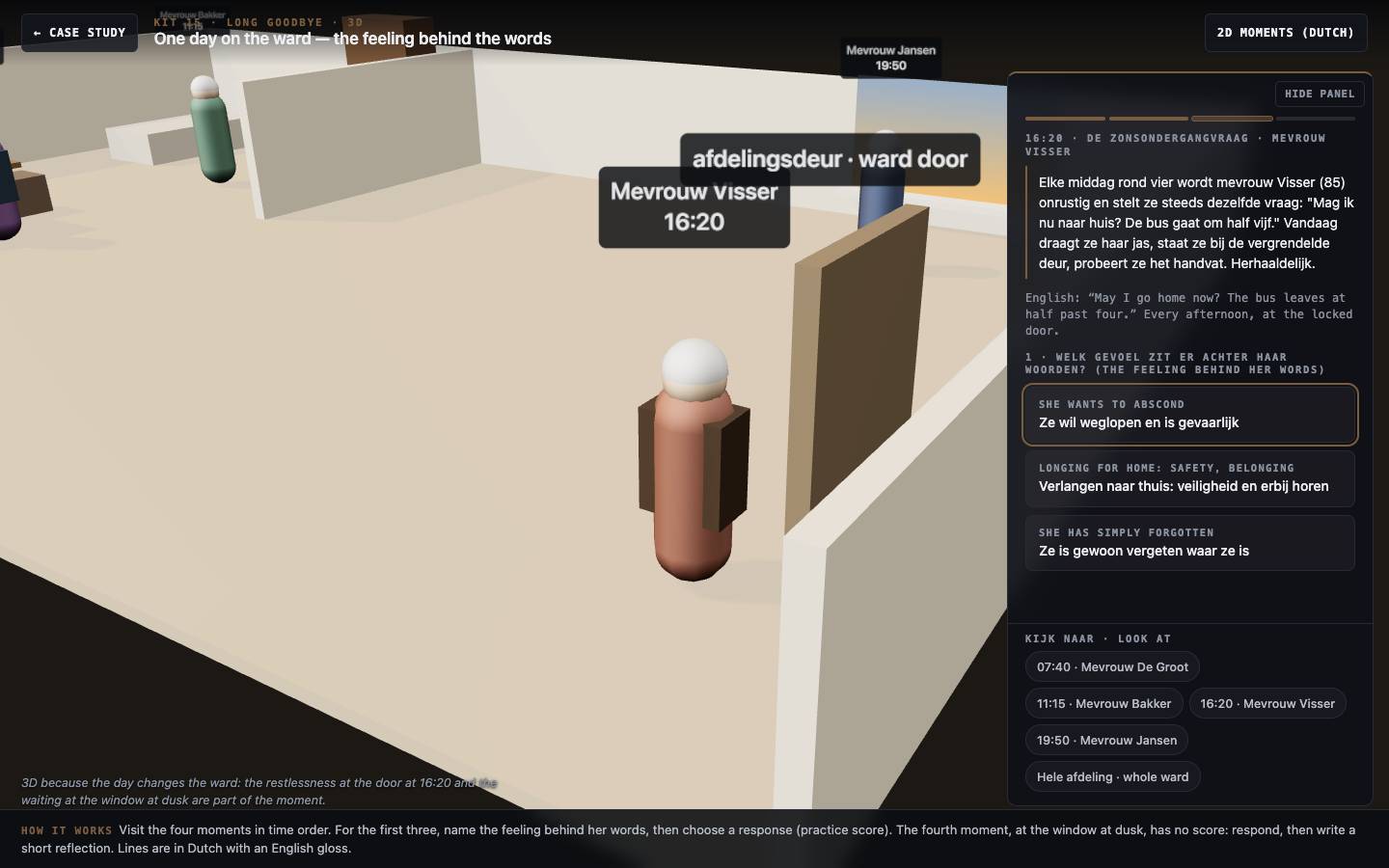
3D ward through one day
Visit four moments in time order as the light changes. Name the feeling, respond, and watch restlessness calm or grow; the last moment ends in reflection. Dutch with an English gloss.
Scene-by-Scene Storyboard & UI Spec
Scene plan: moments, join/correct/deflect forks, anatomy feedback, before build. Full branching dialogue, distractor rationales, and visual system tokens.
Why conventional training failed the operational reality
Dementia-communication training fails at the same four moments, every ward, every shift:
The gap: staff are trained in facts, safety and tasks. Nobody practices the feeling-first reflex — honoring the emotion while skipping the false fact — because it contradicts every correctness instinct the rest of life rewards.
Core diagnostic finding
In this fictional brief, care staff answered residents accurately and it went badly: the truth used as a wall, self-defence against an accusation, a death re-announced. Every correctness instinct is wrong in these moments, so they have to be practised: name the feeling, let the wrong facts rest, give the feeling somewhere to go.
The feeling is the client
Illustrative premise: used as a wall — "your children are adults now" is accurate and cruel
Design Constraint → Build Rule: Scoring joins-her-reality vs corrects-her-facts required a feedback philosophy that honours the emotion without endorsing the false fact — the single lens every moment is scored on.
Give the feeling somewhere to go
Illustrative premise: against theft accusations — technically right, relationally fatal
Design Constraint → Build Rule: Every right answer needs an exit: a walk, a story, a joint search, a window. Writing four endings that redirect without lying took the most drafts.
Honesty about the debate
Illustrative premise: the dead — reminding her of the death is breaking news every time
Design Constraint → Build Rule: Validation-informed care is contested. The debrief names the disagreement instead of pretending consensus — care staff deserve the real picture.
The feeling is the client
Performance problem
In this fictional care home, incident notes on a closed ward show agitation escalating after staff corrected residents. New and agency staff have dementia training on paper but little practice in the moment.
Learners and context
Care staff (verzorgenden, helpenden), including agency and new staff, working in Dutch. Short on time; the trainer takes about 10 minutes on a phone and is in Dutch, as the work is.
Is training the answer? Not on its own
- Staffing at 16:00. Restlessness peaks in the late afternoon. One more pair of hands or an afternoon activity prevents more escalation than any communication script.
- Care plans. Each resident’s life story (children’s names, the bus route, Pieter) should be in the plan so every carer can join the same reality. That is a documentation practice.
- Team reflection. Moments like the fourth need a team conversation, not a score. A monthly reflection moment is a team-leader decision.
Alignment: every objective has practice, evidence, feedback and a route back to the job
| Objective | Practice | Assessment | Feedback | Transfer |
|---|---|---|---|---|
| LO1 Name the feeling behind a resident’s words | Three moments with three possible feelings | 1 point each | Names the more likely feeling | Life-story notes in the care plan (recommended) |
| LO2 Respond to the feeling and give it somewhere to go | Three responses per moment | 2 / 1 / 0 (practice score) | Explains why truth as a wall escalates; in 3D restlessness calms or grows | Handover note: what worked with her today |
| LO3 Reflect on a moment with no right answer | The husband who is not coming | Not scored; a written reflection completes the module | Discusses the therapeutic-lie debate honestly | Monthly team reflection (recommended) |
Evidence register: what is real, what is invented
- Fictional premise Woonzorg De Vlinderhof, the residents and the incident notes.
- Design decision The practice score, the unscored fourth moment and the completion rule.
- Not measured Agitation, incidents or staff confidence. A “caregiver pilot” quote and a 7/8 target on the earlier page were not results.
Measurable Performance Objectives
Three objectives. The scoring philosophy is now stated plainly: practice moments are scored, the hardest moment is not.
Name the feeling behind a resident’s words — care, fear of losing control, longing for home.
Evidence in the build: the feeling step on three moments (1 point each).
Respond to that feeling and give it somewhere to go, without correcting the facts.
Evidence in the build: the response (2 / 1 / 0, practice score).
Reflect in writing on a moment that has no right answer.
Evidence in the build: moment 4: a written reflection, not scored.
Why This Modality Won (Trade-Off Analysis)
Before committing to the final architecture, we evaluated and rejected lower-transfer alternatives against the workplace constraints:
Scales across the ward easily. Rejected because the moments demand presence, not information: staff already knew validation theory — the trainer exists because knowing it and doing it at the door are separated by forty years of correctness instinct.
The gold standard, genuinely. Rejected as the baseline format on cost and consistency — actor hours are scarce and sessions vary. The trainer gives every staff member unlimited baseline practice; the actors remain the advanced layer when the budget allows.
A reaction trainer with four moments, each scored on a single lens: did you join her reality or abandon it? The feedback explicitly teaches the anatomy — honour the emotion, skip the false fact, give the feeling somewhere to go (a walk, a story, a joint search, a window) — and names the therapeutic-fib debate honestly rather than pretending clean answers exist.
Why feeling first
Validation, simplified
Inspired by validation thinking (Feil, de Klerk-Rubin): the feeling is real even when the facts are not. Asking for the feeling before the response makes that the habit.
Why one unscored moment
Some questions stay open
Whether a therapeutic lie is ever right is debated in care. Scoring it would pretend otherwise; reflection is the honest format.
Why 3D here
The day shapes the moment
The ward’s light moves from morning to dusk; the restlessness at the door at 16:20 and the waiting at the window are part of what the carer meets.
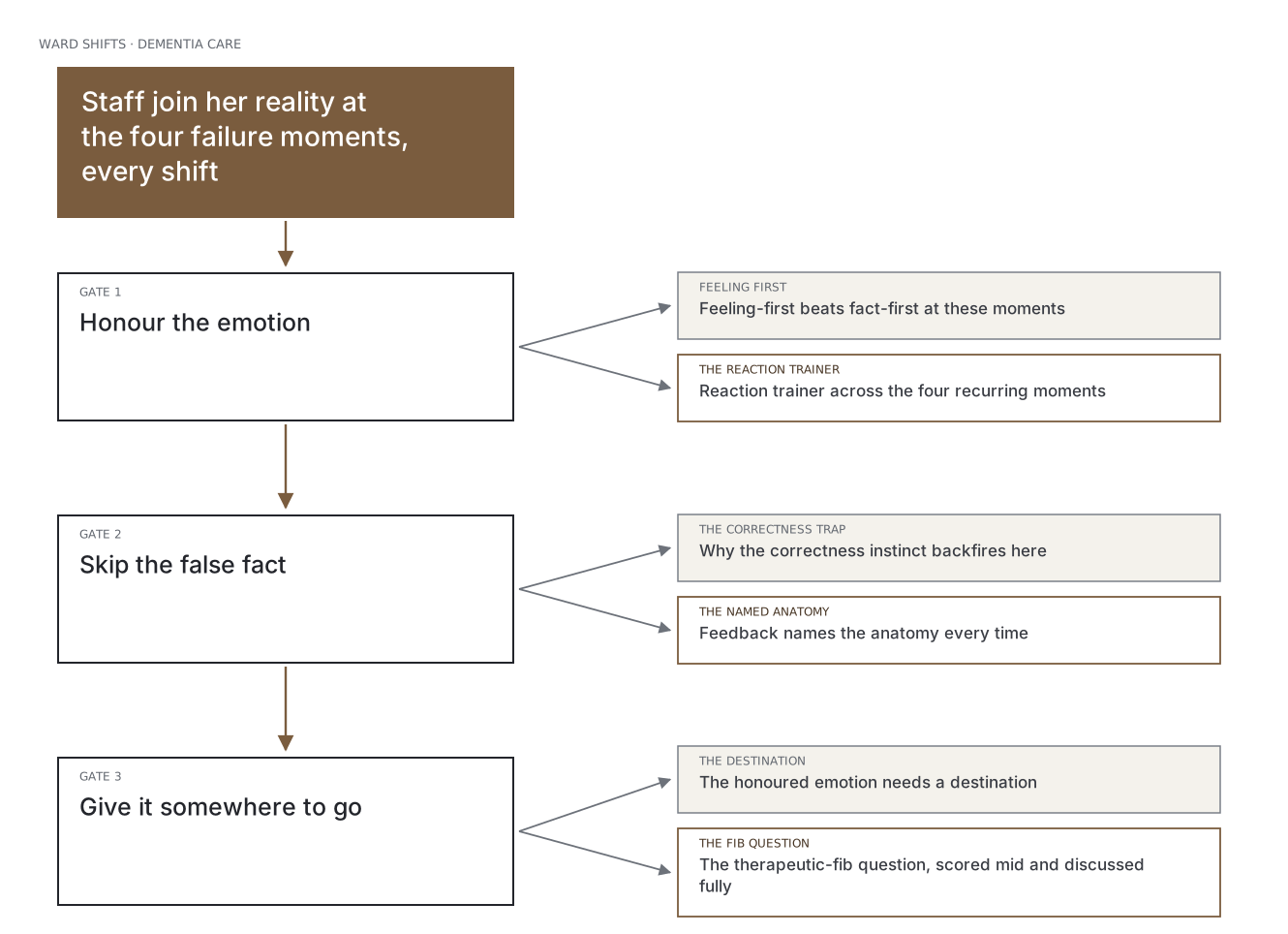
Production Sequence & Traceable Artifacts
The stages below show how the artifacts depend on each other. In this fictional case one designer produced all of them.
What would tell us it worked
A proposed plan. Nothing below has been measured.
| Question | Measure / instrument | When | What we would do with the answer |
|---|---|---|---|
| Do carers name the feeling? | Feeling-step accuracy and response choices | Pilot with one ward team | If the accusation moment is mostly answered with self-defence, practise it live in a team meeting |
| What do the reflections say? | Team leader reads reflections on moment 4 (anonymised) | Same pilot | Use them as material for the team reflection, not as a score |
| Does practice change? | Agitation incidents in the afternoon, before and after, read with staffing levels | Three months | Do not credit training if staffing changed at the same time |
Instructional Design Takeaway
“Why this form wins: the problem is instinct itself, so the solution practises accompaniment on three moments and leaves the hardest one unscored: honour the emotion, skip the false fact, give the feeling somewhere to go.”
Dementia-ward incidents shared a signature: staff responding accurately and relationally fatally — using truth as a wall, self-defending against an accusation, re-announcing a death. Every correctness instinct life rewards is wrong in these moments, which is exactly why they must be practiced. The proposal: three practice moments (name the feeling, then respond) and a fourth that is deliberately not scored, because whether a therapeutic lie is ever right is an open question in care; it ends in reflection.
Transparent Portfolio Scope
Honest limitation: four scripted moments, simplified from validation practice. Not clinical advice; care decisions belong to the multidisciplinary team and the person’s care plan.