Implementation Governance: Compliance vs Custodianship
“The pilot worked. Now it must land — and applause is not ownership.”
A governance move board: four factions whose willingness stays hidden until you learn it, six moves, four quarters, one move each. Mandating after co-owning lands on prepared ground; formalizing locks in only ownership that exists; a handover lands only on a faction that already holds the practice. The debrief scores durable ownership per faction and shows the four-step sequence that fits the quarters.
The Audience
Programme and implementation managers in universities, government and public knowledge institutions.
Responsibilities
Faction modelling · move design · sequence-dependent outcomes · governance debrief — implementation as willingness and ownership.
The Build
Systems modelling · branching outcomes · governance design · AI-assisted drafting (disclosed)
How I used AI in this case
AI helped draft faction-dossier wording and outcome-sentence variants; the faction modelling, the outcome rules and the sequence-dependent logic were designed by hand. Edited, verified and disclosed.
The build itself, not a video about it — open it, make the calls, and read what each one costs.
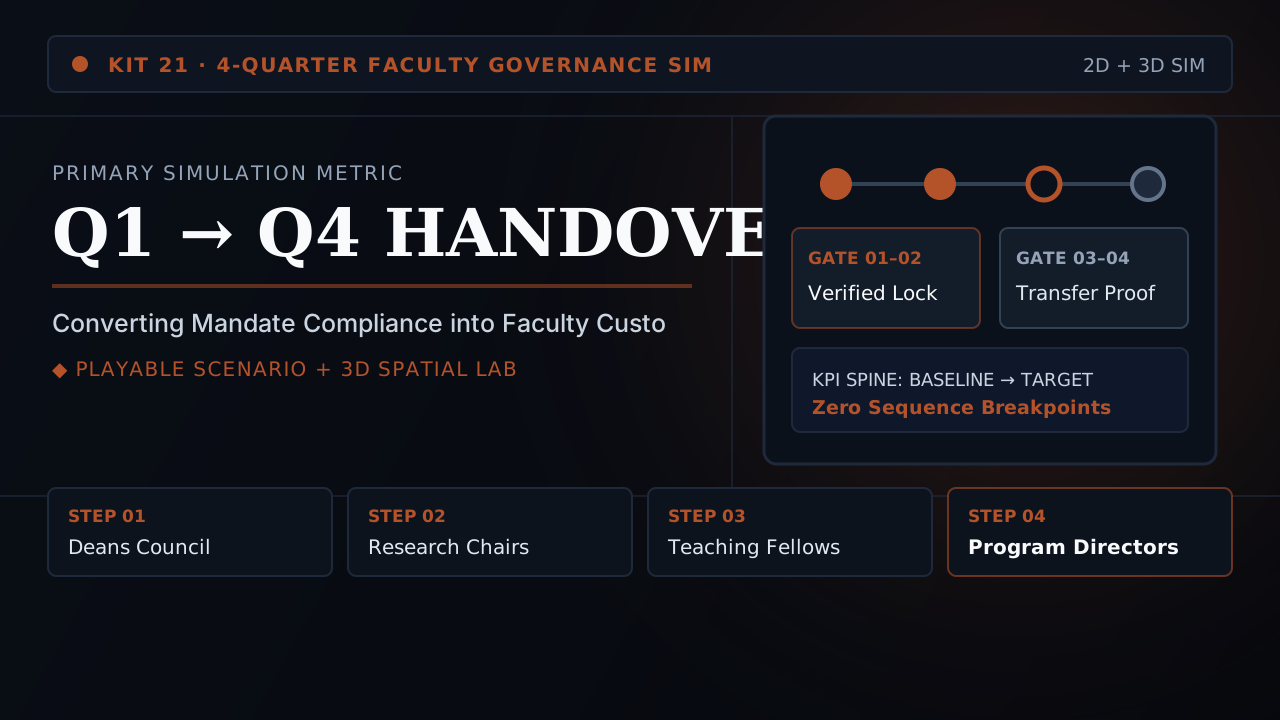
The Quad — Primary Build
The full simulation: hidden willingness, sequence readouts, governance debrief
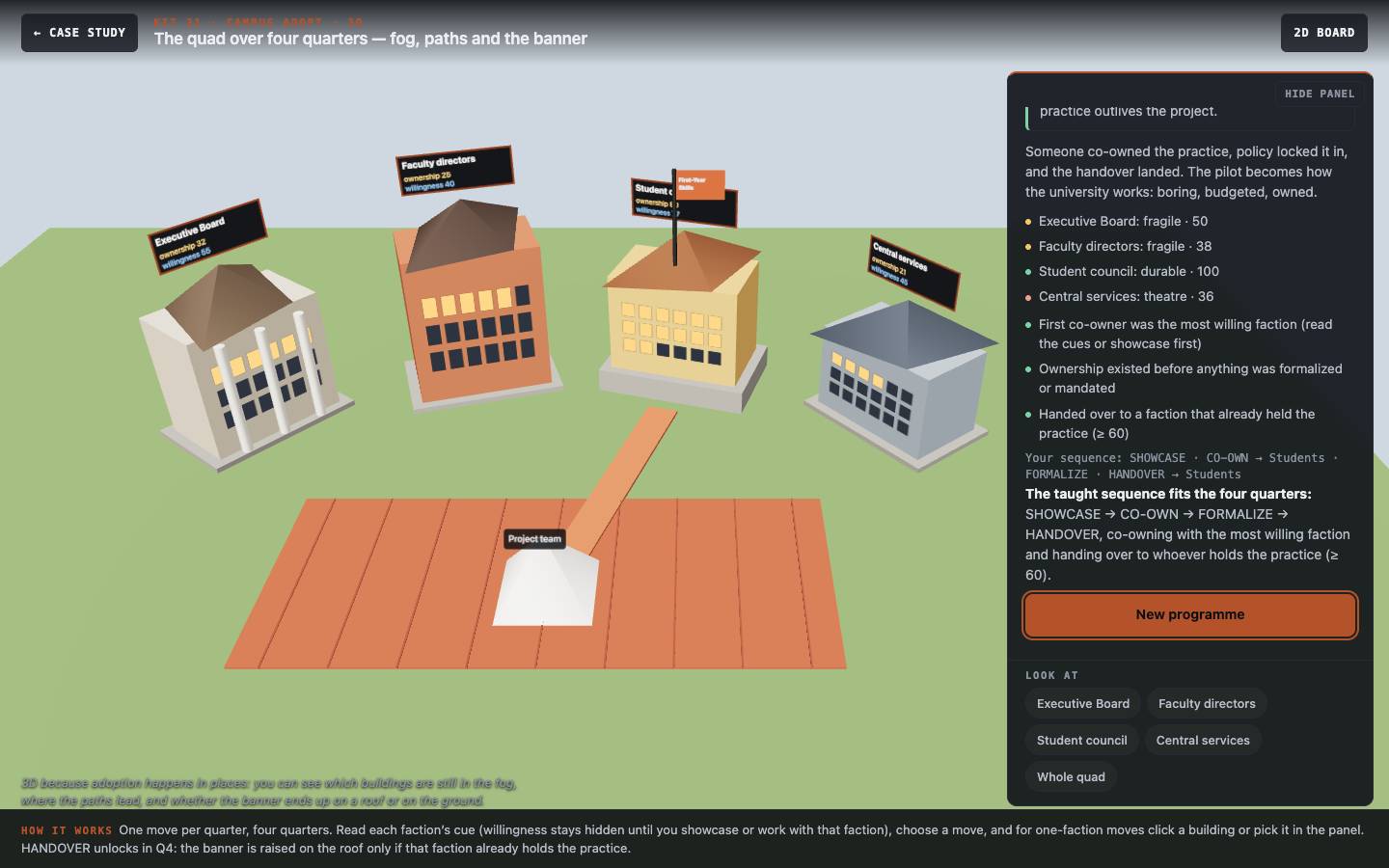
3D campus quad
Four faction buildings around a quad, some in the fog. Choose one move per quarter; co-owning lays a path, formalizing raises a plinth, and in Q4 the banner walks to the building you hand it to.
Scene-by-Scene Storyboard & UI Spec
Scene plan: four quarters, six moves, sequence-dependent readouts, before build. Full branching dialogue, distractor rationales, and visual system tokens.
Why conventional training failed the operational reality
Programmes end and practices die, in one of two rational ways:
Both failure modes feel like leadership. Neither survives the twelve-month mark when the project funding stops.
Core diagnostic finding
In this fictional brief, a pilot worked in two faculties and then stalled. The programme alternated between showcasing results and asking for a mandate; nobody outside the project team held the practice when the funding ended.
Hidden willingness without unfairness
Illustrative premise: mandate — instant coverage, instant resistance, zero custodians
Design Constraint → Build Rule: Factions have hidden postures, but the board must stay solvable: every outcome had to be traceable to moves the player could have read — no gotchas.
Sequence is the lesson
Illustrative premise: endless showcase — real applause, no structure, dies at funding end
Design Constraint → Build Rule: MANDATE before CO-OWN must fail differently than after. Encoding that ordering logic — formalizing locks in only ownership that exists — was the core design work.
Two currencies, one board
Design premise: see the design brief below for the constraint this rule answers
Design Constraint → Build Rule: Willingness (readiness, hidden until learned) and ownership (what a faction holds) move differently. The board names both the same way everywhere and never calls either a currency to spend.
Hand it to whoever holds it
Performance problem
In this fictional university, a first-year skills pilot showed good results in two of eight faculties (an illustrative premise, not data). The Vice-Dean wants it to become how the university works; the project funding ends in twelve months.
Learners and context
Programme and implementation managers in universities and public organisations. One play takes about 8 minutes; the debrief is the teaching moment.
Is training the answer? Not on its own
- Funding model. A project budget that ends with no receiving budget line produces theatre whatever the sequence.
- Consultation. Central services had never been asked about workload; asking is a governance step.
- Plan template. A programme plan with a required “receiving owner” field makes the handover visible from day one.
Alignment: every objective has practice, evidence, feedback and a route back to the job
| Objective | Practice | Assessment | Feedback | Transfer |
|---|---|---|---|---|
| LO1 Read faction cues to choose the first co-owner | Willingness fog; cues always readable | First co-owner is the most willing faction | Debrief check plus revealed willingness | Stakeholder read before the next launch |
| LO2 Build ownership before formalizing or mandating | Move order over four quarters | CO-OWN precedes FORMALIZE and MANDATE | Formalize locks in only ownership ≥ 40; mandate-first collapses willingness | Plan template with move order (recommended) |
| LO3 Hand the practice to the faction that holds it | Q4 HANDOVER | Receiving faction ownership ≥ 60 | The banner lands on the roof or droops | “Receiving owner” field in the programme plan |
Evidence register: what is real, what is invented
- Fictional premise Noorderlicht University, the factions, their cues and the pilot result.
- Illustrative values Starting willingness and ownership, move effects and the 40 / 60 thresholds. A model for reasoning, not a measured system.
- Design decision The four-step taught sequence (the earlier debrief taught five steps in a four-quarter game) and the endings.
- Not measured Whether managers transfer the habit. The earlier L2 target counted a “mixed landing” as success; replaced.
Measurable Performance Objectives
Three objectives, one per habit the debrief checks.
Use each faction’s public cue (or a showcase) to find the faction most willing to co-own the practice before giving anyone authority.
Evidence in the build: who receives the first CO-OWN.
Build ownership before formalizing or mandating, so policy locks in something people already hold.
Evidence in the build: move order across the four quarters.
Hand the practice to the faction that already holds it, not to the sponsor.
Evidence in the build: the receiving faction’s ownership at handover (≥ 60).
Why This Modality Won (Trade-Off Analysis)
Before committing to the final architecture, we evaluated and rejected lower-transfer alternatives against the workplace constraints:
The standard answer in every programme office. Rejected because the frameworks were already on the bookshelf — the failure is allocating four quarters of scarce moves between visibility and structure, which no framework slide makes you feel. The board makes the trade-off physical.
Agile and honest. Rejected because willingness and ownership are hard to see in live play — you discover in month nine that two quarters went to applause, and by then the funding calendar has decided for you. The board is where the allocation is rehearsed before the calendar enforces it.
A governance move board: four factions whose willingness stays hidden until you learn it, six moves, four quarters, one move each. Mandating after co-owning lands on prepared ground; formalizing locks in only ownership that exists; a handover lands only on a faction that already holds the practice. The debrief scores durable ownership per faction and shows the four-step sequence that fits the quarters.
Why fog
Read before you move
The earlier board showed every faction’s willingness from the start, so there was nothing to read. Hiding it behind cues makes the stakeholder read part of the decision.
Why four steps
A sequence that fits
Teaching a five-step sequence in a four-quarter game told learners the ideal was impossible. The taught sequence now fits, and other good orders still work.
Why 3D here
Where it lands
Adoption happens in buildings: you can see which are still in the fog, where the paths lead, and whether the banner ends on a roof or on the ground.
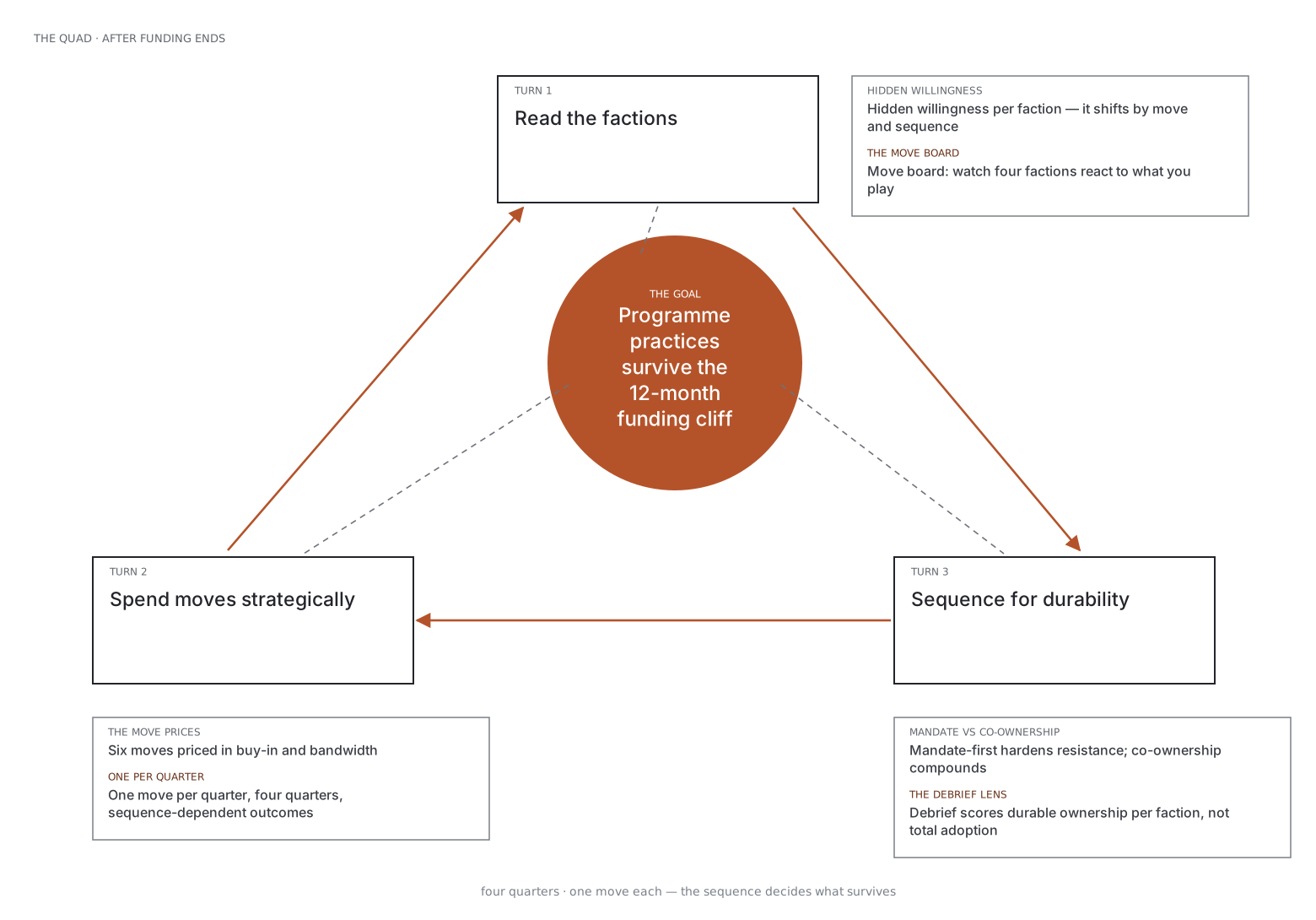
Production Sequence & Traceable Artifacts
The stages below show how the artifacts depend on each other. In this fictional case one designer produced all of them.
Evaluation plan (proposed)
A proposed plan. Nothing below has been measured.
| Question | Measure / instrument | When | What we would do with the answer |
|---|---|---|---|
| Do managers read before moving? | Share of first plays whose first co-owner is the most willing faction | Workshop pilot | If low, put the cues on the board before the moves |
| Do they reach a landed handover? | Share reaching Embedded (not Mixed) by the second play | Same pilot | Mixed landings are failures; review which check fails most |
| Does it change plans? | Programme plans with a named receiving owner per practice | Next two programme launches | If absent, add the field to the plan template |
Instructional Design Takeaway
“Why this form wins: four moves have to be split between applause and structure, and the board makes the result visible: whose building is still in the fog, where the paths lead, and whether the banner lands on a roof.”
The pilot worked; the question was whether the practice would outlive the project funding. Implementation fails in two rational ways — day-one mandates that buy compliance without custodians, and endless showcasing that builds applause instead of structure. The proposal was a governance move board: four factions, six move types, four quarters, making willingness and ownership visible enough to reason about.
Transparent Portfolio Scope
Honest limitation: a fictional university and an illustrative model. Real implementations have more stakeholders and more than four quarters; the board trains reading, sequencing and handover, not a playbook.