Student Wellbeing Conversations: Join, Refer, Follow Up
“Every student opens with one problem and is really carrying another.”
Dialogue forks with a referral dial: three replies per room (the join, advice-splash, and the correct-service-closed-door), then LISTEN MORE / REFER NOW / REFER + CHECK-BACK. Feedback names what each choice cost; the debrief scores full sequences and explains why partial sequences fail.
The Audience
Student advisors, tutors and wellbeing staff — first conversation training before shadowing hours.
Responsibilities
Decoy-ask writing · defensible-wrong calibration · referral-dial mechanics · safe-scope design — sequence as the trained unit.
The Build
Dialogue design · referral pathways · scoring design · AI-assisted drafting (disclosed)
How I used AI in this case
AI drafted decoy-ask variants and dialogue phrasings; the reply-dial mechanics, defensible-wrong calibration and safe-scope design were authored by me. Edited, verified and disclosed.
The build itself, not a video about it — open it, make the calls, and read what each one costs.
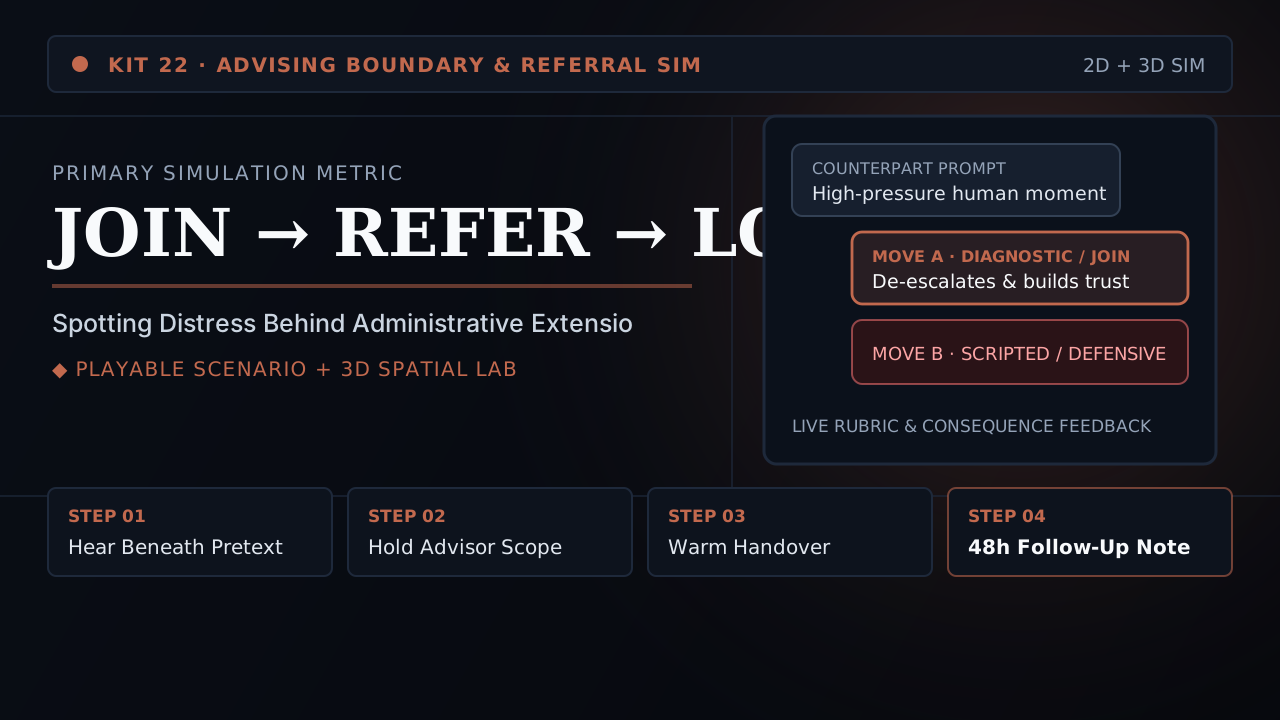
Four Rooms — Primary Build
The full trainer: four rooms, referral dial, sequence scoring, safe-scope debrief
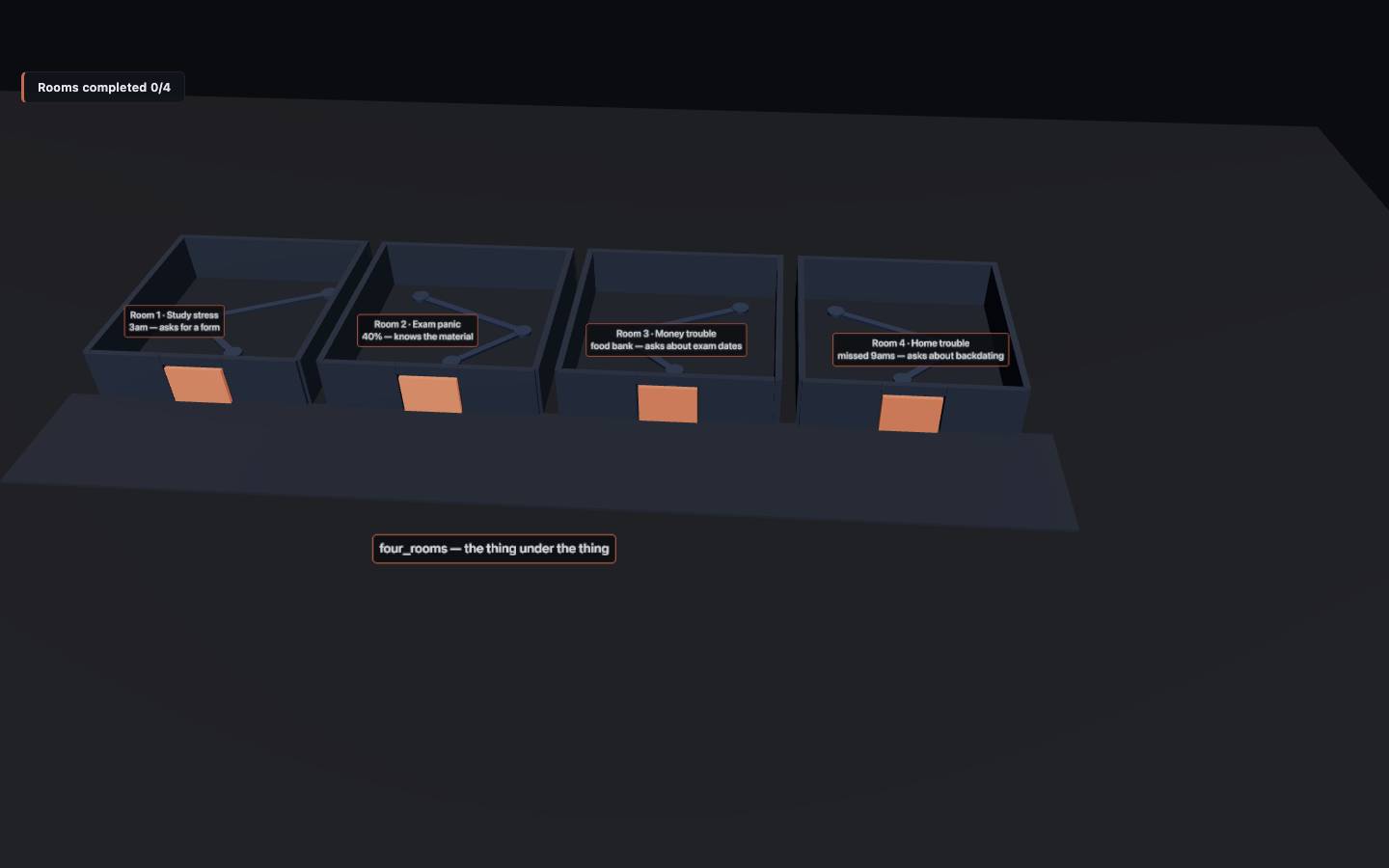
3D corridor of four rooms
Open each door, join the student, choose the service that fits and set the check-back. The floor track lights only for earned steps; a wrong-service referral turns it red.
Scene-by-Scene Storyboard & UI Spec
Scene plan: four rooms, three-reply forks, dial choices, before build. Full branching dialogue, distractor rationales, and visual system tokens.
Why conventional training failed the operational reality
Each room opens with a decoy: the stated ask is real, answerable — and not the point.
Answer the question, miss the person. The drill scores the sequence because every partial sequence fails differently.
Core diagnostic finding
In this fictional brief, desk staff knew every service. Students still fell through because the stated ask was answered (an extension form, an exam date), the referral went to the service that matched the ask instead of the problem, or nobody checked back. The sequence has to be practised as one unit.
Advice-splash is the enemy
Illustrative premise: the study-stress student asks for a form; the case is the spiral the form lives inside
Design Constraint → Build Rule: The tempting failure is helping too much, too fast. Each room's advice-splash reply had to be genuinely kind — and genuinely out of scope.
Defensible wrong answers
Illustrative premise: the exam-panic student knows the material — panic is a performance condition, not a knowledge gap
Design Constraint → Build Rule: Distractors must be wrong for named reasons a supervisor would endorse, not strawmen. The defensible-wrong calibration took the longest.
Sequences over moments
Design premise: see the design brief below for the constraint this rule answers
Design Constraint → Build Rule: Scoring full sequences — join, listen, refer, check-back — instead of single choices makes the trained unit the conversation, not the click.
Join, refer to the service that fits, check back
Performance problem
At this fictional university’s student desk, staff answer the question students ask. Wellbeing issues surface later, in attendance and results, after the student has already been through the desk.
Learners and context
Student-desk staff and peer mentors. Friendly and knowledgeable about procedures; not counsellors and not expected to be. About 10 minutes, ideally before term starts.
Is training the answer? Not on its own
- Logging check-backs. A check-back only happens if the desk has a simple way to note and remind. Without a log, “I’ll check in next week” is a hope.
- Service capacity. Referring to a counsellor with a six-week wait is not a referral. Waiting times are a capacity issue for student services.
- Warm handover. Services that accept a call or an email from the desk (with consent) make referrals land; that is an agreement between departments.
Alignment: every objective has practice, evidence, feedback and a route back to the job
| Objective | Practice | Assessment | Feedback | Transfer |
|---|---|---|---|---|
| LO1 Join the thing under a decoy ask | Four opening lines with three replies each | Best / mid / no | Names what each reply cost | Opening question prompt card at the desk |
| LO2 Refer to the service that fits the real issue | Service directory with a plausible wrong service per room | Fitting service required for a full sequence | Explains why the stated-ask service misses | Service directory with “what it is really for” notes (proposed) |
| LO3 Agree and keep a check-back | Follow-up dial | Refer + check-back required for a full sequence | “One week later” outcome | Check-back log at the desk (recommended) |
Evidence register: what is real, what is invented
- Fictional premise The university, its services and the four students.
- Design decision The service directory, the full-sequence rule and the scoring.
- Not measured Referral uptake or student outcomes.
Measurable Performance Objectives
Three objectives. The service choice (LO2) was named before but never practised; it is now a scored step.
Respond to the thing under a student’s stated ask before answering the ask itself.
Evidence in the build: the reply in each room.
Refer to the service that fits the real issue, not the one that fits the stated ask.
Evidence in the build: the service step; the wrong service breaks the sequence.
Agree a concrete check-back so the referral is followed up.
Evidence in the build: the follow-up dial and the one-week-later outcome.
Why This Modality Won (Trade-Off Analysis)
Before committing to the final architecture, we evaluated and rejected lower-transfer alternatives against the workplace constraints:
Accurate and easy to deliver. Rejected because the staff could already name every service — the scored failures were sequence failures: correct destination, zero join, no check-back. A directory maps the roads; it doesn't teach crossing them with someone.
The gold standard for conversation practice. Rejected as the baseline on cost and consistency: actor hours are finite and session quality varies. The trainer gives every staff member unlimited consistent practice first; actors remain the advanced calibration layer.
Dialogue forks with a referral dial: three replies per room (the join, advice-splash, and the correct-service-closed-door), then LISTEN MORE / REFER NOW / REFER + CHECK-BACK. Feedback names what each choice cost; the debrief scores full sequences and explains why partial sequences fail.
Why a decoy ask
The first question is rarely the question
Each student asks something answerable. Answering it well is the tempting failure; the practice is noticing what sits under it.
Why one unit
A sequence, not three skills
Join without refer is a warm dead end; refer without join is a closed door; refer without check-back is a coin-flip. Scoring them together reflects how they fail together.
Why 3D here
Doors and floor tracks
Four rooms off one corridor, with a track from each door that lights only for steps actually earned. The step names appear only when reached, so the floor shows progress without giving away the order.
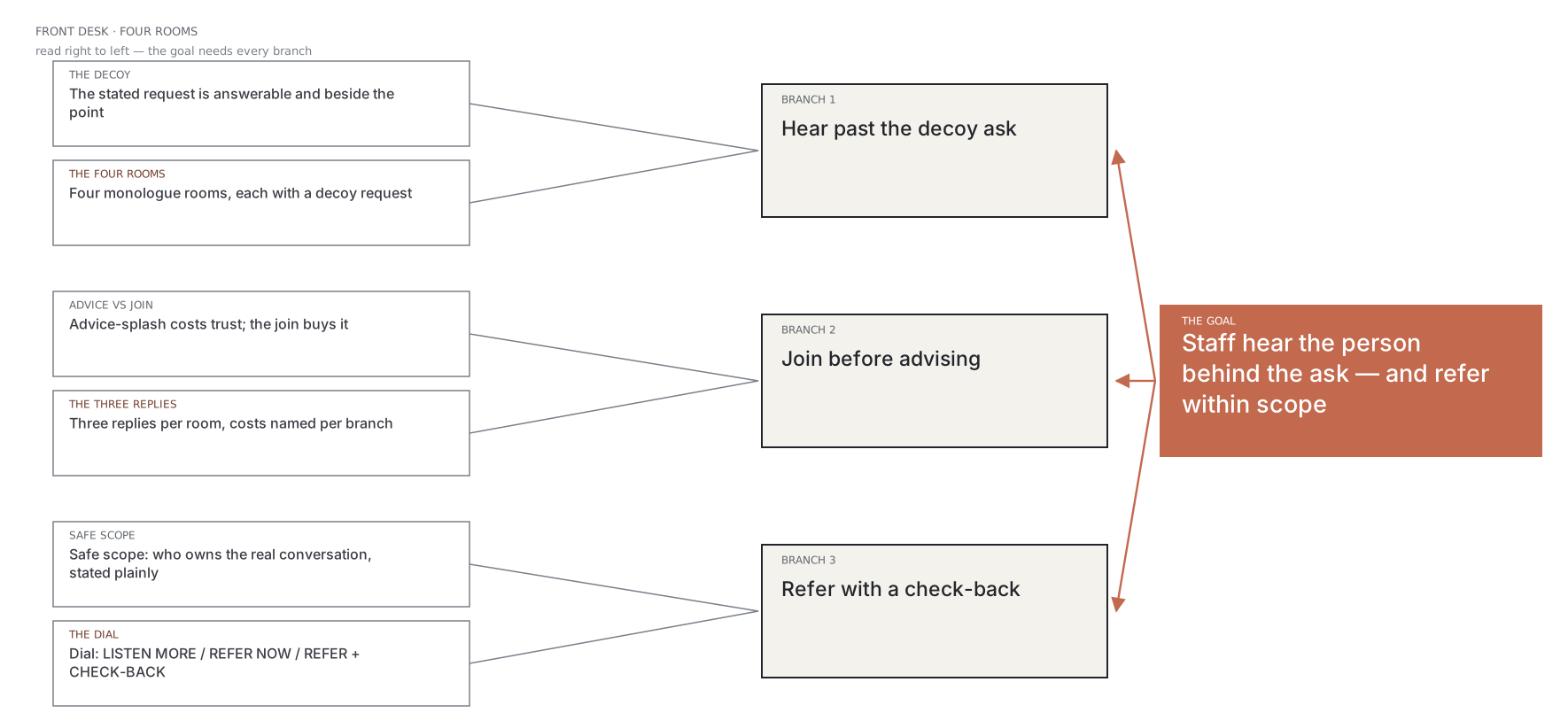
Production Sequence & Traceable Artifacts
The stages below show how the artifacts depend on each other. In this fictional case one designer produced all of them.
What would tell us it worked
A proposed plan. Nothing below has been measured.
| Question | Measure / instrument | When | What we would do with the answer |
|---|---|---|---|
| Do staff pick fitting services? | Service accuracy per room | Pilot with one desk team | If room 3 is mostly sent to the exams office, add the money case to the opening briefing |
| Do check-backs happen? | Check-backs logged vs agreed | First month of term | Requires a log; set it up before measuring |
| Do referrals land? | Services report referrals from the desk (with consent) | One term | Agree the data with student services first |
Instructional Design Takeaway
“Why this form wins: the problem is sequence, not service knowledge, so the solution scores join → refer → follow up as one unit — because partial sequences fail silently while feeling like good conversations.”
Student wellbeing training named every service on campus; the conversations still failed — because a correct referral through a closed door helps nobody. The failure is sequence: join the thing under the thing, then refer, then follow up. The proposal was a dialogue-fork trainer with a referral dial: four distressed-but-safe rooms where the stated ask is always a decoy, three replies each, and a follow-up dial scored as part of the same unit.
Transparent Portfolio Scope
Honest limitation: four scripted rooms. Desk staff are not counsellors; the trainer rehearses the first minutes and the handover, not therapy.