Feedback Conversations: Run-Sheet, Role-Play, Rubric
“Team leads aren't avoiding feedback — they're delivering it in a form that triggers defensiveness.”
A 90-minute practice workshop around SBI-C (Situation, Behaviour, Impact, Commitment): a fishbowl round where observers calibrate their scoring, two rubric-scored role-play rounds whose delta is the learning evidence, and a commitment booked in the calendar before anyone leaves. A 3D simulator lets facilitators rehearse the four calls where the room is most likely to break.
The Audience
80 team leads at Brinkhaven Facilities Group (1,100 employees, post-restructure) — cohorts of max 14, volunteer-first pairing with an opt-out clause for psychological safety.
Responsibilities
Workshop design · run-sheet with recovery lines · observer rubric · fishbowl calibration · evaluation plan · facilitation simulator.
The Build
Role-play design · SBI-C · observer rubric (HTML) · Three.js simulator · Kirkpatrick at event scale · AI-assisted drafting (disclosed)
How I used AI in this case
AI drafted role-play scenario variants and rubric wording options; the workshop structure, the run-sheet with recovery lines, the simulator’s calls and consequences and the evaluation plan were designed by me. Edited and checked; use disclosed.
The build itself, not a video about it — open it, make the calls, and read what each one costs.
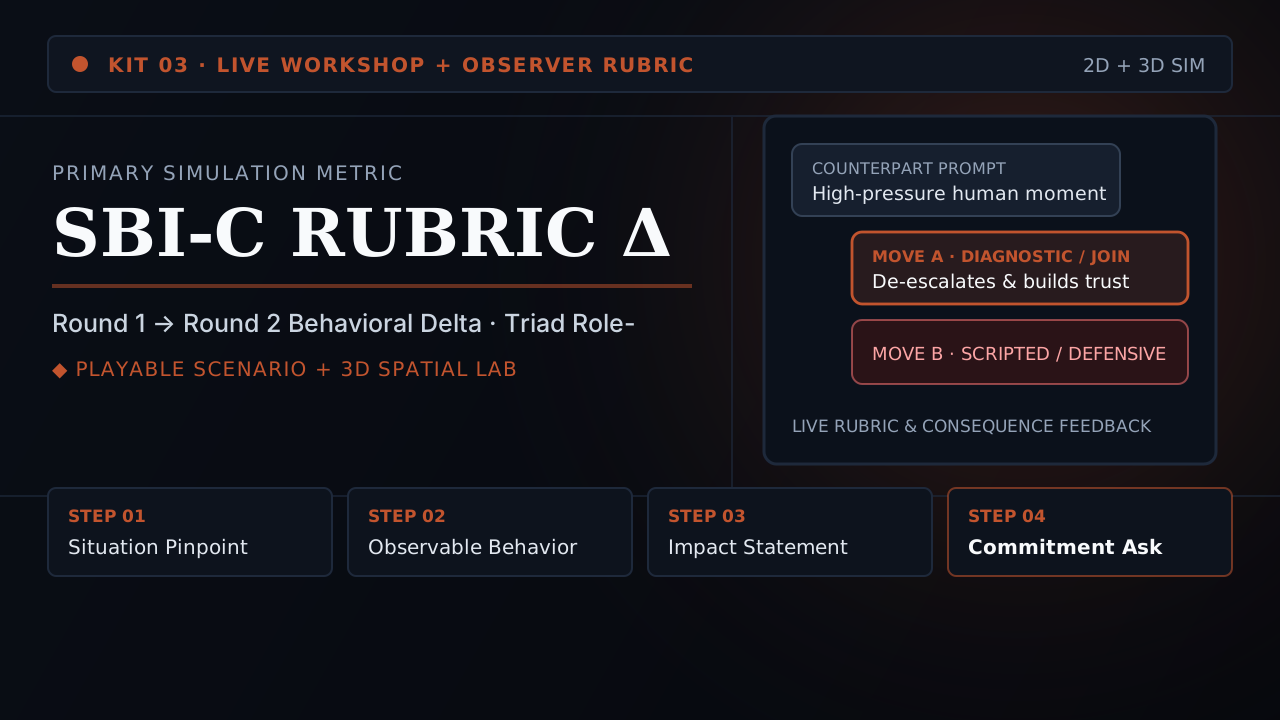
Facilitator Guide — Primary Build
The full workshop kit: pre-work, run-sheet, scored rounds, commitment cards
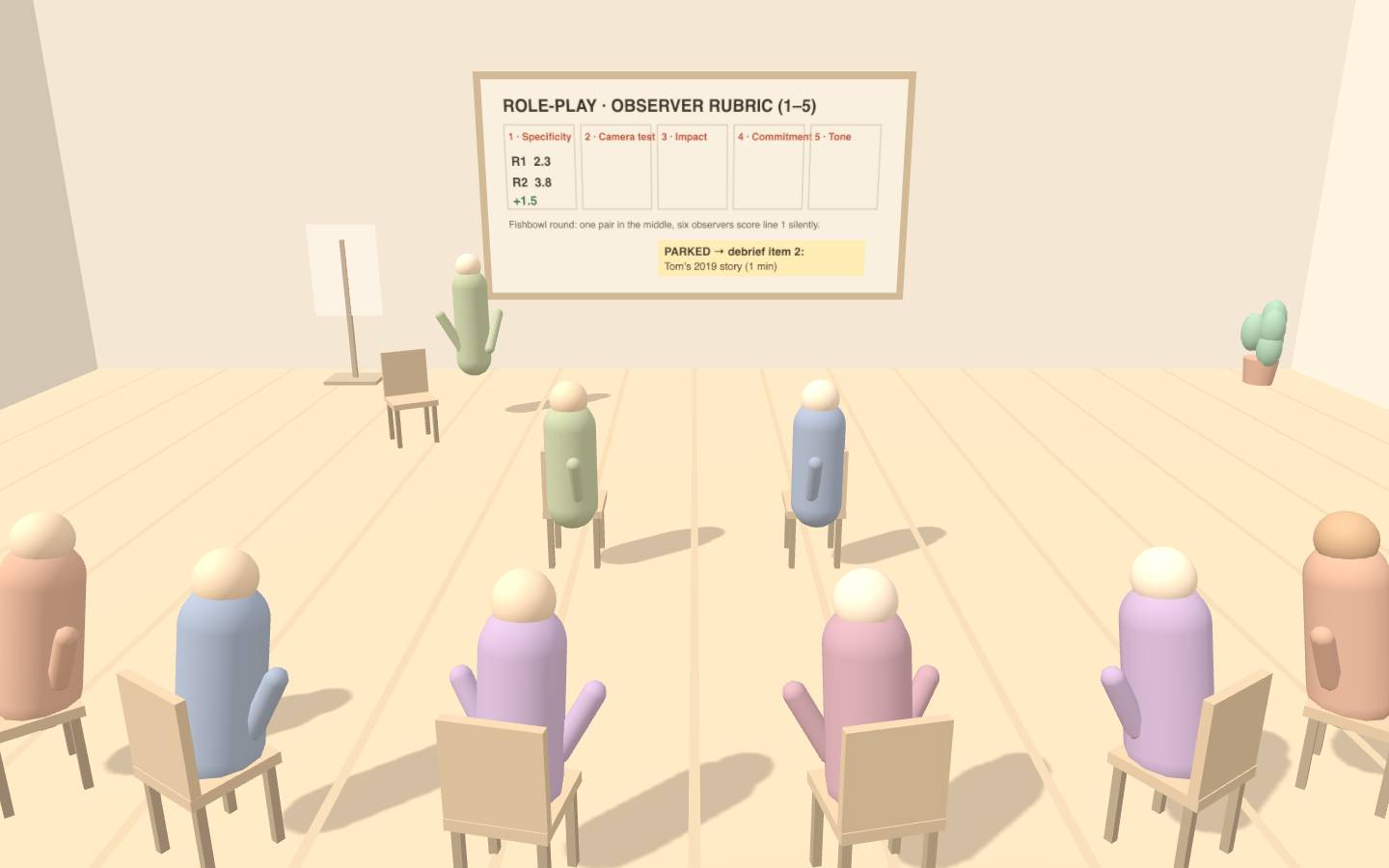
3D facilitation simulator
Run the fishbowl round as the facilitator: four calls, and the room, the board, the delta, the clock and the cards show what each one did.
Live Digital Observer Rubric (SBI-C)
Five lines, 1–5 each, with named score buttons; saves cards per round and shows the round-1 → round-2 delta with one decimal.
Why conventional training failed the operational reality
Premise of the case: survey comments cluster into one sentence, "I give feedback; nothing changes", and exit interviews mention "no honest conversations" more often. The leads are willing; their feedback triggers defensiveness instead of change:
Not an awareness problem but a skill under pressure. Every lead delivers a feedback conversation twice, scored by peers who first calibrate on one shared example.
Core diagnostic finding
In this fictional brief, team leads give feedback that does not land: they open with “always”, guess at motives and end without an agreed next step. They can name feedback models; what breaks is the first ten seconds under social pressure. So the design is rehearsal in front of peers, scored twice, with a commitment booked before leaving.
Practice needs safety
Illustrative premise: team leads to develop — calendar reality rules out half-day events
Design Constraint → Build Rule: Volunteer-first pairing with an opt-out clause is not soft HR — it is the design condition for honest role-play. The run-sheet protects that condition explicitly, with recovery lines for the moments it wobbles.
A rubric observers can hold
Illustrative premise: YoY growth in "no honest conversations" exit mentions
Design Constraint → Build Rule: Two scored rounds need observers who agree. The fishbowl round calibrates them on line 1 before the triads, and the rubric tracks behaviours, not impressions.
Transfer inside five days
Illustrative premise: development ask in the engagement survey: feedback quality
Design Constraint → Build Rule: The commitment card is booked in the calendar before anyone leaves; the day-10 manager pulse checks whether it happened.
Rehearse the first ten seconds in front of witnesses, score it twice, book the real one
Performance problem
At Brinkhaven Facilities Group (fictional), survey comments say “I give feedback; nothing changes”, and after a restructure team leads are asked to hold more difficult conversations with less time (premise).
Learners and context
80 team leads in cohorts of up to 14, most of whom did not choose to attend. Plus the facilitators: the run-sheet is written so a second facilitator can run it without the designer.
Is training the answer? Not on its own
- Protected one-to-one time. A booked conversation that the calendar cancels teaches that the workshop was theatre. Protected one-to-one slots are a management decision.
- The performance process. If reviews reward “no surprises”, leads save feedback for the annual form. The process owner can change the form; the workshop cannot.
- Facilitator capacity. Two scored rounds with live observers need a facilitator who protects the practice condition under pressure. That is why the kit includes a facilitator simulator, and why cohorts are capped at 14.
Alignment: every objective has practice, evidence, feedback and a route back to the job
| Objective | Practice | Assessment | Feedback | Transfer |
|---|---|---|---|---|
| LO1 Deliver a feedback conversation in SBI-C order | Fishbowl, then triad rounds 1 and 2 with scenario cards | Observer rubric lines 1–4, 1–5 each, per round | “One thing that worked” and “one growth seed” from the observer, straight after the round | Commitment card booked in the calendar before leaving |
| LO2 Recover when the other person pushes back | Defensive-moves clinic (deflection, counter-attack), then round 2 | Rubric line 5, Tone under pressure | Room suggests responses; facilitator plays the defender harder each volley | Pocket card with the two moves at T+1 |
| LO3 Score a peer consistently on the rubric | Fishbowl: all observers score line 1 and show their number at once; simulator call 3 for facilitators | Spread of observers’ scores (within one point) | Highest and lowest scorer say what they heard | The cohort’s delta is reported with its calibration spread |
| Facilitators: protect the practice condition | Simulator: the pair, the freeze, the calibration, the derail | Three scored calls /6; the room shows each consequence | Per call, plus the delta, clock and cards at the end | Run-sheet recovery lines |
Evidence register: what is real, what is invented
- Fictional premise Brinkhaven Facilities Group, its 80 team leads, the survey comments and the exit-interview trend (shown earlier as “2× YoY” and “#1 development ask”, as if measured).
- Design decision The five-line rubric, the fishbowl calibration and the proposed +1.0 / 25 delta check.
- Design decision The simulator’s observer scores, deltas, minutes and card counts are scripted to show consequences. They are not data from a session.
- Not measured Any reaction, learning or behaviour result. An earlier page line said the rubric was “tested live in a pilot round”; no pilot exists, and the line is removed.
Measurable Performance Objectives
Three objectives for participants and one for facilitators. LO3 (scoring a peer) had no practice before; the fishbowl calibration and the simulator now provide it.
Deliver a corrective conversation in SBI-C order: a specific situation, one observable behaviour, the impact on you, team or work, and a commitment in the other person’s words with a date.
Evidence in the build: observer rubric lines 1–4 in rounds 1 and 2; the round-2 minus round-1 delta.
Hold the structure when the other person deflects or counter-attacks, using a bridge or a refocus on the record.
Evidence in the build: rubric line 5 in round 2, after the clinic.
Score a peer’s conversation on the rubric within one point of the other observers, so the delta can be trusted.
Evidence in the build: fishbowl calibration spread; simulator call 3 for facilitators.
Why This Modality Won (Trade-Off Analysis)
Before committing to the final architecture, we evaluated and rejected lower-transfer alternatives against the workplace constraints:
Well-rated and easy to scale. Rejected because the failure is not conceptual — the leads could name every model; they still opened with 'don't take this the wrong way'. Frameworks without rehearsal change nothing in the first ten seconds of a real conversation.
Scalable practice. Rejected as the core format because the trigger here is live interpersonal discomfort — the flinch when a colleague pushes back — which a solo module rehearses with a mouse, not a face. Kept as pre-work to establish shared vocabulary.
A 90-minute practice workshop around SBI-C (Situation, Behaviour, Impact, Commitment): a fishbowl round where observers calibrate their scoring, two rubric-scored role-play rounds whose delta is the learning evidence, and a commitment booked in the calendar before anyone leaves. A 3D simulator lets facilitators rehearse the four calls where the room is most likely to break.
Why a fishbowl first
Calibrate before you measure
Six observers score the same opening on one line and show their numbers at once. Disagreement is discussed before anyone scores a triad, which is what makes the round-to-round delta meaningful.
Why two rounds
The delta is the evidence
Same rubric, same triads, a new scenario: the change between rounds is the learning evidence, reported next to the scenario difficulty so a harder round two is not read as no learning.
Why 3D here
A room that reacts
In the simulator the facilitator’s calls show up as people: observers lean in or away, a benched pair walks back to the row, a parked story appears on the board, the clock runs over and fewer cards get written.
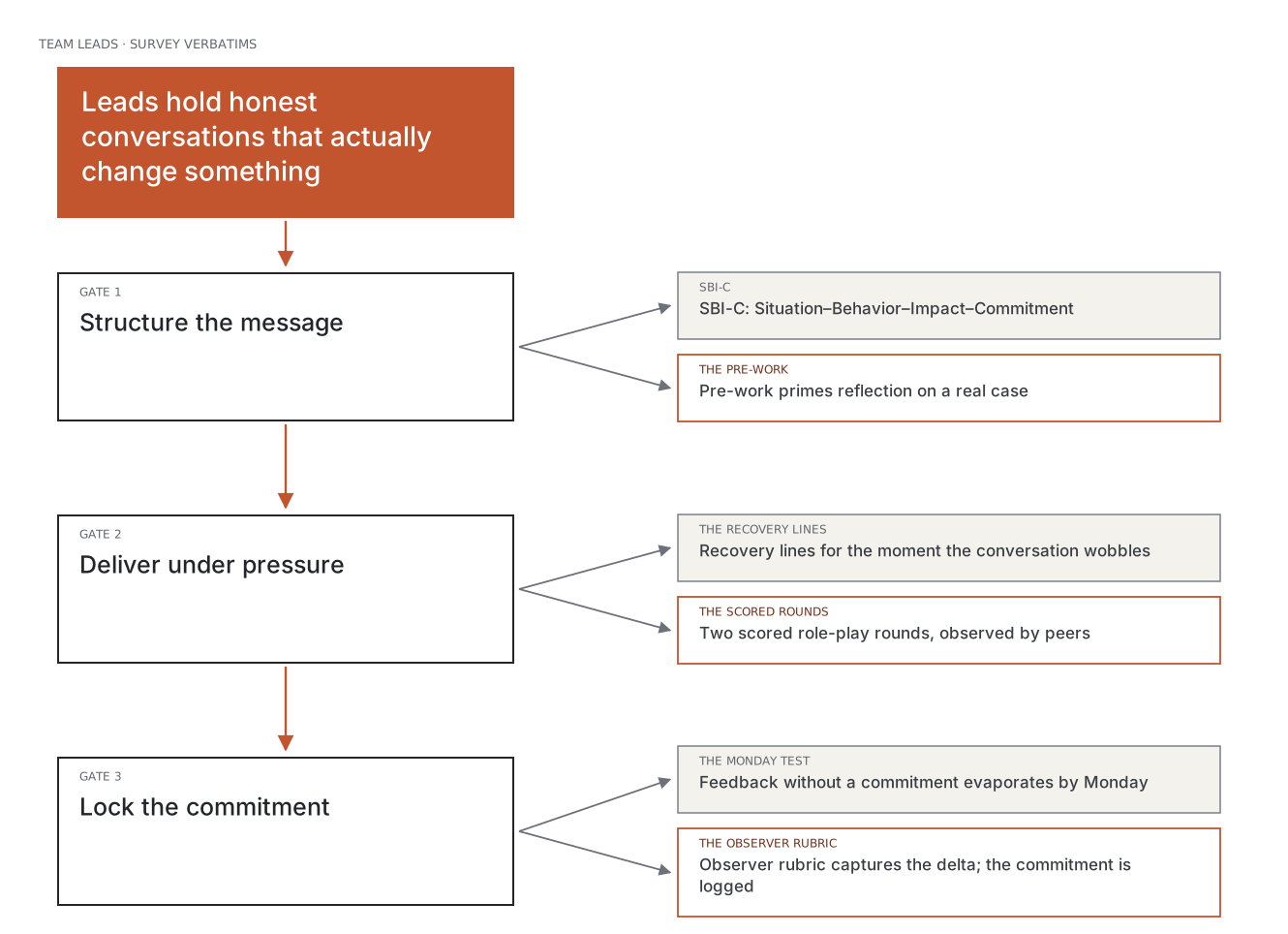
Production Sequence & Traceable Artifacts
From design brief to a workshop room-leaders can run without me — each stage links the working document.
What would tell us it worked
A proposed plan. Nothing below has been measured.
| Question | Measure / instrument | When | What we would do with the answer |
|---|---|---|---|
| Do observers agree? | Spread of line-1 scores in the fishbowl | Every cohort | If wider than one point, rewrite the line’s anchors before reporting any delta |
| Does the conversation improve within the session? | Mean round-2 minus round-1 rubric total (proposed check: +1.0 / 25) | Every cohort | The line that lifts least becomes next cohort’s clinic focus |
| Are the booked conversations held? | T+10 manager pulse: “held?” + “any visible change?” | Day 10 | Target to agree with the client (e.g. 70%); if low, check protected one-to-one time first |
| Do facilitators protect the practice condition? | Simulator play-mode score and co-facilitator observation of the first live cohort | Before and during cohort 1 | Pair new facilitators with an experienced one until the freeze and derail moves are routine |
Instructional Design Takeaway
“Why this form wins: the problem is a behavior that collapses under social pressure, so the solution rehearses the behavior in front of witnesses — with observers calibrated first, so the round-to-round delta can be read as evidence rather than noise.”
Team leads were not avoiding feedback conversations — they were delivering them in a form that triggered defensiveness, then concluding 'feedback doesn't work here'. Knowing that, the gap was behavioral: the opening sentence, the framing, the composure when the other person pushes back. The proposal is a role-play workshop with calibrated observers and a digital rubric, scored twice so the delta is the evidence, plus a simulator for the facilitators who have to protect that practice.
Transparent Portfolio Scope
Honest limitation: a single workshop cannot claim movement in the engagement survey, and nothing here has been run. The simulator is facilitator practice with scripted numbers, not footage of a session.