Kitchen Service Decisions: Allergens Under Pressure
“New kitchen leavers don't quit over cooking. They quit over moments: the flooded pass, the allergy call, the correction that hits like weather.”
A brigade decision game with a live ticket counter and four moments, scored on one lens: did you protect the control or your comfort? The kitchen tone stays real (blunt corrections included) because sanitizing it would teach nothing — the lesson is absorbing the weather while catching the data.
The Audience
New kitchen staff (dishwashers moving up, culinary students, first-job cooks) — plus head chefs building a week-one onboarding that survives contact with a real service.
Responsibilities
Moment taxonomy · allergen-protocol dramatization · hierarchy dynamics without sanitization · closing-discipline design — early churn treated as a design problem.
The Build
Service-moment design · allergen-safety scenario writing · hierarchy dynamics · AI-assisted drafting (disclosed)
How I used AI in this case
AI drafted ticket-moment variants and blunt-correction phrasings; the moment taxonomy, the allergen protocol dramatization and the control-lens scoring were designed by hand. Edited, verified and disclosed.
The build itself, not a video about it — open it, make the calls, and read what each one costs.
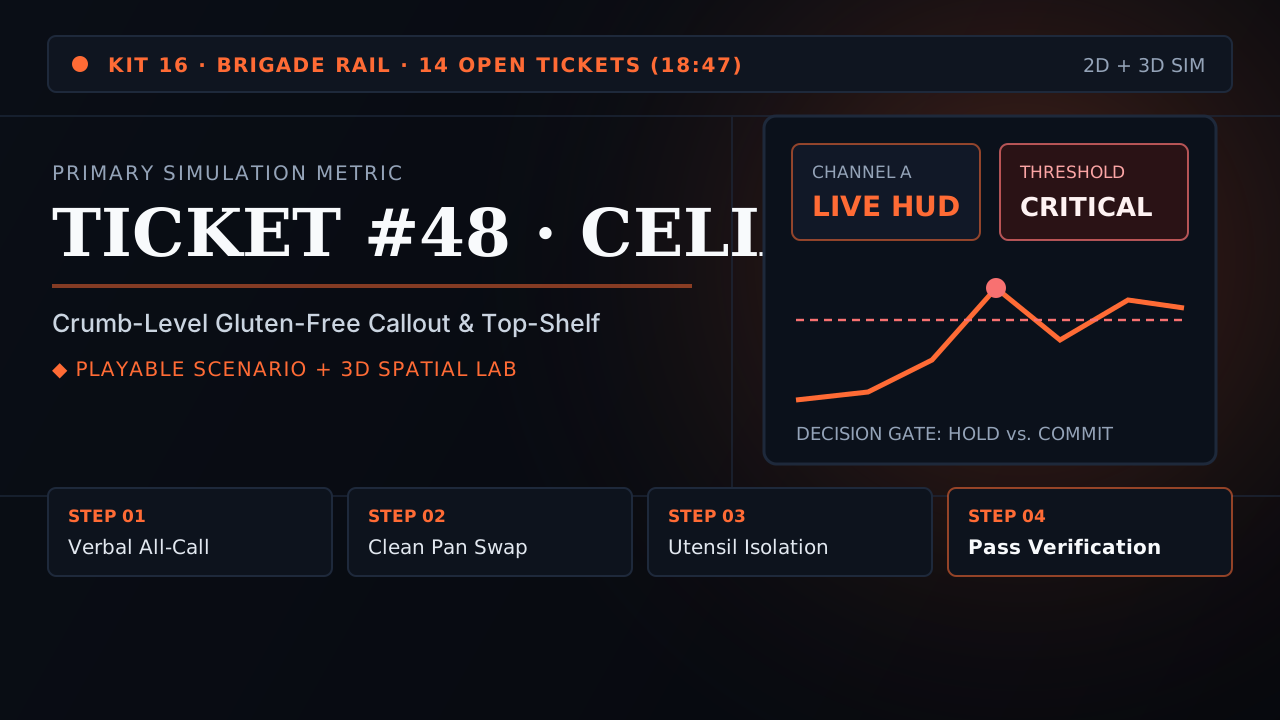
Friday Rush — Primary Build
The full brigade game: four moments, ticket counter, closing-discipline debrief
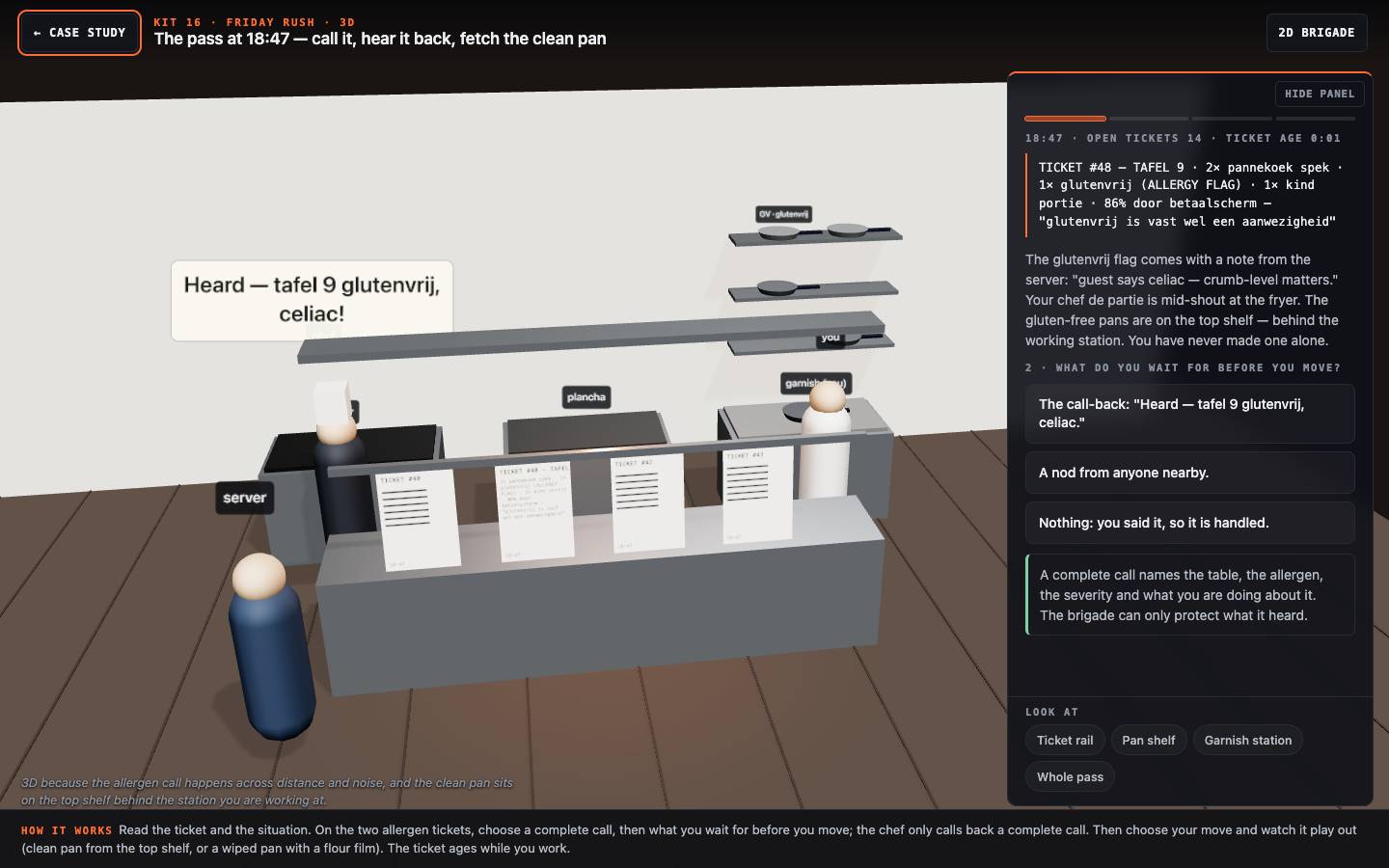
3D kitchen pass
Make the allergen call, wait for the chef’s call-back, then fetch the clean pan from the top shelf or watch a wiped pan keep its flour film. The ticket ages while you work.
Scene-by-Scene Storyboard & UI Spec
Scene plan: four moments, ticket-counter pressure, before build. Full branching dialogue, distractor rationales, and visual system tokens.
Why conventional training failed the operational reality
Kitchen exit interviews cluster on four moments that no onboarding covers:
Training covers recipes and food safety. It never practices making the critical thing audible during chaos — or absorbing tone without absorbing the mistake.
Core diagnostic finding
In this fictional brief, new cooks knew the allergen rules. They failed at the moment of saying them: waiting for the chef to stop shouting, or wiping a pan because the clean ones were behind the station. Part of this is training (the closed-loop call); part of it is the kitchen itself (tone at the pass, where pans are stored), and the case says so.
Tone you cannot sanitize
Illustrative premise: ticket mid-shout — the allergy call that waits for a quiet moment
Design Constraint → Build Rule: Blunt corrections are part of kitchen weather. Sanitizing them would teach nothing; the design keeps the tone real while keeping the scoring fair.
One lens: control or comfort
Illustrative premise: corrections — the tone is weather; the data inside is not
Design Constraint → Build Rule: Every moment scores on whether you protected the service's control or your own comfort — a single question that survives the rush.
Allergen moments cannot be soft
Illustrative premise: lists rushed — grease fires and mislabels are born at 21:45
Design Constraint → Build Rule: The allergen protocol dramatization had to feel like a near-miss, not a poster — the stakes are printed on the ticket.
Allergen safety is a closed loop, and partly a kitchen-design problem
Performance problem
In this fictional pancake restaurant, new kitchen staff leave in their first weeks and near-misses on allergen tickets cluster on busy evenings. New cooks absorb harsh corrections at the pass and stay quiet at exactly the moments that need a loud, complete call.
Learners and context
First-week cooks and kitchen assistants, often young, Dutch-speaking, with basic food-safety certificates. The trainer runs in about 8 minutes on a phone before a first shift.
Is training the answer? Not on its own
- Pan placement. The dedicated gluten-free pans are on the top shelf behind the garnish station. Move them to a marked spot at the station; a training module cannot make the safe pan the nearest one.
- Tone at the pass. If the chef’s corrections are public and personal, new cooks will stay quiet. The head chef needs a norm for the pass (blunt about food, not about people), owned by the owner, not by L&D.
- Ticket design. Allergen flags buried in a line of text are easy to miss. A separate printed allergen line on the ticket is a POS setting.
Alignment: every objective has practice, evidence, feedback and a route back to the job
| Objective | Practice | Assessment | Feedback | Transfer |
|---|---|---|---|---|
| LO1 Make a complete allergen call and wait for the call-back | Two allergen tickets with a call step and a call-back step | 1 point each; in 3D the chef answers only a complete call | Names what a complete call contains | “Table, allergen, severity, action — then heard” card at the pass (proposed) |
| LO2 Use the dedicated pan and utensils every time | Gluten ticket under time pressure | Wiped pan is a critical error | In 3D the flour film shows on the wiped pan | Pans moved to the station (recommended) |
| LO3 Keep the safety check when the tone is hostile | The chef’s put-down with a nut marker open | Plating unchecked or leaving the pass is critical | “Tone is weather; the marker is data” | Pass tone norm agreed with the head chef (recommended) |
Evidence register: what is real, what is invented
- Fictional premise De Pannenkoeksble in Utrecht, its brigade and its leavers.
- Design decision The scoring, the critical moments and the 9 / 12 pass mark.
- Not measured Allergen incidents, near-misses or retention. A “kitchen pilot” quote on the earlier page described a pilot that never happened; it is now a proposed reaction item.
Measurable Performance Objectives
Three objectives. The allergen moments are now scored as a loop (call, call-back, pan), which makes this trainer’s format different from the other conversation kits.
Make a complete allergen call — table, allergen, severity, action — and wait for the call-back before moving.
Evidence in the build: call and call-back steps on two allergen tickets (1 point each).
Use the dedicated pan and clean utensils for an allergen order, every time.
Evidence in the build: the gluten move; a wiped pan is critical.
Keep the allergen check alive when a correction is public and hostile.
Evidence in the build: the nut move; skipping the check or leaving the pass is critical.
Why This Modality Won (Trade-Off Analysis)
Before committing to the final architecture, we evaluated and rejected lower-transfer alternatives against the workplace constraints:
Already in place and necessary. Rejected as the churn fix because the leavers could cook — they quit over moments of unhandled chaos, not over technique. More of the existing training would have been excellent and irrelevant.
Trackable and calm. Rejected because calm is the lie: the whole failure happens when service is loud and the ticket counter is climbing. A calm module trains for a kitchen that does not exist — the tone in the game stays blunt on purpose.
A brigade decision game with a live ticket counter and four moments, scored on one lens: did you protect the control or your comfort? The kitchen tone stays real (blunt corrections included) because sanitizing it would teach nothing — the lesson is absorbing the weather while catching the data.
Why a closed loop
Heard, not just said
In a loud kitchen a call that nobody repeats back did not happen. Scoring the call-back makes the loop the skill, not the sentence.
Why name the system
Some fixes are not training
Moving the pans and setting a tone norm would prevent more incidents than any module. The case recommends them so the training is not asked to carry what the kitchen should fix.
Why 3D here
Distance and noise are real
The pass shows that the clean pan is on the top shelf behind the station and that the chef is across the line. The call-back only appears when the call was complete.
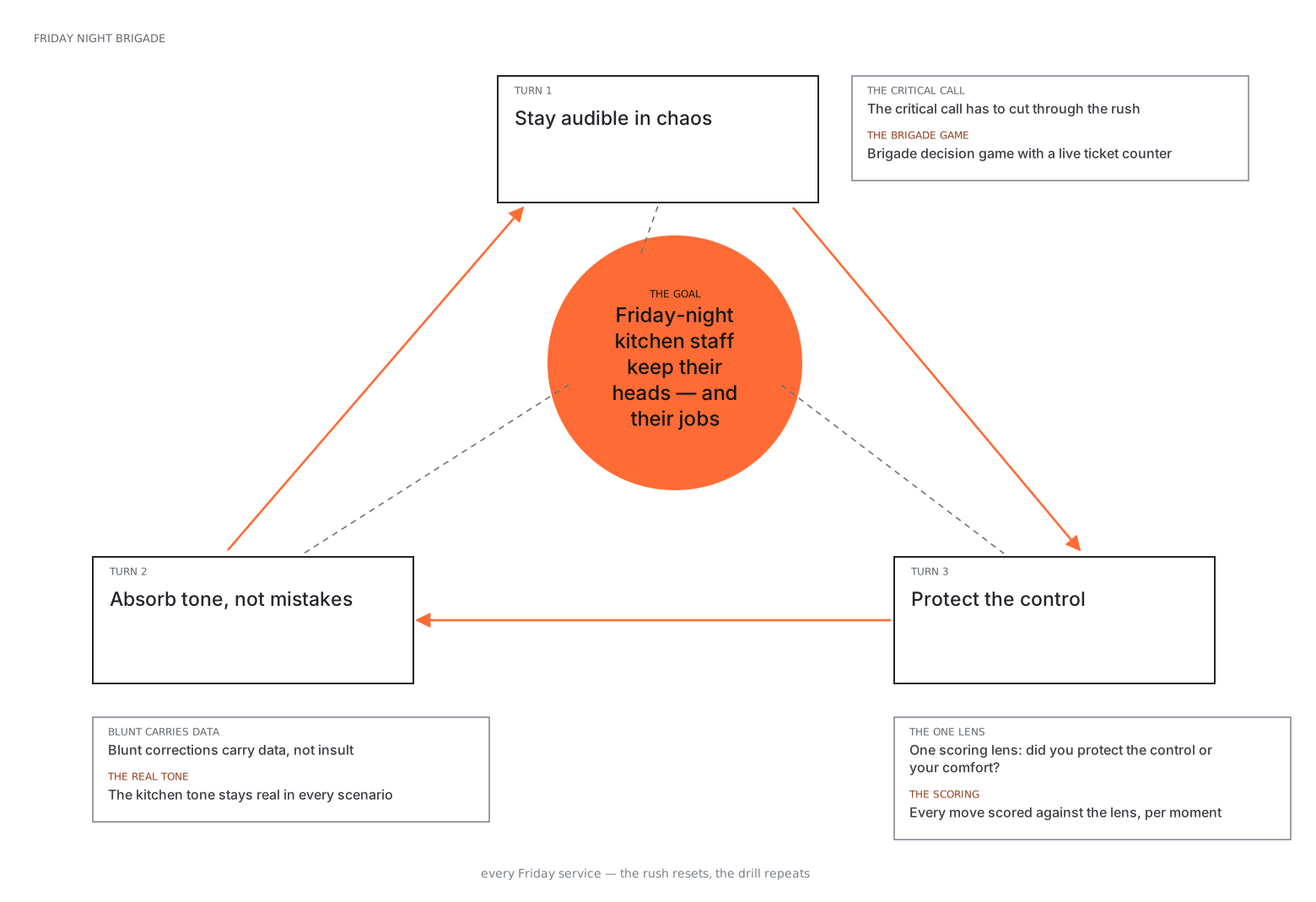
Production Sequence & Traceable Artifacts
The stages below show how the artifacts depend on each other. In this fictional case one designer produced all of them.
What would tell us it worked
A proposed plan. Nothing below has been measured.
| Question | Measure / instrument | When | What we would do with the answer |
|---|---|---|---|
| Do new cooks make complete calls? | Call and call-back accuracy in the trainer | Pilot with new starters at one restaurant | If the call-back step is often missed, practise it live in the first shift briefing |
| Do calls happen on the line? | Head chef or sous-chef observes allergen tickets on two busy shifts: complete call + call-back yes/no | Weeks 1–2 | Agree the observation with the head chef; it is coaching, not appraisal |
| Did the kitchen fixes happen? | Pan location and ticket allergen line checked | One month | Without these, treat any improvement as fragile |
Instructional Design Takeaway
“Why this form wins: the problem is protecting the critical call inside chaos, so the solution IS chaos — a live counter, a shouting chef, and one lens scored throughout: did you protect the control or your comfort?”
Kitchen churn happened in week one over moments no recipe covers: the celiac ticket shouted mid-service, the harsh correction hiding an allergen question, the 9-minute wait with a parent watching the exit. Onboarding taught recipes and food safety; nothing taught making the critical thing audible during chaos. The proposal was a brigade decision game with a live ticket counter — the pressure on-screen and ticking, the tone kept deliberately real.
Transparent Portfolio Scope
Honest limitation: four moments and simplified food-safety content. Real allergen control includes suppliers, storage and labelling that the trainer does not cover.