Wellbeing Signal Triage: Diagnose Before the Fix
“Absence is up, mood is flat — and everyone has a favourite fix. Read the wall first.”
A signal triage wall: nine cards read into three root causes (each with the wall's own reading — including the yoga poll as a management-vacuum signal), then exactly two interventions from seven. The wellbeing-wash traps — resilience training for structural overload, the visible quick win — get named debrief entries.
The Audience
HR advisors, team leads and prevention/occupational-health staff facing rising absence and flat mood.
Responsibilities
Signal-family design · root-cause architecture · wellbeing-wash traps · advisory debrief — the Monday curve as evidence.
The Build
Diagnostic design · intervention scoring · advisory writing · AI-assisted drafting (disclosed)
How I used AI in this case
AI drafted signal-card variants and advisory wording; signal-family design, root-cause architecture and trap calibration were authored by me. Edited, verified and disclosed.
The build itself, not a video about it — open it, make the calls, and read what each one costs.
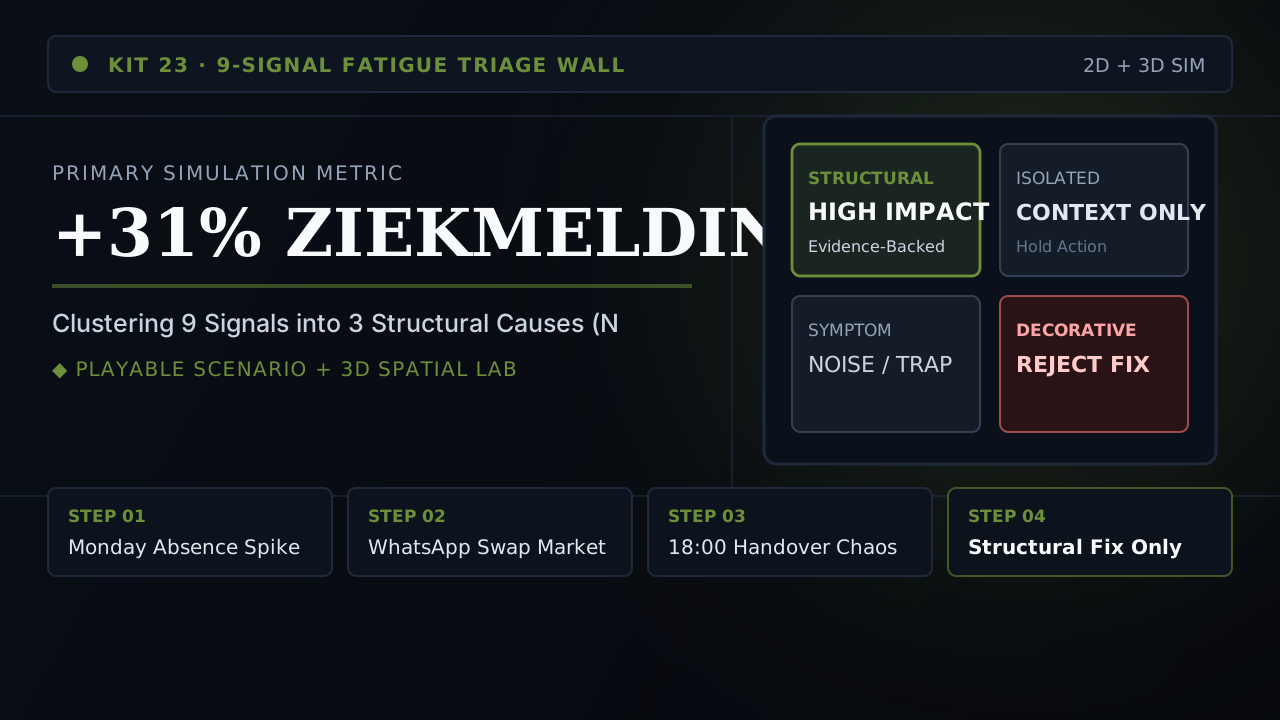
Shift Keeper — Primary Build
The full tool: nine cards, three causes, 2-of-7 interventions, advisory readout
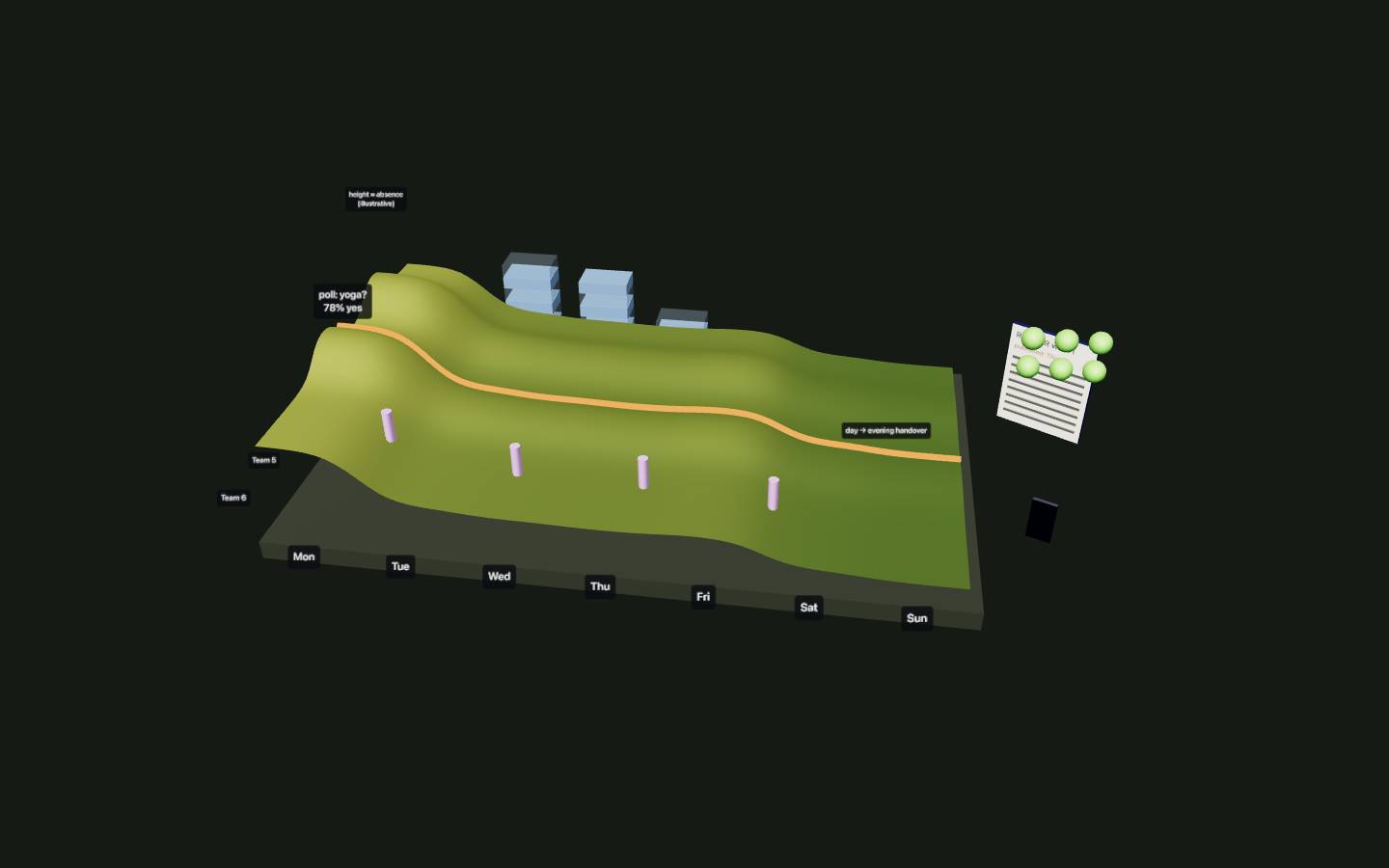
3D week landscape
Pin each of nine signals onto the feature of the week it explains, then choose two interventions and see whether the Monday ridge moves. Wellbeing-washing leaves a ghost of the unchanged ridge.
Scene-by-Scene Storyboard & UI Spec
Scene plan: nine signals, three causes, intervention rounds, before build. Full branching dialogue, distractor rationales, and visual system tokens.
Why conventional training failed the operational reality
Absence complaints arrive pre-interpreted. The wall is built to re-anchor the reading:
Eight of nine signals point at how the week and the roster are designed or managed. The ninth — personal circumstance — is real, and is made worse by a management practice that refuses adjustments.
Core diagnostic finding
In this fictional brief the absence signals reached HR already interpreted as stress, so the discussion jumped to the visible fixes. Read one by one, eight of nine signals describe how the week is built and managed. The training has to make reading the evidence a scored, required step before any intervention is on the table.
Signals that argue
Illustrative premise: of absence lands on Mondays — a load-shape signature; lives do not know it is Monday
Design Constraint → Build Rule: Nine cards must support three root causes — including the yoga poll as a management-vacuum signal — so the evidence genuinely competes for the reader's story.
Wellbeing-wash traps
Illustrative premise: weekly meeting load on dock planners, 11 without a decision output
Design Constraint → Build Rule: Resilience training for structural overload and the visible quick win must be tempting AND named as traps in the debrief — the wash is the failure mode.
Two of seven is the advice
Illustrative premise: want a yoga programme in the fictional poll: the popular fix that scores zero as an intervention
Design Constraint → Build Rule: The intervention cap makes the debrief read like a real advisory: prioritized, reasoned and honest about trade-offs.
Read the signals before you choose the fix
Performance problem
In this fictional logistics site, sick-leave reports are up and HR is under pressure to “do something about wellbeing”. A resilience course and a staff-organised yoga pilot are on the table; the roster, the meeting load and the late publication of schedules are not.
Learners and context
HR advisers and operational team leads who propose interventions to site management. Experienced, busy, and used to being asked for quick wins. About 12 minutes, ideally run in a pair so the readings get argued.
Is training the answer? Not on its own
- Roster redesign and publication policy. These are management decisions with cost and coverage trade-offs. The trainer prepares people to recommend them; it does not make them happen.
- Meeting load. Eleven hours a week without decisions is a meeting-governance issue for the site manager.
- Absence data quality. The Monday pattern only shows if absence is recorded by day and team. If it is not, fix the reporting first.
Alignment: every objective has practice, evidence, feedback and a route back to the job
| Objective | Practice | Assessment | Feedback | Transfer |
|---|---|---|---|---|
| LO1 Attribute each signal to its root cause before proposing a fix | Nine signal cards (buttons); interventions locked until all are read | 1 point per reading that matches the evidence | Explains the evidence behind each reading | Signal-reading checklist for the next absence review (proposed) |
| LO2 Choose interventions that act on the causes found | Seven interventions, pick exactly two | 2 / 1 / 0 per pick; at least one structural fix to pass | Per-intervention reasoning; in 3D, whether the Monday ridge moves | Advice template: “signal → cause → fix” |
| LO3 Decline to count wellbeing offers as the intervention | Resilience training and yoga as tempting picks | Either one fails the advice | Names the wellbeing-washing pattern | Offer wellbeing activities alongside, never instead of, the structural fix |
Evidence register: what is real, what is invented
- Fictional premise Havenlogistiek Veldhoven, its teams, its exit interviews and its WhatsApp swap group.
- Illustrative values 44% Monday absence, 23 meeting hours, 78% yoga poll, and the 3D terrain heights. Chosen to make the pattern legible; not workplace data.
- Design decision The cause key (4 workload, 4 management, 1 personal), the intervention points and the 10 / 13 pass mark.
- Not measured Any change in absence. The earlier “≥70% map correctly” was a target, not a result.
Measurable Performance Objectives
Three objectives. Readings are now scored and required: the earlier build called them “the designed verdict” without scoring them and unlocked interventions after three of nine.
Attribute each of nine absence signals to workload design, management practice or personal circumstance before proposing anything.
Evidence in the build: nine readings, 1 point each; interventions locked until all are read.
Choose two interventions that act on the causes the signals show.
Evidence in the build: two picks, 2 / 1 / 0 each; at least one structural fix required.
Decline to count resilience training or a wellbeing programme as the intervention for structural absence.
Evidence in the build: either pick fails the advice.
Why This Modality Won (Trade-Off Analysis)
Before committing to the final architecture, we evaluated and rejected lower-transfer alternatives against the workplace constraints:
Friendly, fast, and what HR usually ships. Rejected because menus presuppose the diagnosis — picking yoga off a menu while the Monday absence curve screams roster design is wellbeing-washing, and the wall exists to make that failure visible before the budget is spent.
Rigorous and defensible. Rejected because reading numbers and interpreting them under social pressure are different skills — a report tells the advisor what the analyst concluded; the wall trains the advisor to conclude. Reports inform; the wall rehearses the reading.
A signal triage wall: nine cards read into three root causes (each with the wall's own reading — including the yoga poll as a management-vacuum signal), then exactly two interventions from seven. The wellbeing-wash traps — resilience training for structural overload, the visible quick win — get named debrief entries.
Why read before choosing
Diagnosis gates the fix
Locking the interventions until all nine signals are read is the lesson in structure form: the popular fix only looks good when the evidence has not been looked at.
Why tempting decoys
Wellbeing-washing is sincere
Resilience training and yoga are offered in good faith and are often well received. That is exactly why they are dangerous as the intervention, and why the debrief names them explicitly.
Why 3D here
The pattern has a shape
Monday absence is a ridge, meeting load is a stack, the handover is a seam through every day. Pinning signals onto those features shows that the problem lives in the week, not in the people.
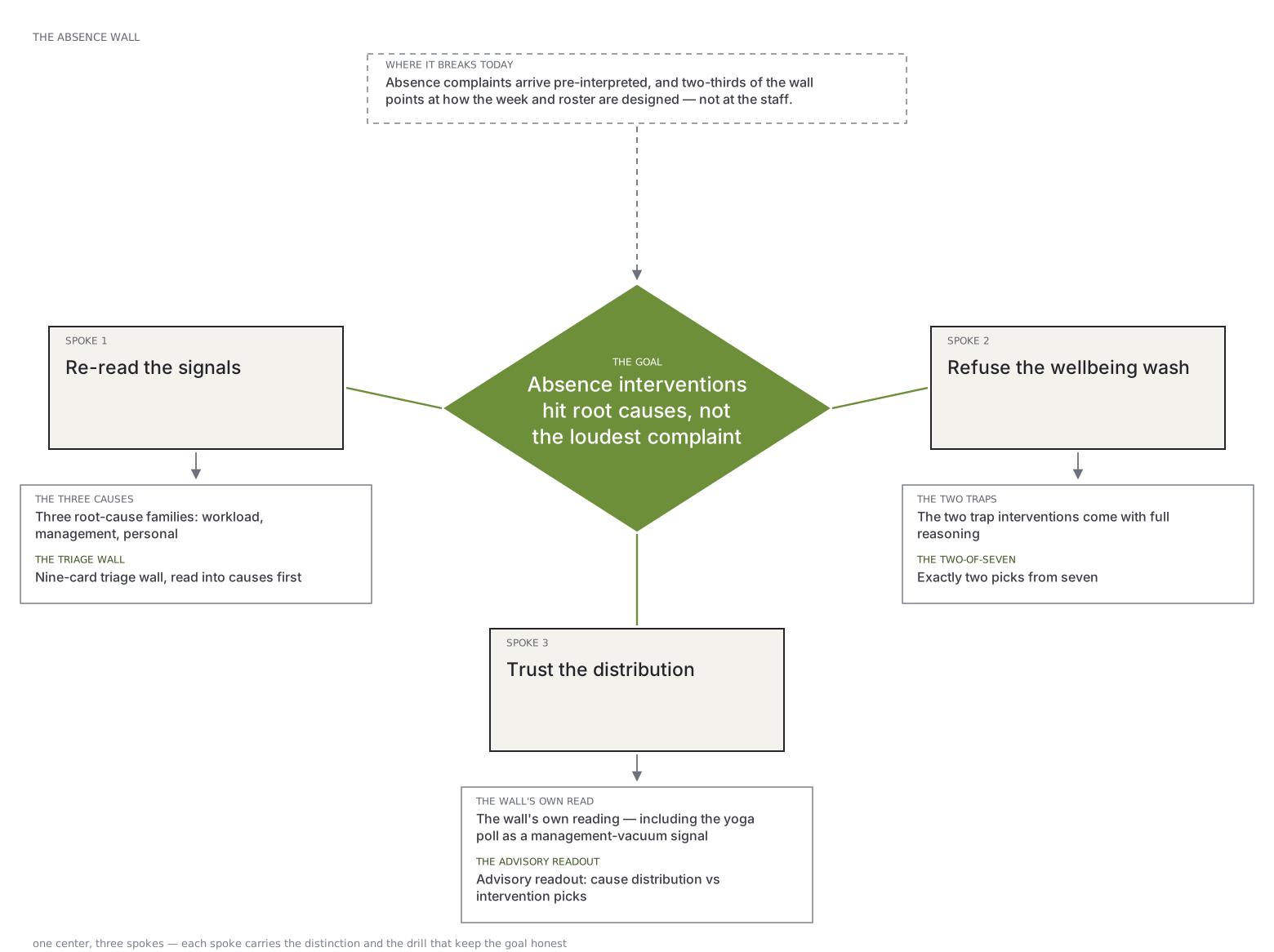
Production Sequence & Traceable Artifacts
The stages below show how the artifacts depend on each other. In this fictional case one designer produced all of them.
What would tell us it worked
A proposed plan. Nothing below has been measured.
| Question | Measure / instrument | When | What we would do with the answer |
|---|---|---|---|
| Do advisers read signals correctly? | Reading accuracy per signal, especially the decoy (yoga poll) and the handover seam | Pilot with 6–8 HR advisers and team leads | If the handover seam is mostly read as “communication”, add a contrasting example |
| Do recommendations change? | Content of the next real absence-review recommendation: does it name a structural cause? | Next quarterly absence review | Review with the HR manager; one review is a case, not a trend |
| Does absence move? | Monday share of absence by team | 6–12 months after a structural change | Credit the structural change, not the training |
Instructional Design Takeaway
“Why this form wins: the problem is fixing before reading, so the solution scores the reading first — the Monday curve is evidence, the yoga poll is a mood, and the two interventions only count if the wall's verdict supports them.”
Absence was up, mood was flat, and every meeting produced a favourite fix — usually the most visible one. The advisory reality: eight of nine signals pointed at workload design and management practice, and the popular fixes were structurally irrelevant. The proposal was a signal triage wall: nine team signals read into three root causes, then exactly two interventions from seven — built so the wellbeing-wash traps (resilience training for structural overload, the yoga programme) get named debrief entries of their own.
Transparent Portfolio Scope
Honest limitation: nine fixed signals with a designed key. Real signal sets are noisier, and the right fix depends on budgets and labour agreements the trainer does not model.